

Audio By Carbonatix
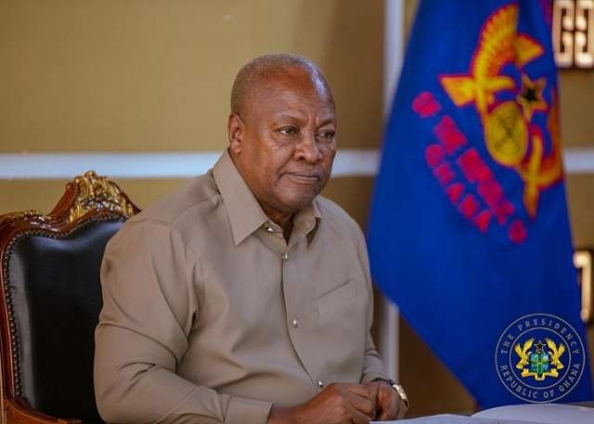
President John Dramani Mahama has emphasised the need for farmer-centred policies in Ghana’s cocoa sector, drawing on his personal experience as a cocoa farmer to illustrate the tangible impact of government pricing decisions.
Speaking at the maiden Ghana Tree Crops Investment Summit and Exhibition on Tuesday, February 17, the President stated that he directly understands the economic pressures facing cocoa farmers, particularly amid recent volatility in global cocoa prices and recent developments within the sector.
His remarks follow the controversial reforms of the cocoa economy, where the farmgate price was slashed from GH¢3,625 to GH¢2,587 per bag to align with a volatile international market.
“Nana Kwebu Ewusi gave me 50 acres of land, and I planted cocoa on the 50 acres, so I am a cocoa farmer. So when the price is reduced by the government, it affects me too. I want to be able to empathise with farmers so that when we take any policy decision, we know that it has an effect on farmers and we feel it ourselves,” he said.
Ghana, the world’s second-largest cocoa producer after Côte d’Ivoire, relies heavily on cocoa as a major foreign exchange earner and source of livelihoods for more than 800,000 farm households. The sector contributes significantly to export revenues and supports millions of people across farming communities, transport networks, and processing industries.
Recent developments in the cocoa sector have included sharp fluctuations in global prices, which surged to historic highs of over $10,000 per tonne in 2024 before declining significantly due to improved production forecasts and market corrections. These shifts have created uncertainty for producers and policymakers alike.
The President emphasised that government decisions on cocoa pricing and sector reforms must reflect the realities faced by farmers, whose incomes depend heavily on producer price adjustments announced annually by the Ghana Cocoa Board.
He noted that policies affecting cocoa farmers have direct consequences for rural livelihoods, education, and household welfare, stressing that reforms must prioritise sustainability, fairness, and long-term growth.
The summit, organised with support from the Ghana Tree Crops Authority, aims to attract investment into key tree crops including cocoa, cashew, rubber, coconut, and oil palm, as part of efforts to diversify Ghana’s agricultural economy and enhance value addition.
President Mahama reaffirmed his administration’s commitment to strengthening the cocoa sector through improved pricing mechanisms, investment in productivity, and measures to ensure farmers receive fair returns for their produce.
He added that aligning policy with the lived experiences of farmers would be critical to safeguarding the future of Ghana’s cocoa industry and maintaining its global competitiveness.
Latest Stories
-
We can tackle multiple priorities – Sam George defends Anti-LGBTQ Bill push
9 minutes -
Statement: Ghana Chamber of Mines’ Response to Claims in Joe Jackson’s “Ananse Stories about the Economy of Ghana”
10 minutes -
GES opens 2026 teacher recruitment for licensed B.Ed graduates
12 minutes -
Ghana must value skilled trades, build resilient learners — Ibn Chambas
20 minutes -
Ghana must rethink education around relevance, resilience and responsibility — Ibn Chambas
23 minutes -
Prince Harry faces defamation lawsuit from charity he co-founded
25 minutes -
South Korea deploys thermal cameras to track escaped zoo wolf
27 minutes -
Calls for royal meeting with Epstein survivors grow ahead of US visit
30 minutes -
Ibn Chambas advocates blend of technology and human values in education
32 minutes -
UMA improves healthcare access in Asutifi North with GH₵700k ‘Kim Taylor Legacy’ Walkway
37 minutes -
Scholarships Authority and Fanaka University offer sponsorship for procurement and supply chain studies
40 minutes -
Bisa Kdei drops new single ‘Go N Look’ featuring Medikal
46 minutes -
Benin facing rising terrorism in north as French military presence faces growing criticism
47 minutes -
UEW Public Lecture Series 2026: Education debate ‘about the soul of Ghana’s future’ — Dr Ibn Chambas
48 minutes -
EU fingerprint and photo travel rules come into force from today
1 hour