


Audio By Carbonatix
Participants at a round table discussion on Air Pollution have made recommendations to improve Air quality in Accra and other urban areas of the country.
The recommendations concern the waste management, the transport, the household energy, and industrial sectors, as well as markets of Accra and other urban areas of the country.
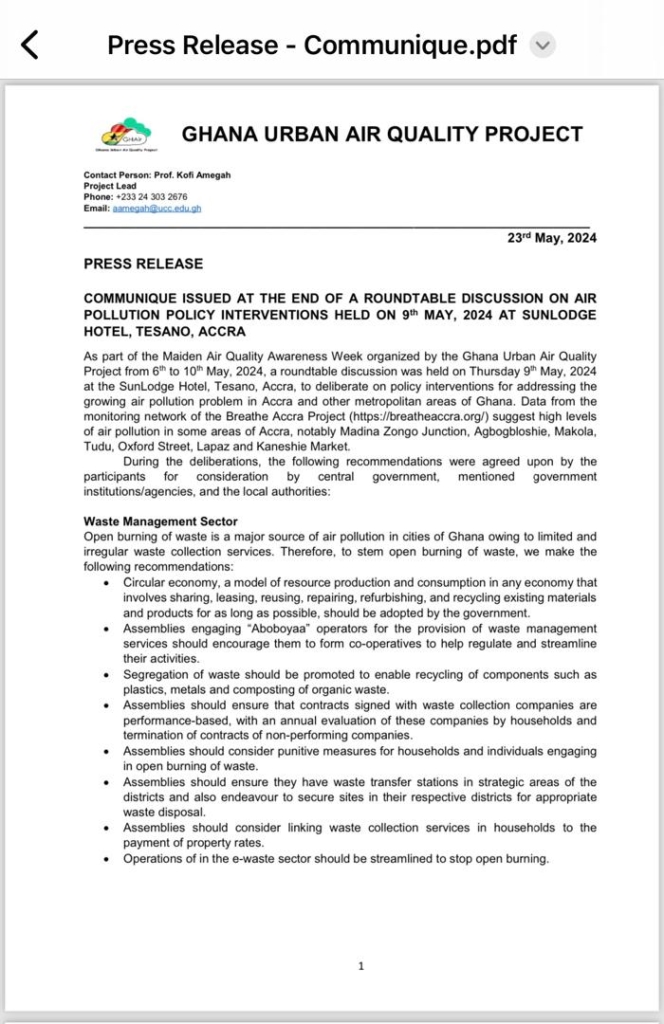
The discussions formed part of the Maiden Air Quality Awareness Week observation organised by the Ghana Urban Air Quality Project that focused on policy interventions to address the growing air pollution problem in Accra and other metropolitan areas of Ghana.
Data from the Breathe Accra Project indicated high levels of air pollution in several areas, including Madina Zongo Junction, Agbogbloshie, Makola, Tudu, Oxford Street, Lapaz, and Kaneshie Market.
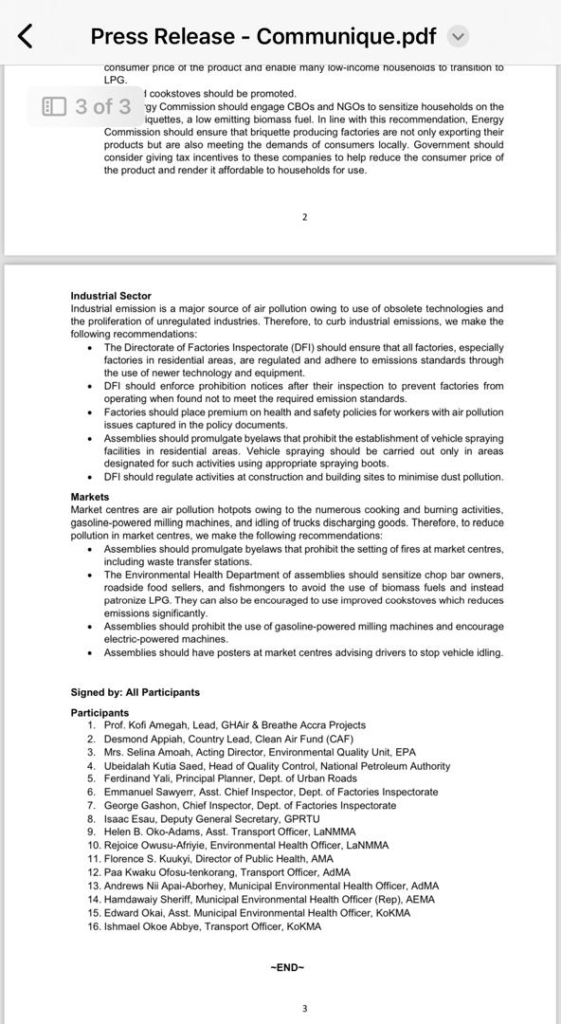
A panel of experts convened to discuss strategies for improving air quality in Ghana. Among the participants were Prof. Kofi Amegah, lead of the GHAir & Breathe Accra Projects, and Desmond Appiah, country lead of the Clean Air Fund (CAF). Also present were representatives from various government agencies including Mrs. Selina Amoah, acting director of the Environmental Quality Unit at the EPA, and Ubeidalah Kutia Saed, head of Quality Control at the National Petroleum Authority.
Additionally, experts from departments responsible for urban planning and transportation attended, such as Ferdinand Yali from the Department of Urban Roads, and Isaac Esau, deputy general secretary of the GPRTU. Environmental health officers from local municipalities, including Florence S. Kuukyi from the AMA and Andrews Nii Apai-Aborhey from AdMA, were also part of the discussion.

The meeting aimed to address the pressing issue of air pollution in Ghana and develop actionable strategies to mitigate its effects.
During the deliberations, participants put forward the following recommendations for central government, government institutions, and local authorities.
Waste Management Sector
Open burning of waste, a major source of air pollution in Ghanaian cities due to limited and irregular collection services, was a key focus at the roundtable discussion during Air Quality Awareness Week. Participants recommended that the government adopt a circular economy model to promote the reuse and recycling of materials. Assemblies were advised to encourage "Aboboyaa" operators to form co-operatives for better regulation and to promote waste segregation to facilitate recycling. Contracts with waste collection companies should be performance-based, with regular evaluations, and punitive measures should be implemented for those engaging in open burning. Additionally, the establishment of strategic waste transfer stations, linking waste collection services to property rates, and regulating e-waste sector operations to prevent open burning were recommended.
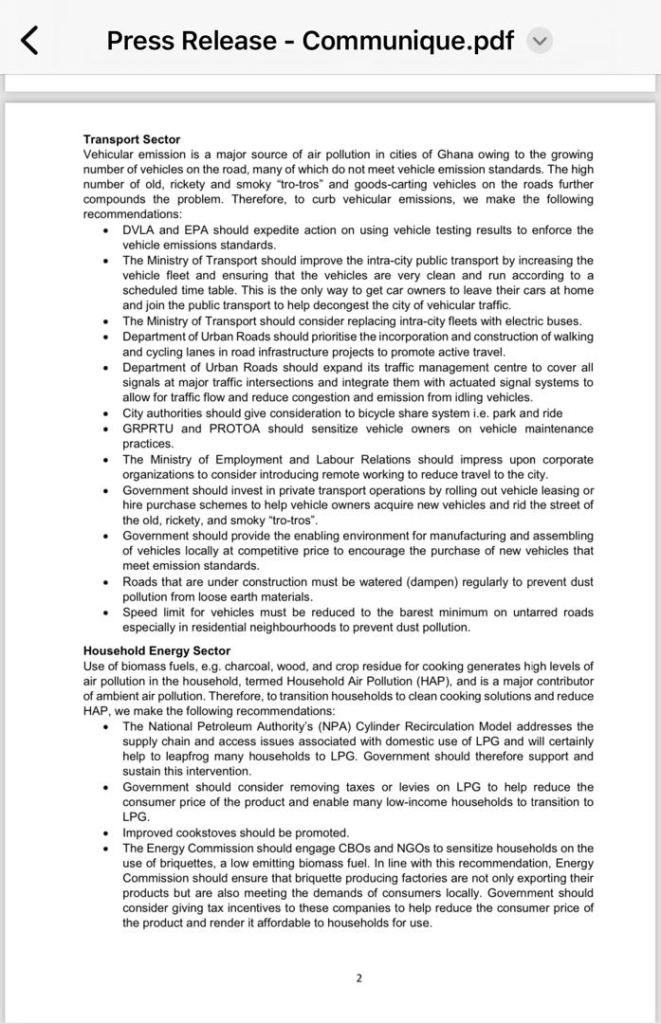
Transport sector
Vehicular emissions, driven by a growing number of vehicles on the roads, many of which fail to meet emission standards, are a major source of air pollution in Ghanaian cities. The problem is exacerbated by old, smoky "tro-tros" and goods-carting vehicles. To address this, experts at the recent Air Quality Awareness Week roundtable made several recommendations.
The DVLA and EPA should enforce vehicle emissions standards based on testing results. The Ministry of Transport should improve intra-city public transport by increasing the fleet, ensuring cleanliness, and maintaining a scheduled timetable to encourage car owners to use public transport. The introduction of electric buses for intra-city transport should be considered.
The Department of Urban Roads should prioritize constructing walking and cycling lanes and expanding the traffic management center to cover major intersections, integrating actuated signal systems to reduce congestion and emissions from idling vehicles. Authorities should consider implementing a bicycle share system.
Vehicle owners should be sensitized on maintenance practices by GRPRTU and PROTOA, while the Ministry of Employment and Labour Relations should encourage remote working to reduce city travel. The government should invest in private transport operations through vehicle leasing schemes and create an environment conducive to local vehicle manufacturing, ensuring compliance with emission standards.
Additionally, roads under construction should be regularly watered to prevent dust pollution, and speed limits on untarred roads, especially in residential neighborhoods, should be minimized to reduce dust emissions.
Household Energy Sector
The use of biomass fuels such as charcoal, wood, and crop residue for cooking generates high levels of Household Air Pollution (HAP) and significantly contributes to ambient air pollution in Ghana. To transition households to cleaner cooking solutions and reduce HAP, experts at the recent Air Quality Awareness Week roundtable proposed several measures.
The National Petroleum Authority's (NPA) Cylinder Recirculation Model should be supported and sustained by the government to address supply chain issues and increase LPG usage. The government should consider removing taxes or levies on LPG to lower its consumer price, facilitating its adoption by low-income households. The promotion of improved cookstoves is also recommended.
The Energy Commission should collaborate with community-based organizations (CBOs) and NGOs to educate households on using briquettes, a low-emission biomass fuel. Additionally, the Energy Commission should ensure that briquette-producing factories meet local consumer demand and the government should offer tax incentives to reduce briquette prices and make them affordable for household use.
Industrial sector
Industrial emissions are a significant source of air pollution in Ghana, driven by obsolete technologies and unregulated industries. To address this, experts at the recent Air Quality Awareness Week roundtable proposed several measures.
The Directorate of Factories Inspectorate (DFI) should ensure that all factories, especially those in residential areas, adhere to emissions standards through the use of modern technology and equipment. The DFI should also enforce prohibition notices to prevent non-compliant factories from operating.
Factories should prioritize health and safety policies that address air pollution issues for workers. Assemblies should enact byelaws to prohibit vehicle spraying facilities in residential areas, restricting such activities to designated zones with appropriate equipment. Additionally, the DFI should regulate construction and building sites to minimize dust pollution.
Markets
Market centers, identified as significant air pollution hotspots due to cooking and burning activities, gasoline-powered milling machines, and idling trucks, require urgent intervention. To address this issue, experts at the recent Air Quality Awareness Week roundtable offered several recommendations.
Assemblies should enact byelaws prohibiting fires at market centers, including waste transfer stations. Additionally, the Environmental Health Department of assemblies should educate chop bar owners, roadside food sellers, and fishmongers on the benefits of using LPG instead of biomass fuels, along with promoting the use of improved cookstoves to reduce emissions.
Moreover, assemblies should ban the use of gasoline-powered milling machines and encourage the adoption of electric-powered alternatives. To further mitigate pollution, posters advising drivers to avoid vehicle idling should be prominently displayed at market centers.
Below is the full communique issued after Air Quality Awareness week roundtable.
Latest Stories
-
Trump seeks $152m to reopen notorious Alcatraz prison
5 minutes -
Ex-Chelsea player Oscar retires with heart issue
14 minutes -
CA Foundation drives constitutional literacy in Kpone Katamanso municipality
19 minutes -
GPRTU to hold talks with Transport Ministry over rising fuel costs
21 minutes -
CUTS International urges gov’t to halt sachet water price hike pending cost review
27 minutes -
Chief Justice: Efficient Judiciary essential to reducing business costs
30 minutes -
Bayern grabs 99th-minute winner to cap superb fightback
30 minutes -
Ahmed Ibrahim urges Ghanaians to reflect Easter values in nation-building
34 minutes -
ECG inefficiencies undermining power supply -Mahama outlines reforms
35 minutes -
Lewandowski scores as Barca fight back to defeat Atletico
37 minutes -
Lack of private sector consultation undermining economic growth – Jerry Ahmed Shaib
40 minutes -
Real Madrid seven points adrift after Muriqi’s late Mallorca winner
41 minutes -
Ghana must lead AfCFTA implementation by example – Trade Minister Ofosu-Adjare
46 minutes -
Strong Judiciary key to business confidence – Chief Justice Baffoe-Bonnie
49 minutes -
Mahama announces 60-Hectare irrigation project to boost tomato production
56 minutes