

Audio By Carbonatix
A jewelry advertisement in India showing a Hindu woman married into a Muslim family led to a fierce backlash from right-wing groups. But what is it like for a real interfaith couple amid rising intolerance?
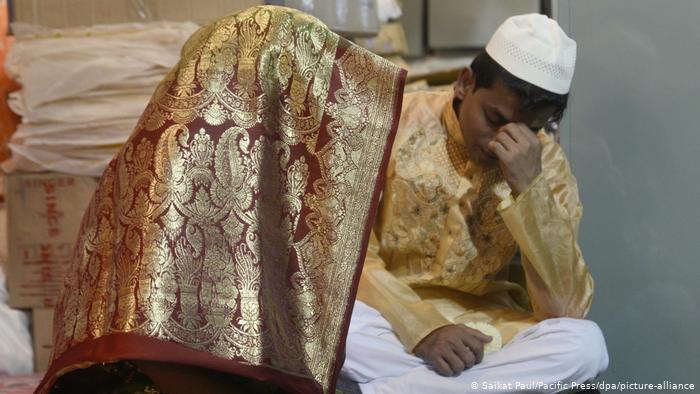
Sadaf has not had a proper conversation with her father for about three years now. He just wouldn't talk to her. That is the price she had to pay for choosing to marry a non-Muslim. The New Delhi-based lawyer still visits her parents' home in the Northern Indian city of Lucknow, in the hope that her father will eventually come around and accept her Hindu husband.
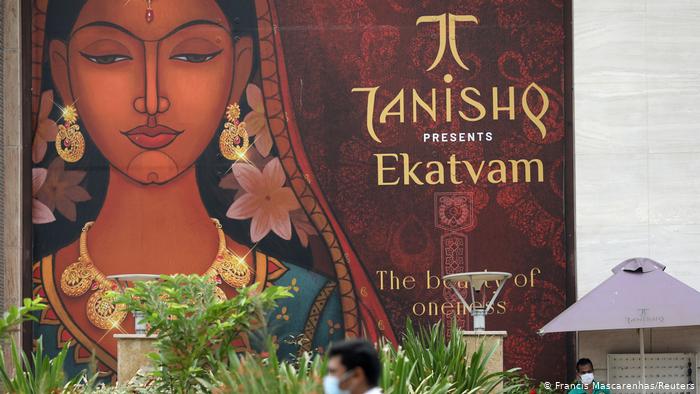
Interfaith marriages are often contentious in Indian society, especially when it involves a Hindu and a Muslim. This was recently seen when a jewelry advertisement featuring an interfaith couple sparked an outrage so intense that the brand, owned by one of the largest conglomerates in India, was forced to withdraw the ad.
The jewelry brand said in a statement that its decision to take down the ad was made "keeping in mind the hurt sentiments and the well-being of our employees, partners, and store staff."
The controversy — not the first of its kind — once again brought into question the tolerance and acceptability of interfaith marriages in a country where religious tensions have been on the rise in recent years.
Women face the brunt of the backlash
Sadaf married her colleague and fellow lawyer, Yatin, in February 2018. But the months preceding their wedding weren't easy for either of them.
"It was particularly difficult from my side," Sadaf said. "It's always more difficult for the woman's family to come around," she said.
Marriages in India's patriarchal system see women as being "given away" by their families. "Most families are reluctant to 'give away' their daughter into a faith they do not understand," Sadaf told DW.
While this wasn't something Yatin had to worry about, he faced challenges of his own. "My family went into an absolute shock when I first told them about Sadaf," he said.
"In fact, my mother had casually told me sometime earlier that they would accept whomever I wanted to marry, except a Muslim," Yatin said.
After several months of persuasion, his family finally agreed. But he admits that in interfaith marriages, the brunt of the backlash is often faced by women.
"If it were my sister who wanted to get married to a Muslim guy, I don't think my parents would have agreed to it," he said. "The woman's side often gets very aggressive too."
Fortunately for Sadaf, the reaction from her community was limited to a social boycott.
Only her mother, who was quite supportive from the start, and her brother attended the wedding. Sadaf's father refused to be part of the ceremony.
'Love jihad'
Unlike many inter-religious couples in India, Sadaf and Yatin had a lot going for them. They both came from educated families that were not prone to violence, lived in urban centers, and were financially independent. But most importantly, Yatin was a Hindu.
"Had Yatin been a Muslim, and I a Hindu, our marriage would have been called 'love jihad,'" Sadaf said.
"Love jihad" is a conspiracy theory floated by far-right Hindu groups in India which accuse Muslim men of trying to convert Hindu women to Islam by marrying them.
"The concept of 'love jihad' has really become widespread now," Sadaf said, adding that the current political environment has only fueled such conspiracy theories.
Critics also blame India's ruling Hindu nationalist Bharatiya Janata Party (BJP) of emboldening rightwing religious groups that threaten and intimidate interfaith couples.
Sadaf said they had kept their wedding quite low-key out of fear that one of these groups might show up.
"We were quite scared. We didn't know who might just come and disrupt the wedding," she said.
"It could be just any party wanting to make it political," Sadaf said, adding that the situation has only gotten worse with time. "If we were getting married now, it would be a lot more difficult."
Politicization of interfaith marriages
Hindu-Muslim marriages have never been socially acceptable in India, but only recently has it become a political issue, drawing the attention of what were earlier considered to be fringe groups.
According to social activist Asif Iqbal, interfaith couples have become more careful now, so as to avoid allegations of religious conversions.
"Earlier when people from two different faiths got married, it was considered a private matter of their respective families," Iqbal told DW. "There was little political intervention in the matter. All that has changed now."
Iqbal is the co-founder of Dhanak, an NGO in New Delhi that provides interfaith and inter-caste couples counseling, as well as legal and financial aid.
Founded in 2010, his organization helps about 1,000 couples every year, half of whom are interfaith couples.
"The people that reach out to us are mostly those who fear that either during or after their wedding, there would be violence," Iqbal said.
"There are also different kinds of violence. In some cases, the couple is beaten up, while in others, they are locked up at home, cutting off all communications with the outside world," he said.
"What we do is make these couples aware of their rights. We tell them that there is nothing wrong with what they're doing, either legally or morally," Iqbal said. "Once they become confident, it becomes easier for them to handle the situation."
Social stigma
While there are many couples who make it together against all odds, the social stigma is still very prevalent in India. It mainly stems from the state of Hindu-Muslim relations which, Iqbal says, have always been somewhat strained.
"People have lived in harmony too, but when there are two religions within one family, it becomes a controversial issue. It has always been this way," he said.
Iqbal added that it's not just the conservative Hindu groups that cause all the trouble.
"Their outrage seems intense and attracts attention because they have the political space to do that right now. I believe if conservative Muslim groups were given the same political space, they too would be reacting the same way," he said.
"Nobody can instigate one group against the other that easily. The bias has always existed in the people's minds," Iqbal said. "It has just been inflamed in the current political environment."
Latest Stories
-
Police recover stolen Honda CR-V in Kumasi within 48 hours
5 minutes -
Apetorku Gbodzi 2026 Festival opens in Dagbamete with development focus
19 minutes -
President Mahama arrives in Lyon to co-chair One Health Summit
26 minutes -
Beverly View Plus Hotel draws crowds amid coastal Easter rush in Volta
26 minutes -
Maiden Zongo Festival held in Wa amid calls to tackle drug abuse among the youth
49 minutes -
FDA warns of fake HIV test kits on Ghanaian market
1 hour -
Africa urged to build resilient health systems as donor support tightens
1 hour -
Easter gesture: Ablakwa settles medical bills for 85 North Tongu constituents
3 hours -
Africa must harness its population strength—Titus-Glover
3 hours -
Visa-free access doesn’t mean unlimited stay – Lom Ahlijah
3 hours -
From Golgotha to Kwahu: The Easter Migration of the Faithful and the Faithless
5 hours -
How the Ghanaian onion traders’ standoff with Nigeria unfolded and threatened local supply
5 hours -
No compensation for demolished structures on 24-Hour Economy market lands — Gov’t to structure owners
5 hours -
Financial Institutions must back local enterprises to spur growth – Deputy Minority Whip
5 hours -
Photos: Gomoa Easter Carnival 2026 ends in a burst of colour and celebration
6 hours