

Audio By Carbonatix
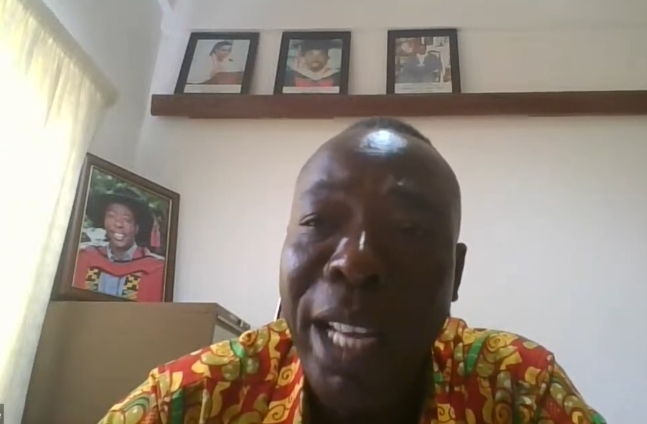
Prof. Samuel Kojo Kwofie, the Head of the Department of Biomedical Engineering at the University of Ghana, has called on the government, corporate institutions, and funding agencies to invest in artificial intelligence (AI) training, research, and technology development to improve health and alleviate poverty.
He says AI has the potential to reduce the gap in healthcare between urban and rural communities.
He made this appeal during a virtual session hosted under the auspices of the US Embassy Ghana, in collaboration with American Spaces and Mobile Web Ghana, on the topic, Artificial Intelligence in health and poverty alleviation.
The event, moderated by Florence Tofa, Director at Mobile Web-Ghana, was streamed live on the US Embassy Ghana YouTube Channel, attracting a diverse audience eager to explore the future of AI in Africa.
Revolutionising Healthcare with AI
Prof. Kwofie who is also a Bioinformatician at the West African Centre for Cell Biology of Infectious Pathogens (WACCBIP), University of Ghana, began by demystifying AI, explaining its core concepts and burgeoning role in health.
He discussed how the attainment of the Sustainable Development Goals is underpinned by robust investment in AI. He also highlighted key issues from his research and publications on AI and health to buttress these assertions.
His research group has blended AI and big biomedical data to develop various open-source applications including TubPred and EBOLApred. EBOLApred and TubPred support the discovery of potential drugs for Ebola virus disease and cancer, respectively. Another significant innovation discussed was BuDb, the first drug discovery database for Buruli ulcer.
Together with his collaborators including Prof. Michael Wilson at Noguchi Memorial Institute for Medical Research and others in Mayo Clinic, Jacksonville, Florida, they have successfully filed for patent application for Mycolactone as a potential COVID-19 drug. His team’s ongoing research also involves developing applications for regenerative AI and diagnosis using medical images.
Prof. Samuel Kojo Kwofie, the mentor of the Team Deep Breath made up of biomedical engineering students who won the best research paper presentation award at the 3rd National Biomedical Engineering Conference, for the development of an AI application for the automated diagnostics of Covid-19, emphasised the importance of AI in accurate diagnosis.
A Strategic Path Forward
Prof. Kwofie outlined a comprehensive roadmap for harnessing AI's full potential in Africa. This includes supportive policies, robust infrastructure, and the establishment of AI ethics review committees. He reiterated the call for a National Data Centre and a West African network for data-driven AI applications, alongside the creation of a National AI Network (NAIN) with centres of excellence across various institutions.
To foster innovation, Prof. Samuel Kojo Kwofie called for the development of an AI technology ecosystem, comprising start-ups and incubators, and a National Centre for High Performance Computing (NCHPC). He also stressed the need for substantial investment from state, private, local, and international sources, alongside dedicated portions of GDP for AI research and development. Scholarships, training, and effective intellectual property and technology transfer mechanisms were also identified as crucial vehicle for success.
Addressing Challenges and Concerns
Prof. Samuel Kojo Kwofie candidly addressed the significant challenges facing AI adoption in Africa and its role in health. These include limited infrastructure, electricity, and internet connectivity, as well as issues with data availability, bias, quality, and governance in resource-constrained settings. He underscored the need for culturally and contextually adapted AI solutions, considering Africa's diverse linguistic landscape and varying levels of digital illiteracy.
Ethical considerations were another focal point, with Prof. Kwofie calling for fairness and transparency in AI algorithms and cautioning against the generalization of applications without considering local contexts.
Economic Impact and Investment Potential
Highlighting the economic potential of AI, Prof. Kwofie referenced projections by the Economic Commission for Africa (ECA), suggesting AI could contribute up to $1.2 trillion to Africa's economy by 2030 constituting 5.6% increase in Africa’s GDP. Furthermore, Goldman Sachs forecasts global AI investment to approach $200 billion by 2025, underlining the immense financial opportunities in this sector with potential implications for poverty reduction.
Latest Stories
-
Over 25m enquiries conducted by financial institutions for credit appraisals, others in 2025
1 minute -
Ballon d’Or Power Rankings: Lamine Yamal leads race for Golden Ball ahead of Rodri and Kane
2 hours -
‘Nothing worked for us’ – Gideon Mensah takes responsibility for Gambia defeat
3 hours -
Habib Iddrisu says rejected motion was exactly what triggered Parliament recall
3 hours -
Spain announces ban on evictions after protests over 87-year-old woman’s removal from flat
4 hours -
Habib Iddrisu ‘very surprised’ as Speaker rejects Parliament recall motion
4 hours -
Speaker’s decision to reject recall motion catches Dep Minority Chief Whip off guard
4 hours -
2026 Women’s Super Cup: FC Savannah beat Epiphany Warriors to win trophy for first time
4 hours -
Fifa accuses Uefa of ‘misinformation campaign’
4 hours -
Kane and Gordon give England victory over Czech Republic in Nations League
4 hours -
AFCON 2027Q: ‘The last time Ghana won was eight games ago’ – Carlos Queiroz
5 hours -
AFCON 2027Q: Gambia defeat doesn’t make me a loser – Carlos Queiroz
5 hours -
Yamal inspres Spain to homecoming victory over Croatia
5 hours -
2027 AFCONQ: Late goals seal 2-0 for Côte d’Ivoire against Somalia
5 hours -
I’d stick my Man City medals in bin – Keane
5 hours