

Audio By Carbonatix
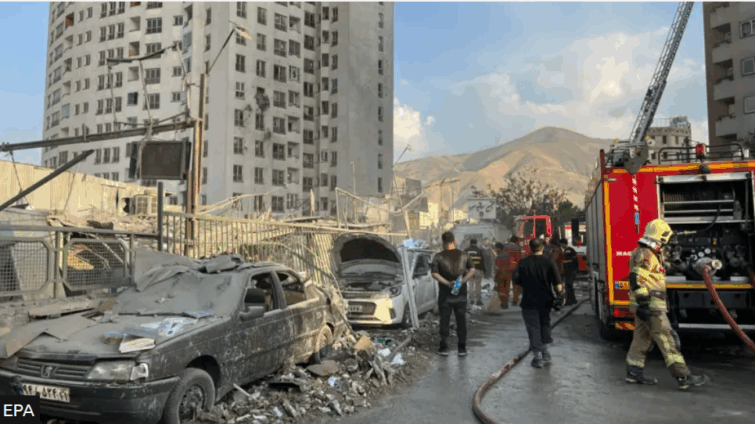
The first five days of the Iran-Israel war released more than 35,000 tonnes of carbon dioxide (CO2), equivalent to emissions from 8,300 cars driven for a year, according to a new estimate by two researchers.
A senior lecturer at Queen Mary University of London, Dr. Benjamin Neimark, and a lecturer at the University of Energy and Natural Resources in Ghana, Dr. Frederick Otu-Larbi, used a methodology previously applied in their study of the Gaza war.
Their findings suggest that emissions from jet fuel, rocket fire, and ballistic missiles during the early stages of the conflict mirror the carbon output of burning 20,000 tonnes of coal.
Based on these alarming figures, the researchers expressed concern that very few countries report their military emissions in any transparent or systematic way, and where reporting exists, it is often inconsistent.
They emphasised that the world’s armed forces are among the largest consumers of hydrocarbons and biggest greenhouse gas emitters, comparable to medium-sized countries.
“But little is known about their overall contribution to climate change,” they warned.
Military emissions reporting under the United Nations Framework Convention on Climate Change (UNFCCC) has been voluntary since the Paris Agreement, leaving large gaps in available data.
At COP26 in Glasgow (2021), a global network was created to track the military emissions gap, encouraging countries to report their military emissions to the UNFCCC. However, the researchers say most countries still fail to disclose this data, pushing independent researchers to estimate it on their own.
“From Gaza to Tel Aviv, Yemen to Tehran and onto Ukraine, the effects of war on the climate are only now beginning to be tallied, but much more needs to be done. The intensity of military footprints during war, however, remains a ‘black box,’” the researchers said.
“For instance, we need new categories to account for the unique properties of emissions during war, categories that will allow us to account for expansive and complex supply chains and differential aspects of war-fighting emissions, such as bunker fuels, reconstruction, and aid delivery.”
According to available figures, military and defence industries are responsible for 5.5% of global GHG emissions—about 2,750 MtCO2e.
But these figures exclude conflict-related emissions, such as infrastructure fires, loss of carbon sinks, post-conflict reconstruction, and war-related healthcare. Yet even with these omissions, the total is still comparable to that of civilian aviation (2%) and shipping (3%).
At COP29, developed countries rejected a proposed climate finance target of $1 trillion, settling instead for $300 billion.
Panama’s representative said: “Global military spending stands at about $2.5 trillion yearly. $2.5 trillion to kill each other is not too much, but one trillion to save lives is unreasonable.”
The decision has raised tensions in global negotiations, especially as many countries cut aid budgets while increasing defence spending.
UK Prime Minister Keir Starmer recently stated that reductions in aid would help fund increased defence, a move echoed less directly by other European leaders.
The Sustainable Development Goals (SDGs) envision a peaceful, equitable, and sustainable future by 2030. But researchers and advocates argue that militarisation is undermining that vision, especially as climate impacts worsen globally.
According to CEOBS, the international community must urgently act by adopting several steps including mandatory military emissions reporting, to establish accurate baselines.
CEOBS' recommendations align with those of the researchers, emphasizing that mandatory reporting of military emissions is a crucial first step toward reduction. As they put it, “we cannot cut what we do not know, and right now we do not have adequate baselines to make meaningful cuts.”
The researchers noted that militaries have historically led innovation, but now rely more on adapting private-sector technologies. As they modernize, new technologies should prioritize non-fossil fuel alternatives and geopolitical considerations around resource supply chains.
“As they measure their effect on the climate, military forces cannot only focus on protecting assets. There is a clear need to reduce carbon emissions through sensible, sustainable and just energy transitions. Discussions on the way forward must also include the wider society and ask: what kind of military forces do we want?”
“As the wars in Gaza, Ukraine and now the Israel-Iran conflict demonstrate, the humanitarian and environmental costs of war are intrinsically linked. To understand the full cost to people and the planet, we need transparent emissions reporting within international climate agreements.”
Latest Stories
-
Power restoration fault suspected in Kumasi Central Market fire
5 hours -
The 7-foot giant of Ngleshie Amanfro: Seven-foot Ghanaian Ephraim Saawa dreams of joining the national basketball team
5 hours -
Government promises support for Kumasi Central Market fire victims
5 hours -
Vibes The Movie: Big Ghun’s Ghanaian film earns five nominations at 2026 REFFA
6 hours -
MamaCare CEO warns unresolved conflicts among health workers could undermine maternal and neonatal care
6 hours -
Health professionals urged to translate medical knowledge into practice to save mothers
6 hours -
Retired judge Justice Francis Korbieh charges 1,568 new lawyers to uphold integrity
8 hours -
Conflicts among care providers linked to maternal, neonatal deaths – Expert
8 hours -
GIS marks 10th TIME conference, champions improved teaching practices
8 hours -
BRICS Or Balance? What Ghana’s bid really means
8 hours -
GPRTU wants full TRAFFITECH-GH implementation to start in 2027
9 hours -
How 10-mile walks for basic education birthed a 50-year legal career for Justice Korbieh
9 hours -
Mahama announces plans to import electric wheelchairs for PWDs
9 hours -
KGL U17 Colts 2026: Western beat Prempeh Elite Academy to set up final final with Greater Accra Region
9 hours -
Late Solanke strike salvages 10-man Spurs draw at Man United
9 hours