

Audio By Carbonatix
With 99 days to the start of the 2026 FIFA World Cup in the United States, Canada and Mexico, Ghana’s focus has shifted decisively from qualification to preparation. Having secured their place at the global showpiece, attention within the Black Stars setup is now centred on squad balance, positional depth and reliability.
In anticipation of the tournament, the Ghana Football Association has appointed a new four-member technical team to support head coach Otto Addo, reinforcing a transition from short-term results to long-term optimisation. Yet amid these structural adjustments, one long-standing issue remains unresolved: the left-back position.
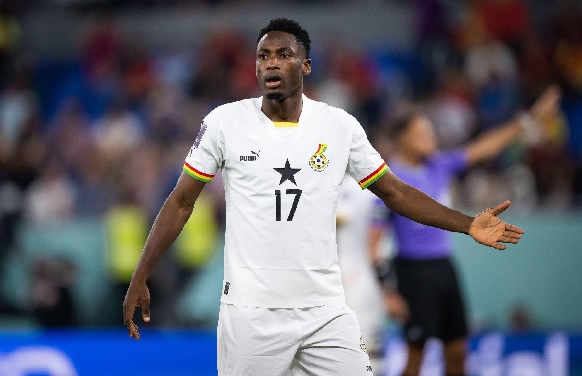
Nearly three years on from Abdul Rahman Baba’s last appearance for the Black Stars in September 2023, Ghana are still searching for continuity on the left side of defence. Despite multiple personnel changes and tactical tweaks, no candidate has fully cemented ownership of the role, an absence that grows more significant as World Cup planning intensifies.
A Position Without Continuity
In Baba Rahman’s absence, Ghana have cycled through several options at left-back, each offering different strengths but none fully establishing themselves as an undisputed first choice or, arguably, entirely guaranteeing their place in the squad.
Gideon Mensah of AJ Auxerre has been the most consistent selection, starting the majority of competitive fixtures, including matches at the 2023 Africa Cup of Nations and the 2026 World Cup qualifiers. While reliable, his tenure has not entirely settled the debate.
Ebenezer Annan, currently with French Ligue 2 side Saint-Étienne on a three-year deal, featured during qualifiers against Mali and the Central African Republic in June 2024. He made his debut under Otto Addo and has gone on to feature on seven occasions without clearly gaining Addo’s trust, while Patrick Kpozo of Baník Ostrava has also been called up and utilised in the role, albeit only once under Addo right at the start of his second tenure.
At times, Ghana have turned to Alidu Seidu of Stade Rennais, primarily a right-back or centre-back with his club deploying him on the left in an effort to preserve defensive structure.
More recently, Addo’s continued exploration of options at the position has included Isaac Afful of FC Samartex 1996, who earned a call-up for the 2025 AFCON qualifiers in October and November 2024, underlining the continued search for alternatives, whilst Derrick Köhn is a more promising recent addition who has nevertheless managed just a single appearance to date amidst paperwork issues. The situation has become so desperate that Caleb Yirenkyi of FC Nordsjaelland, whose primary role is central midfield, was also tested in the left-back position in the 2025 Unity Cup against Nigeria.
Collectively, these selections highlight a broader reality: Ghana have options, but not certainty. In modern international football, full-backs are no longer peripheral figures. They are central to building up play, defensive transitions and attacking width. For teams preparing for the World Cup, unresolved roles, particularly in defence, are often exposed against elite opposition.
The Weight of Expectation and Public Backlash
Abdul Rahman Baba’s journey with the Black Stars has not been short of turbulence. Once regarded as one of the most promising young full-backs in Europe, particularly during his early rise that earned him a move to Chelsea FC, expectations around him at that time were immense. Many Ghanaian supporters viewed him as a long-term solution to the Black Stars’ left-back position in 2015. However, a succession of injuries disrupted his rhythm at club level and inevitably affected his international sharpness. The explosive acceleration and attacking thrust that once defined his game appeared inconsistent, and defensive lapses in high-stakes matches were amplified under the unforgiving lens of national expectation.
By 2023, sections of the Ghanaian fanbase had grown visibly frustrated. Social media discourse around squad announcements frequently included criticism of his inclusion, with some supporters arguing that his previous European pedigree no longer justified automatic consideration.
That frustration reached a boiling point during Ghana’s decisive Africa Cup of Nations qualifier against the Central African Republic at the Baba Yara Stadium. In a match where Ghana required unity and composure to secure qualification, a section of the home crowd audibly booed Baba almost every time he touched the ball.
It was a rare and uncomfortable sight: a senior national team player, on home soil, subjected to sustained jeers in a must-win fixture. While Ghana ultimately secured victory, the episode symbolised the erosion of public trust in a player who had once been widely celebrated.
Yet context again matters.
Full-backs are often the most exposed players in transitional phases. In a Ghana side that, at the time, struggled with midfield protection and defensive coordination, wide defenders frequently found themselves isolated against direct runners. Individual errors were magnified, but systemic vulnerabilities were equally present.
The criticism directed at Baba was therefore both emotional and symbolic, reflecting broader anxieties about Ghana’s defensive fragility rather than solely his individual performance level. Ironically, nearly three years later, the very instability that fuelled calls for change remains unresolved. The left-back position continues to rotate without a definitive owner, raising a critical question ahead of the World Cup: was the problem truly the individual, or the structure around him?
As Ghana refine their squad for the World Cup 2026, that question may be more relevant than ever.
Baba Rahman’s Form at PAOK
Away from the national team setup, Baba Rahman has quietly re-established himself at PAOK FC, enjoying one of his most consistent spells in recent seasons. Now fully fit, the 30-year-old has been a regular starter in both the Greek Super League and the UEFA Europa League, contributing across domestic and continental competitions. Beyond appearances, performance data paints a fuller picture of his resurgence.
What the Data Shows
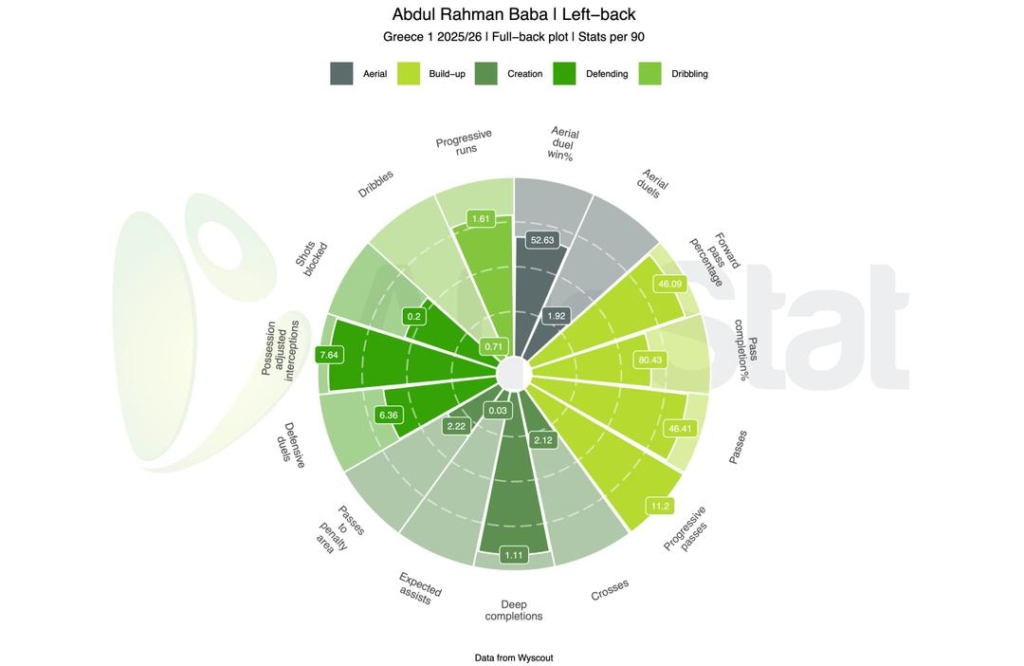
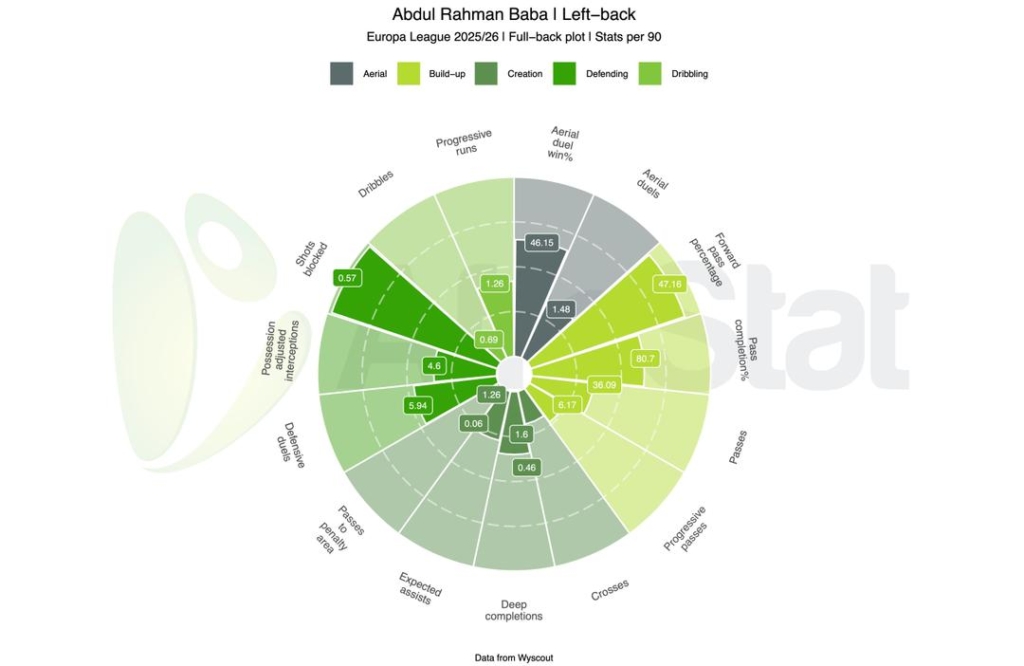
Wyscout data across the 2024/25 and 2025/26 seasons, in both domestic league and Europa League action, suggests Baba remains a well-rounded, high-functioning full-back rather than a specialist limited to one phase of play.
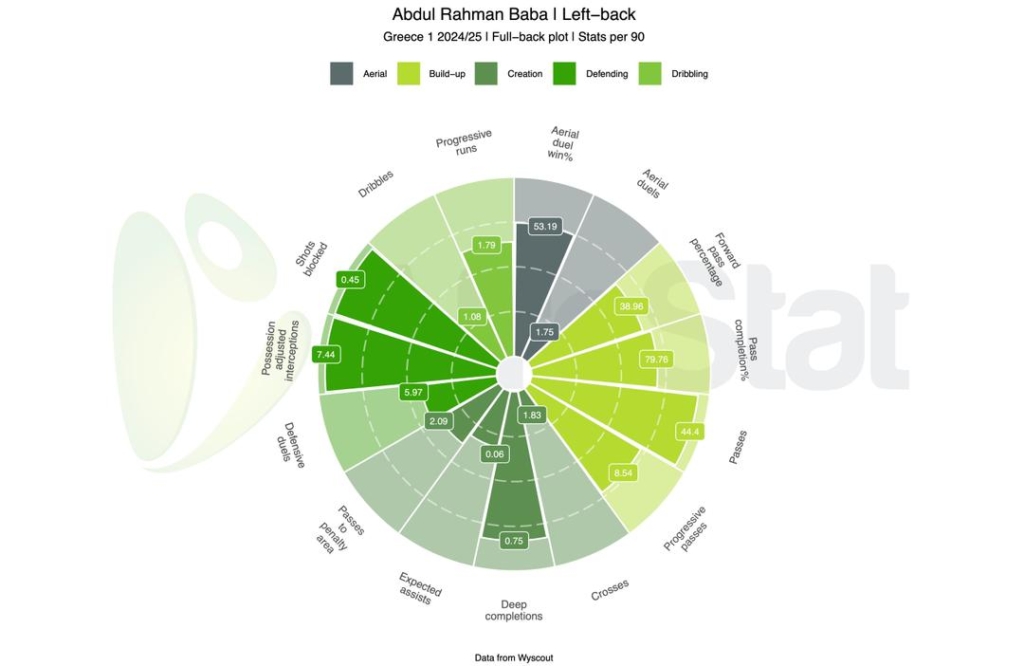
Defensively, Baba’s numbers have been varied, but these reflect the different stylistic demands placed on him, which stand him in good stead to perform in a Ghana side that will be required to approach different games and different game-states, with different styles at the World Cup. In Europe, his duels and interceptions are lower with a high volume of shots blocked, reflecting PAOK’s more defensive, low-block approach. Meanwhile, in domestic competition, his higher duel and interception numbers reflect a more front-foot defensive approach.
He records strong numbers in defensive duels, possession-adjusted interceptions and shots blocked, particularly in European competition where positional discipline and recovery speed are tested more rigorously. His aerial duel involvement remains moderate but stable, reflecting a full-back more engaged in ground-based defending and wide-area coverage.
In build-up and progression, Baba’s pass completion rate consistently hovers around or above 80%, while his volume of progressive passes and forward pass percentage indicate a player comfortable advancing play rather than simply recycling possession, with him enjoying a particularly productive domestic campaign. His progressive runs per 90 remain steady across seasons, pointing to sustained physical output rather than short-term spikes.
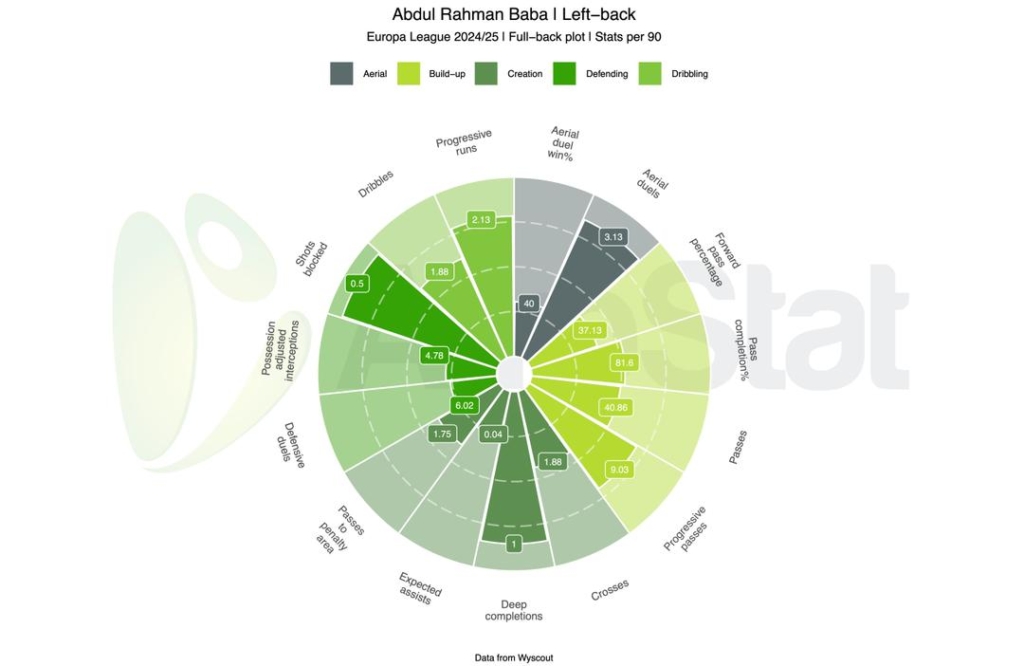
From an attacking perspective, Baba contributes through crosses, deep completions (passes into the penalty box and the area immediately surrounding it) and expected assists, with his Europa League data showing an ability to maintain creative involvement even against higher-level opposition, albeit it demonstrates a stronger preference towards progression when playing a more restrained role. While he is not a high-volume dribbler, his efficiency in ball progression suggests calculated rather than high-risk involvement.
Crucially, these numbers remain consistent across competitions and seasons — an indicator of reliability rather than fluctuation. Perhaps most significantly, availability underpins the entire profile. Regular minutes at the club level have allowed Baba to maintain rhythm, a factor often undervalued but critical when assessing international readiness.
Tactical Fit Under Otto Addo
Otto Addo’s system places significant responsibility on full-backs. They are expected to progress the ball when building up, stretch play as the ball moves up the field to offer a wide presence in the final third in possession, recover quickly during transitions and remain disciplined when the team drops into a compact defensive shape.
Baba’s experience across multiple leagues, including the Premier League, Bundesliga, Ligue 1 and European competition with PAOK, has shaped a profile well suited to those varied demands. Comfortable operating in a back four or as a wing-back, in deeper or narrower roles or bombing on in the final third, he offers tactical flexibility that can prove valuable during tournament football, where in-game adjustments are often decisive.
His Europa League exposure, frequently against high-level wide attackers, further strengthens his case as a player accustomed to managing elite threats.
Experience vs Experimentation
With qualification secured, Ghana’s challenge is refinement rather than experimentation. While integrating younger players remains central to long-term planning, particularly with AFCON 2027 and future cycles in view, World Cups rarely reward uncertainty in key defensive roles. At 31, Baba sits within the typical maturity window for a full-back: physically stable, tactically aware and emotionally composed. His international experience offers intangibles that raw potential cannot always replicate.
A Selection Question, Not a Statement
Ultimately, squad selection rests with Otto Addo, who must balance present form with future planning, including with an eye towards AFCON qualification and (hopefully) tournaments in each of 2027 and 2028. Yet as preparations for the 2026 World Cup gather pace and with enhanced technical support now in place, Baba Rahman’s performances at club level make him increasingly difficult to overlook, a worthwhile option, particularly in a position Ghana have yet to conclusively resolve.
Latest Stories
-
Health Ministry engages Ga Mantse ahead of Free Primary Healthcare launch
6 minutes -
We can tackle multiple priorities – Sam George defends Anti-LGBTQ Bill push
41 minutes -
Statement: Ghana Chamber of Mines’ Response to Claims in Joe Jackson’s “Ananse Stories about the Economy of Ghana”
42 minutes -
GES opens 2026 teacher recruitment for licensed B.Ed graduates
45 minutes -
Ghana must value skilled trades, build resilient learners — Ibn Chambas
53 minutes -
Ghana must rethink education around relevance, resilience and responsibility — Ibn Chambas
56 minutes -
Prince Harry faces defamation lawsuit from charity he co-founded
58 minutes -
South Korea deploys thermal cameras to track escaped zoo wolf
59 minutes -
Calls for royal meeting with Epstein survivors grow ahead of US visit
1 hour -
Ibn Chambas advocates blend of technology and human values in education
1 hour -
UMA improves healthcare access in Asutifi North with GH₵700k ‘Kim Taylor Legacy’ Walkway
1 hour -
Scholarships Authority and Fanaka University offer sponsorship for procurement and supply chain studies
1 hour -
Bisa Kdei drops new single ‘Go N Look’ featuring Medikal
1 hour -
Benin facing rising terrorism in north as French military presence faces growing criticism
1 hour -
UEW Public Lecture Series 2026: Education debate ‘about the soul of Ghana’s future’ — Dr Ibn Chambas
1 hour