

Audio By Carbonatix
The $10bn James Webb telescope has left Earth on its mission to image the first stars to light up the Universe.
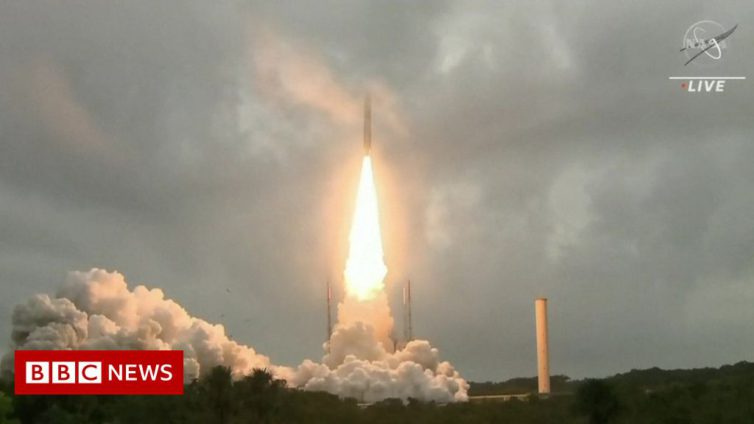
The observatory was lifted skyward by an Ariane rocket from the Kourou spaceport in French Guiana.
Its flight to orbit was expected to last just under half an hour, with a signal confirming a successful outcome due to be picked up in Kenya.
Webb, named after one of the architects of the Apollo Moon landings, is the successor to the Hubble telescope.
Engineers working with the US, European and Canadian space agencies have built the new observatory to be 100 times more powerful, however.
Lift-off was eagerly awaited but accompanied also by a good deal of anxiety. Thousands of people worldwide have worked on the project over the past 30 years, and even though the Ariane is a very dependable vehicle - there are no guarantees when it comes to rockets.
"Webb is an extraordinary mission," US space agency administrator Bill Nelson said before lift-off.
"It's a shining example of what we can accomplish when we dream big. We've always known that this project would be a risky endeavour. But, of course, when you want a big reward, you have to usually take a big risk."
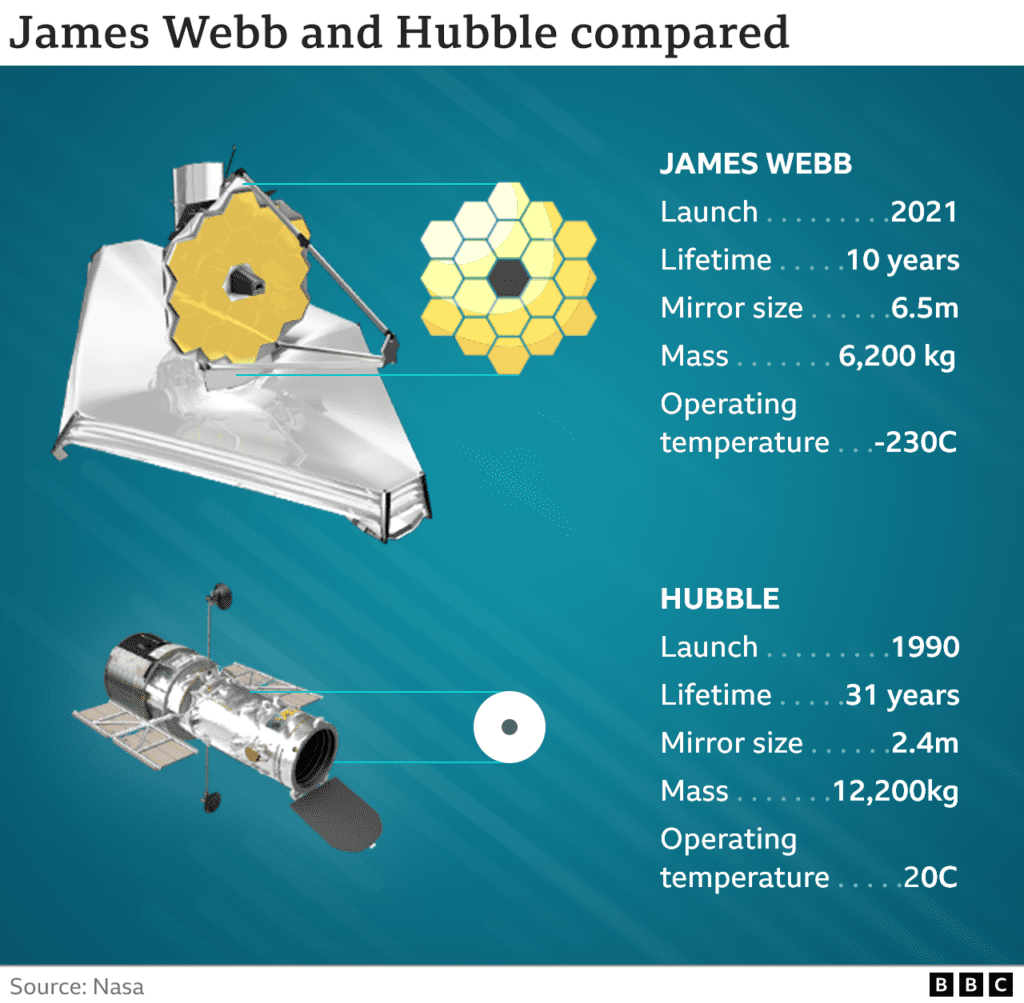
At the core of the new facility's capabilities is its 6.5m-wide golden mirror. This is almost three times wider than the primary reflector on Hubble.
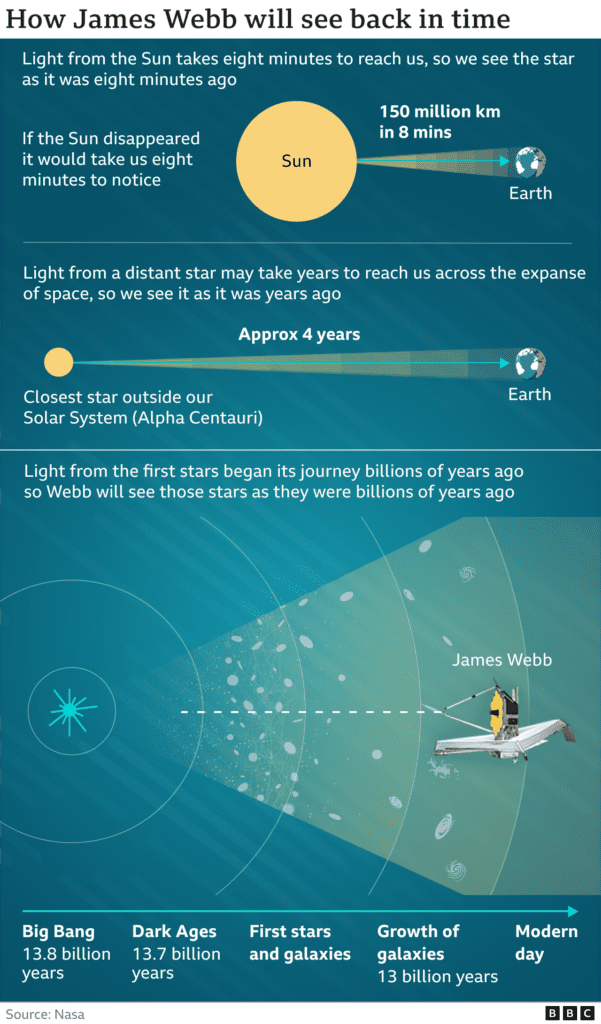
The enlarged optics, combined with four super-sensitive instruments, should enable astronomers to look deeper into space - and thus further back in time - than ever before.
A key target will be the epoch of the pioneer stars that ended the darkness theorised to have gripped the cosmos shortly after the Big Bang more than 13.5 billion years ago.
It was the nuclear reactions in these objects that would have forged the very first heavy atoms essential for life - carbon, nitrogen, oxygen, phosphorus, and sulphur.
Another overarching goal for Webb will be to probe the atmospheres of distant planets. This will help researchers gauge whether these worlds are in any way habitable.
"We're going to be entering a whole new regime of astrophysics, a new frontier; and that is what gets so many of us excited about the James Webb Space Telescope," said Heidi Hammel, a planetary astronomer and an interdisciplinary scientist on the mission.
Webb's launch is only the start of what will be a complex series of initial activities over the next six months.
The telescope is being put on a path to an observing station some 1.5 million km beyond the Earth.
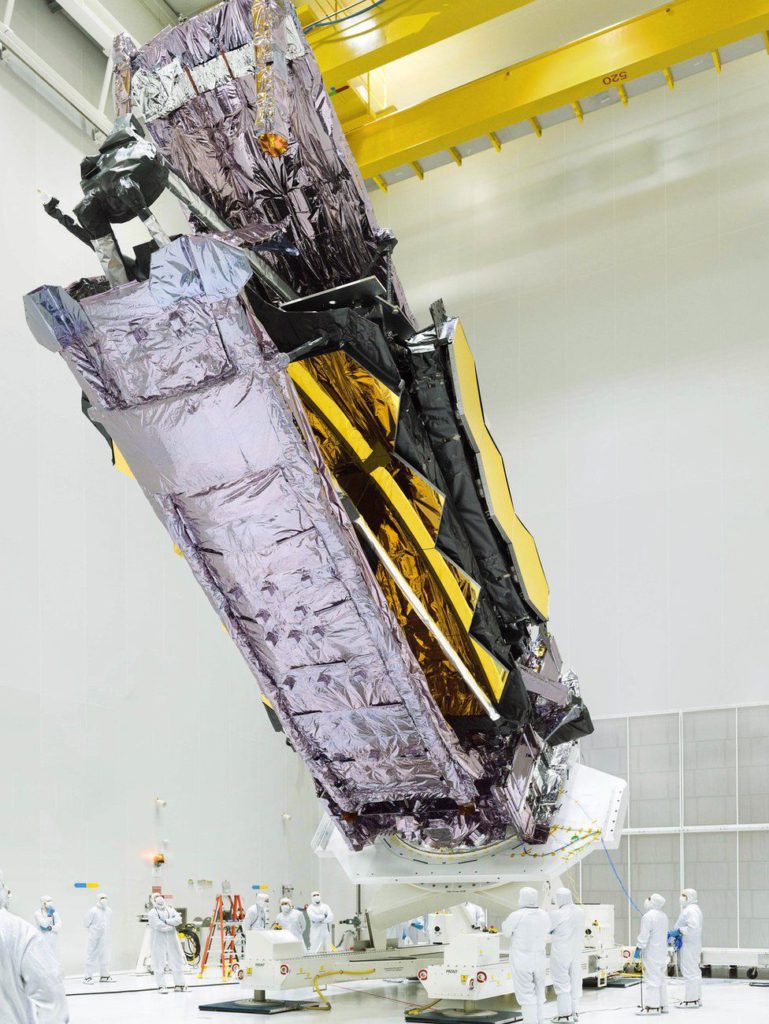
In the course of travelling to this location, Webb will have to unpack itself from the folded configuration it adopted at launch.
"And then the critical thing is that it all has to get very cold," explained Mark Mark McCaughrean, a senior science adviser with the European Space Agency.
"This telescope actually will be at minus 233 degrees Celsius. Only then will it stop glowing at the infrared wavelengths beyond the visible where we want this telescope to work. And only then will it be able to take sensitive pictures of the distant Universe where the first galaxies were born, and of planets going around other stars. So there's a long way to go."
Latest Stories
-
Damang mine award: Minority not against Ghanaian participation; we’re asking for fair process – Konadu
18 minutes -
NPA to enforce stricter registration rules for petroleum tankers
44 minutes -
Manhyia South MP laments decline in hospitality operations in his constituency
57 minutes -
How a simple clean charcoal innovation could benefit Ghana’s climate future
1 hour -
NPA, COMAC launch Safety Week 2026 to promote risk management in petroleum sector
1 hour -
Stakeholder engagement resolves onion trade impasse
1 hour -
Gender Ministry holds staff durbar, welcomes new Chief Director
1 hour -
Unexpected illness sparked my radio career – Tommy Annan-Forson
1 hour -
Bolt Ghana awards GH¢50,000 to women entrepreneurs through “She Moves to Win” campaign
1 hour -
NRGI Country Manager questions speed of ministerial approval in Damang mining deal
2 hours -
Publish the assessment — NRGI demands transparency in Damang mining deal award to E&P
2 hours -
Tamale: Alhaji Hussein Fuzak funds construction of 3-storey classroom block at Ambariya Islamic School
2 hours -
Gender Ministry holds staff durbar, welcomes new Chief Director
2 hours -
Anti-LGBTQ+: Mahama prioritises sentiments of development partners over Ghanaian values – Ntim Fordjour
2 hours -
CPA intensifies crackdown on fake diapers across public hospitals
3 hours