

Audio By Carbonatix
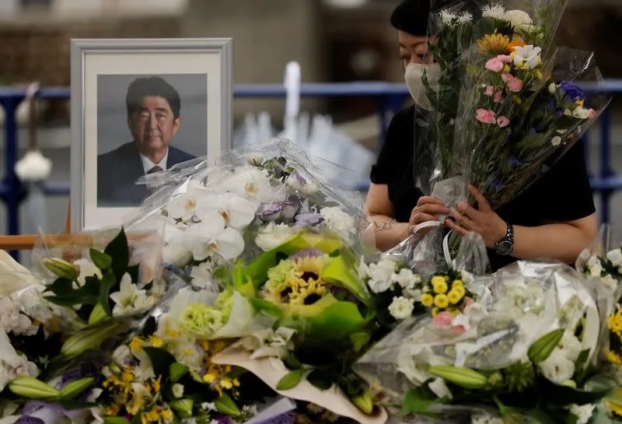
The Japanese government said on Friday it would hold a state funeral for former Prime Minister Shinzo Abe amid street and social media protests that the state shouldn't fund ceremonies for Japan's longest-serving, but divisive, premier.
Abe, prime minister for more than eight years over two terms and hugely influential in the ruling Liberal Democratic Party (LDP) even after leaving office, was gunned down two weeks ago at a campaign rally, an incident that deeply shocked Japan.
His funeral was held soon after, but the cabinet decided on Friday that a state funeral will be held on September 27 at the Nippon Budokan in central Tokyo.
"We made this decision, as has been said before, due to Abe's record as the longest-serving prime minister, during which he exerted leadership skills distinctive from others and bore heavy responsibility for dealing with a number of serious domestic and international issues," chief cabinet secretary Hirokazu Matsuno told a news conference on Friday.
The funeral will be fully paid for by state funds likely to be taken from the budget reserve, he said.
The last state funeral for an ex-prime minister paid for fully by state funds was in 1967, with successive funerals paid for partly by the state and partly by the LDP.
The current plan has triggered growing disquiet. Around 200 people gathered near the PM's office in Tokyo to protest the decision, according to the Kyodo news agency, and on social media objections ranged from the use of taxpayer funds, to complaints the government may seek to make political capital of Abe's death and cement his legacy.
On Thursday, 50 people filed for an injunction in a Tokyo court seeking a halt to the use of public funds for the event, saying there should have been more discussion before making a decision.
Only 49% supported the idea of a state funeral in a recent public opinion poll by public broadcaster NHK, and the topic was trending on social media on Friday.
On Twitter, a user with the handle 'Yuki no Imogai' posted, "(Prime Minister Fumio) Kishida always bragged he listens to the people, so why isn't he doing it now?"
Others contrasted the plan with the government response to the COVID-19 pandemic, with new cases surging to record levels in Japan this week.
"Given they're doing next to nothing about the pandemic, how did they manage to decide this so quickly?", posted Twitter user 'Heron'.
"Take the money you'll use for the funeral and do something about the coronavirus."
Latest Stories
-
‘We don’t have time’ – Fianoo calls for Schäfer to lead Black Stars temporarily
38 minutes -
CAF will not favour any country – President Motsepe
43 minutes -
Otto Addo was appointed through the backdoor – Kudjoe Fianoo slams GFA
43 minutes -
UG Corporate Football League back from the Easter break
47 minutes -
CGI orders motorbike training at tactical school in Kyebi
2 hours -
Sachet water producers in Berekum defy gov’t directives, increase prices
2 hours -
Critical commodities stuck at port, CSOs warn of family planning crisis
2 hours -
Gender Ministry mourns victims of Volta Lake boat tragedy, deploys support for affected families
2 hours -
MPs undergo training on human trafficking and gender dimensions
2 hours -
Don’t expect instant relief – COMAC CEO warns fuel price drops will be gradual
2 hours -
GIS to unveil comprehensive plans to enhance officers’ welfare and infrastructure
2 hours -
Right move, wrong timing? – COMAC CEO questions govt’s delay on fuel price relief
2 hours -
IMF urges Central Banks to keep inflation in check
3 hours -
NRSA stands firm on Toyota Voxy ban despite transport operators’ opposition
3 hours -
H. Kwasi Prempeh raises concerns over Supreme Court’s handling of OSP constitutionality case
3 hours