

Audio By Carbonatix
Japan has reaffirmed its commitment to supporting Ghana’s rice value chain and broader food security efforts, as concerns grow over the impact of illegal mining on rice-producing communities.
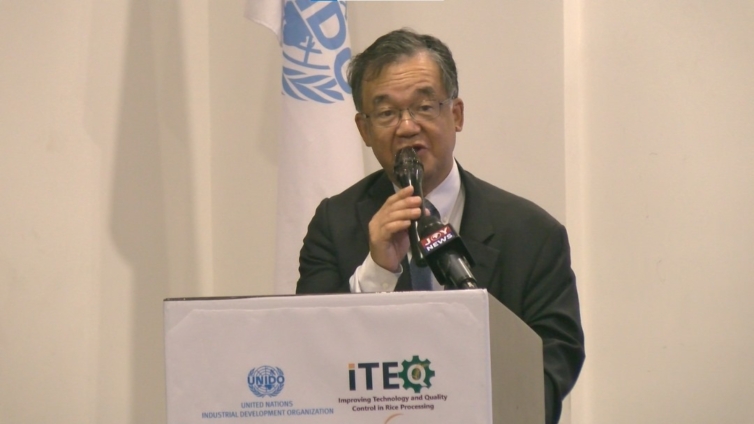
Speaking at the closing ceremony of the UNIDO-backed Improving the Technology and Quality Control System for Higher-Value Addition in the Post-Harvest Processes of the Rice Value Chain (ITEQ-Rice) project, Japan’s Ambassador to Ghana, H.E. Hiroshi Yoshimoto, described the initiative as a symbol of the long-standing partnership between the two countries.
“This is not just the end of a project, but a reflection of the deep and enduring cooperation between Japan and Ghana,” the Ambassador said.
He stressed that capacity development lies at the heart of Japan’s development assistance philosophy, noting that empowering people and institutions with skills, knowledge and modern technology is essential for sustainable growth.
“We firmly believe that when people and institutions are empowered with skills, knowledge and modern technology, they become drivers of sustainable growth,” he stated.
Ambassador Yoshimoto said Japan was particularly pleased to support the ITEQ-Rice project through its Official Development Assistance (ODA), which prioritises the self-help efforts of partner countries, especially in modernising agriculture to create jobs and strengthen food security.
He commended the United Nations Industrial Development Organization (UNIDO) for its technical leadership and praised the Ministry of Food and Agriculture and other stakeholders for their commitment, assuring that Japan remains ready to deepen cooperation with Ghana in the years ahead.
Meanwhile, the Food and Drugs Authority (FDA) raised alarm over the growing encroachment of illegal mining, popularly known as galamsey, into rice-producing areas.
The Head of Food Evaluation and Registration at the FDA, Percy Agyekum, warned that the trend poses serious risks to Ghana’s food safety and national food supply.
“With the increasing threat of contamination, we must strengthen our testing systems to ensure the safety of rice consumed by Ghanaians,” he said.
He appealed to the Government of Japan to partner with Ghana in establishing a national rice testing laboratory to enhance food safety monitoring and strengthen quality control systems across the country.
Beneficiaries of the project say the intervention has already delivered tangible benefits. A rice processor, Memunatu Alhassan, said the introduction of a briquetting machine has enabled processors to convert rice chaff—previously discarded at a cost—into fuel, reducing reliance on firewood and cutting production expenses.
UNIDO Project Manager Nicolas Martys assured stakeholders that sustainability remains central to the project’s design. He explained that a train-the-trainer approach and the development of long-term knowledge products would help ensure the project’s lasting impact.
The ITEQ-Rice project has significantly modernised Ghana’s rice value chain, improving post-harvest handling, strengthening business competencies and laying the foundation for safer and more resilient rice production in the face of environmental and food safety challenges.
Latest Stories
-
Vice President Opoku-Agyemang enstooled as Development Queen of Kedzi
2 minutes -
Globen School @30: From humble beginnings to a hub of innovation and excellence
3 minutes -
Children’s health and happiness take centre stage at 2026 Giggle Fun Fest in Peki Avetile
23 minutes -
Four dead, 14 injured in Dawadawa Highway crash
3 hours -
Ga Mantse, Spanish Ambassador discuss Hola Accra Music Festival
3 hours -
President Mahama reflects on the birth of Kwahu Business Forum at 2026 event
3 hours -
How Dr. Joseph Bonney’s ‘No Bed Syndrome’ moved from Ghana hospitals to global use
3 hours -
President Mahama emphasises need for stable and predictable cedis
3 hours -
Deliver quality or be penalised, GETFund Administrator cautions contractors
3 hours -
President Mahama urges Ghanaian businesses to prioritise tax compliance and succession planning
3 hours -
Invest in start-ups and explore mergers – President Mahama urges Ghanaian businesses
4 hours -
Mahama confirms progress on 24-Hour Economy initiative at Kwahu Business Forum
4 hours -
Parliament passes Ghana Investment Promotion Authority (GIPA) Bill
4 hours -
New airport infrastructure tax – a costly own goal that ground Ghana’s aviation ambitions
4 hours -
Sachet water price increase: Why Ghana urgently needs a competition law to address price fixing and cartel conduct
4 hours