

Audio By Carbonatix
Sarah Evanega works in a challenging space.
No, not her pandemic home office or even her car to free up needed internet bandwidth for her three young children’s remote schoolwork. Those are minor compared to a career spent depolarizing and demystifying issues around genetic engineering, especially given the disconnect between scientific consensus on its safety and lingering public skepticism.
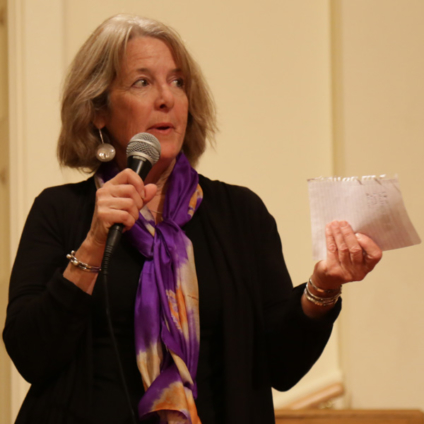
As founder and director of the Cornell Alliance for Science, a global communications initiative in the College of Agriculture and Life Sciences (CALS), Evanega faces down misperceptions, myths, and misinformation about GMOs — or to use the scientific term, agricultural biotechnology. Now she’s also taking on the conspiracy theories and disinformation campaigns that swirl around the pandemic, vaccines, climate change, and synthetic biology.
Evanega, a research professor in the Department of Global Development and School of Integrative Plant Science, has found that understanding GMO misinformation trends provides important lessons that can be applied to misinformation around COVID-19. In 2020, she led a comprehensive examination of coronavirus misinformation in traditional and online media, analyzing 38 million documents in order to understand the root of the “infodemic.” The research garnered global coverage from The New York Times, CNN, NBC News, The Hill, and MSN.
“Misinformation became a buzzword with COVID, but in plant science, we’ve been dealing with misinformation for decades,” Evanega says. “We’re not finished yet, but we have made significant progress. Now we’re seeing how we can apply learnings from agricultural biotechnology to other issues of science that suffer from misinformation.”
Evanega didn’t plot a career course into this thicket. She first discovered plant science in 1996 upon taking a plant physiology course as a college elective. It was a revolutionary time for ag-biotech, with the Cornell-developed virus-resistant GM papaya hitting the market. Excited about the role that biotechnology could play in advancing plant science, Evanega earned a doctorate in plant biology from Cornell in 2009.
Then reality hit: “You invest your career and time only to discover that this technology isn’t having the impact that it could,” she says. “And you find it’s not because of the science, but the politics and profit-driven campaigns against it. At that point, I became concerned about the factors that are limiting the plant sciences field’s ability to advance and have impact.”
Evanega wasn’t interested in standing by as misinformation derailed science that provided solutions. In 2013 she pitched her big idea for combatting ag biotech misinformation to the Bill & Melinda Gates Foundation: a $4.5 million grant then launched the Alliance for Science in 2014. She has since brought in a total of $27 million in funding — none of it from industry, despite what some critics claim.
The Alliance’s emphasis is three-pronged: policy, training and communications. “If we want science to have an impact, we have to improve the policy environment. We have to train people who can engage with the public. And we have to tell better stories about the technology,” she says.
As part of that initiative, Evanega mentors science champions across the globe and from all professional backgrounds. Launched in 2015, the Alliance’s Global Leadership Fellows Program delivers an extensive 12-week course at Cornell, to date training 111 Fellows from 35 countries. Additionally, Evanega has facilitated workshops with nearly 800 scientists from 48 countries, and 109 journalists from 15 countries.
Evanega believes that scientists must join the public debate about the key issues of our time, and she is often invited to give talks on the importance of science communication, especially at the request of young scientists. She also offers guest lectures on plant biotechnology in a range of graduate and undergraduate courses in SIPS and is part of an interdisciplinary team that developed a massive open online course (MOOC) on the science and politics of GMOs on Cornell’s EdX platform in 2016. Throughout her career, she has worked to promote ethnic and gender diversity at Cornell through programs such as Advancing Women in Agriculture through Research and Education.
Evanega sees those efforts and the work of the Alliance as an extension of the land-grant university mission. “Agricultural biotechnology can help us be better stewards of the land and shift people from subsistence to a significant increase in quality of life,” she says.
Looking back on the past seven years, Evanega believes the Alliance has made a difference. “We’re giving people agency. It’s not about us doing development out there in the world. It’s as simple as creating a platform that people can hop on and do what’s culturally appropriate in their own contexts. Not everybody agrees with or appreciates our work, but it’s important, because we’re standing firmly with the science and we’re not imposing it on other cultural contexts.”
Joan Conrow is the managing editor of the Cornell Alliance for Science.
Latest Stories
-
Prudential Life settles GH¢100,000 medical bills under its PRUCares Valentine Experience Initiative
6 hours -
Wa West Picnic: Peter Lanchene Toobu champions peace, health and unity in landmark celebration
6 hours -
Dr Mensah Market flooded after downpour in Kumasi
6 hours -
Armed men reportedly storm Adjen Kotoku Onion Market amid tensions
7 hours -
Tecco Mensah writes: Why football fans must look beyond statistics
8 hours -
Police recover stolen Honda CR-V in Kumasi within 48 hours
9 hours -
Apetorku Gbodzi 2026 Festival opens in Dagbamete with development focus
9 hours -
President Mahama arrives in Lyon to co-chair One Health Summit
9 hours -
Beverly View Plus Hotel draws crowds amid coastal Easter rush in Volta
9 hours -
Maiden Zongo Festival held in Wa amid calls to tackle drug abuse among the youth
9 hours -
FDA warns of fake HIV test kits on Ghanaian market
10 hours -
Africa urged to build resilient health systems as donor support tightens
10 hours -
Easter gesture: Ablakwa settles medical bills for 85 North Tongu constituents
12 hours -
Africa must harness its population strength—Titus-Glover
12 hours -
Visa-free access doesn’t mean unlimited stay – Lom Ahlijah
12 hours