


Audio By Carbonatix
Ethiopians and Eritreans have been celebrating the reopening of two key crossing points more than 20 years after a border war shut them.
Hundreds of people from the two countries hugged each other and some wept as their leaders led celebrations to mark the reopening.
It is the latest sign of rapprochement between the former enemies.
Ethiopian Prime Minister Abiy Ahmed and Eritrean President Isaias Afwerki signed a peace deal in July.
It restored diplomatic and trade relations between the nations.
The reopening at Burre gives landlocked Ethiopia access to the sea. Another border post, near the Ethiopian town of Zalambessa, also reopened.
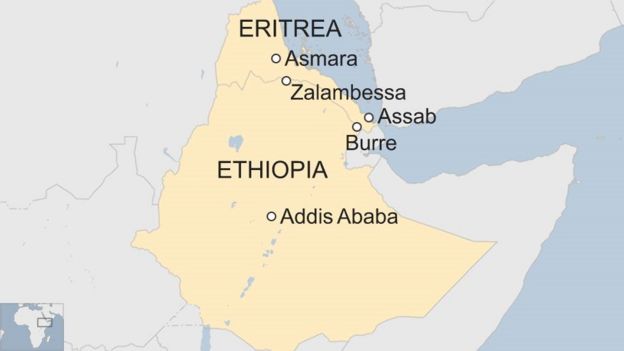
The reopening coincides with the Ethiopian New Year, adding to the festive atmosphere.
The war, fought over the exact location of the boundary between Ethiopia and Eritrea, began in May 1998 and left tens of thousands of people dead.
It ended in 2000 with the signing of the Algiers agreement. But peace was never fully restored as Ethiopia refused to implement a ruling by a border commission established by the agreement.
What is the significance of the reopening?
Families divided by the conflict will be able to go and visit each other after more than two decades.
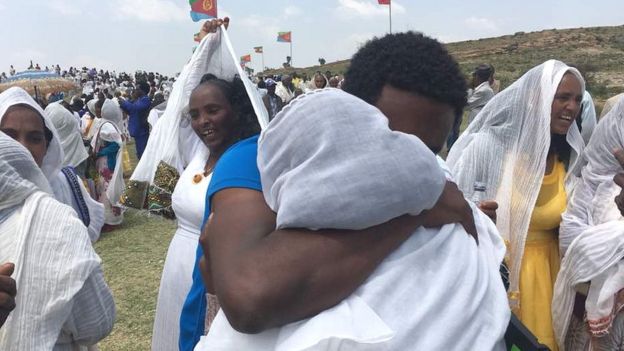
Ethiopian Yonad Fesseha hugged and kissed his Eritrean cousin
Eritrea won independence from Ethiopia in 1991 but members of the same family continued to live on both sides of the border as the two countries enjoyed good relations until 1998.
Zalambessa resident Yonas Fesseha told the BBC's Tigrinya service that his mother and brother are set to meet for the first time in 20 years. His mother felt as though it was a dream when she heard the news about the reopening, he said.
There is a celebratory mood in the town, he added.

People dressed up to celebrate
The crossing at Zalambessa is on the main trade route linking the capital of Ethiopia's northern Tigray region with Eritrea's capital, Asmara.
Its closure damaged trade, and consequently the economy in the border region suffered.
The reopening of the border at Burre should allow Ethiopia to access Eritrea's southern port of Assab.
What else has changed between the two countries?
This is just the latest in a series of rapid changes as relations between Ethiopia and Eritrea have thawed.
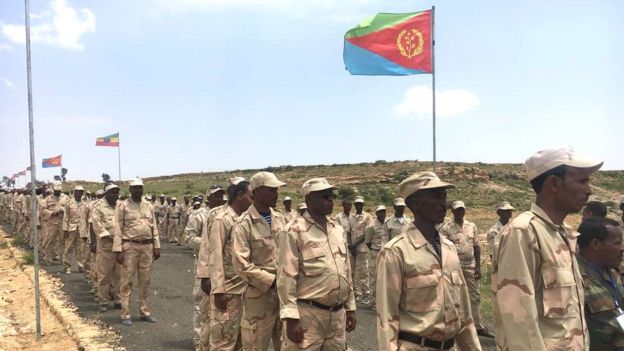
Eritrean troops arrived at the Zalambessa border for the reopening ceremony
In July, Ethiopia's Prime Minister Abiy and Eritrea's President Isaias signed a declaration saying that the state of war between the two countries was over.
Since then, phone calls and flights between the two countries resumed, and last week a ship registered in Ethiopia arrived in an Eritrean port.
The two countries have also reopened their embassies in each others' capital cities.
What will happen at other border crossings?
For now, only the land crossings at Zalambessa and Burre have reopened. The details about other parts of the 1,000km (620 miles) border still need to be worked out.
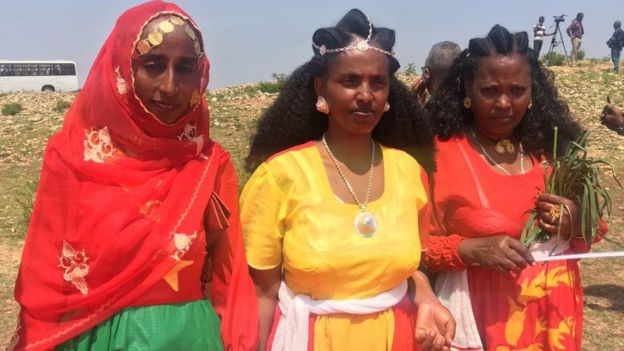
There is a lot of hope that the Ethiopia-Eritrea rapprochement can change the whole region
The town of Badme, the flashpoint for the 1998-2000 conflict, was ruled to be in Eritrea by the border commission set up by the Algiers peace agreement.
But until recently Ethiopia, which still administers Badme, refused to accept this. That changed when the two leaders met, but the town has not yet been handed to Eritrea.
What happened to Zalambessa during the war?
The border town was one of the main theatres of the conflict.
During the two-year war, Zalambessa was occupied by Eritrean forces and, in the fighting, much of it was destroyed.
But Eritrea has never contested that it is part of Ethiopia and its status is not controversial.

Eritrea's President Isaias Afwerki (l) and Ethiopia's Prime Minister Abiy Ahmed met ahead of the reopening of the border
What other changes have happened in the region?
The rivalry affected the whole region, with Ethiopia and Eritrea normally taking opposite positions whatever the question.
They took rival sides in Somalia's long conflict - Eritrea was accused of backing Islamist groups, while Ethiopia, a US ally, supported the internationally recognised government.
That is now changing and last week Ethiopia, Eritrea and Somalia signed a cooperation agreement to restore peace and stability to the region.
Eritrea and Djibouti also agreed to normalise relations after a dispute over their border had threatened to break out into war.
Latest Stories
-
Trapped miner rescued from flooded Mexican tunnel after 14 days
5 minutes -
NPRA to prosecute employers over unpaid Tier 2 Pension contributions — Deputy CEO warns
11 minutes -
ACCPA calls for Africa’s strategic repositioning at NUS, Singapore
19 minutes -
Oil prices rise as concerns grow over ‘fragile’ US-Iran ceasefire
22 minutes -
NPP revises internal election guidelines to strengthen transparency and inclusiveness
1 hour -
NACOC set to issue licences to qualified applicants for cannabis cultivation – Deputy Director-General
1 hour -
Easter Outreach: Victory Bible Church offers free healthcare, NHIS support to hundreds
1 hour -
NPP cannot pressure Mahama to sign a bill not yet received—Solomon Owusu
2 hours -
MPs, institutions deepen support for Ghana Sports Fund with fresh contributions
2 hours -
Four people die trying to board boat in Channel crossing attempt
2 hours -
Abirem MP announces GH₵500,000 education fund to support needy students
2 hours -
African stakeholders call for stronger ‘One Health’ action on climate and health crises
2 hours -
DVLA to commission 5 new service centres in Greater Accra
2 hours -
Agenda 111 and the right to health: A broken social contract
2 hours -
Bawa-Rock Ltd funds GH¢400,000 free surgeries for 102 vulnerable patients
2 hours