

Audio By Carbonatix
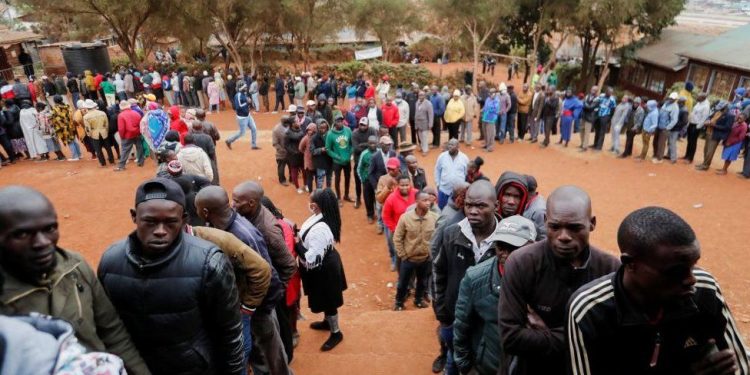
Kenyans are choosing their next president after an intense campaign dominated by debates about living costs, unemployment and corruption.
Outgoing President Uhuru Kenyatta, having served the constitutionally limited two terms, is backing one-time foe Raila Odinga, 77, to succeed him.
His decision followed a falling out with Deputy President William Ruto, 55, who had expected to be endorsed.
More than 22 million Kenyans have registered to vote.
There are several other elections happening at the same time and a mix-up of ballot papers in some areas for some of those votes has again raised questions about the organisation of the general election.
Polls are open for 11 hours from 06:00 local time (03:00 GMT). Anyone still in the queue at closing time will be allowed to vote.
The results of the last presidential election in 2017 were annulled after the Supreme Court ruled that the electoral commission had not followed the law when it came to the electronic transmission of the vote tallies from the polling stations.
Judges ruled that “illegalities and irregularities” had taken place.
A re-run was won by Mr Kenyatta, but boycotted by Mr Odinga – the main opposition candidate at the time.
The chairman of the electoral commission, Wafula Chebukati, who was also in charge of the 2017 vote, has frequently tried to reassure Kenyans that his team will be up to the task this time.
But Monday’s logistical problems have increased the pressure on him.
Baba v Hustler
This election looks like it will be a tight race between frontrunners Mr Odinga and Mr Ruto.
Mr Odinga – a long-serving opposition leader, nicknamed Baba (“father”) by his supporters, is running for president for a fifth time.
Mr Ruto, who has tried to emphasise his connection with ordinary Kenyans by calling himself a “hustler”, will be taking his first stab at the presidency.
Two other candidates – David Mwaure and George Wajackoya – are also in the race.
Despite the campaign being dominated by issues, ethnic loyalty may also play a part in determining how people vote.
For the first time in the multi-party era none of the main candidates are from the country’s largest ethnic group – Kikuyu.
But knowing that those votes are vital, both have chosen Kikuyu running mates.
Voting process
To win the presidential race in the first round, a candidate needs:
- more than half of all the votes cast across the country
- at least 25% of the votes cast in a minimum of 24 counties.
Voters will also be choosing MPs and senators to go to the national parliament, county governors and county assembly members, as well as 47 women’s representatives to sit in the National Assembly.
On election day, voters will have their fingerprint scanned to check their identity but a printed register can also be used if the machines fail.
Each voter will then be given colour-coded ballot papers for each of the elections, which they will mark in a private booth and drop in the relevant ballot boxes.
Counting will start at the polling stations shortly after voting ends. Officials will then take a photo of the final tally and send the image to both the constituency and national tallying centres.
To ensure transparency the media, political parties and civil society groups have been urged to run their own tallies using final results declared at the more than 40,000 polling stations.
But only the electoral commission can declare the winner of the presidential election after verifying the physical and digital forms sent to the national tallying centre.
The main presidential candidates have vowed to respect the result of the elections.
Latest Stories
-
CGI orders motorbike training at tactical school in Kyebi
15 minutes -
Sachet water producers in Berekum defy gov’t directives, increase prices
16 minutes -
Critical commodities stuck at port, CSOs warn of family planning crisis
18 minutes -
Gender Ministry mourns victims of Volta Lake boat tragedy, deploys support for affected families
21 minutes -
MPs undergo training on human trafficking and gender dimensions
21 minutes -
Don’t expect instant relief – COMAC CEO warns fuel price drops will be gradual
24 minutes -
GIS to unveil comprehensive plans to enhance officers’ welfare and infrastructure
41 minutes -
Right move, wrong timing? – COMAC CEO questions govt’s delay on fuel price relief
42 minutes -
IMF urges Central Banks to keep inflation in check
1 hour -
NRSA stands firm on Toyota Voxy ban despite transport operators’ opposition
1 hour -
H. Kwasi Prempeh raises concerns over Supreme Court’s handling of OSP constitutionality case
1 hour -
Global childhood cancer cases soar
1 hour -
Airline pilots fear retribution over refusing to fly in Middle East, aviators’ group says
1 hour -
Police intensify security in Bosomtwe communities after deadly clash
1 hour -
Corporate Income Tax contributes highest to 2025 petroleum revenue
1 hour