


Audio By Carbonatix
Kenya's government has ordered the closure of 13 money transfer firms to prevent militant Islamists from using them to finance attacks, the interior minister has told the BBC.
The bank accounts of 86 individuals and "entities" had also been frozen, Joseph Nkaissery added.
Those targeted are believed to include a Somali-linked bus company and hotel.
An assault by the Somalia-headquartered al-Shabab group killed 148 people at Kenya's Garissa University last week.
Kenyan officials have repeatedly accused Somalis in the country of colluding with the militants.
Nearly 500,000 refugees are in the country - many of whom fled decades of conflict and drought in Somalia.
'Lifeline for Somalis'
Kenya also has its own Somali population - most of whom live in the capital, Nairobi, and in the north-east, where the university attack took place.
Somalis say most of them are law-abiding citizens of Kenya, and they have also bore the brunt of al-Shabab's insurgency.
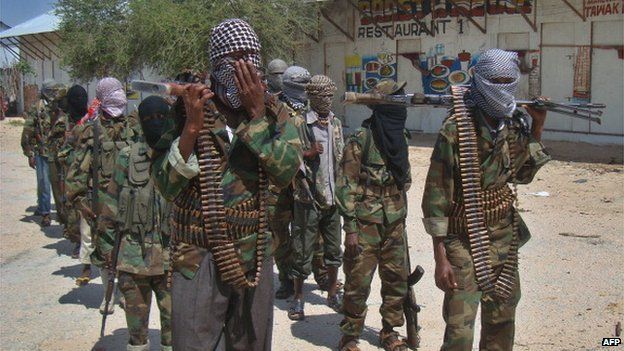
Al-Shabab carried out its bloodiest attack in Kenya at the university in Garissa
They have condemned the government's crackdown as "blanket punishment" of the community.
BBC Africa's Abdullahi Abdi in Nairobi says a leaked document shows that hotel and transport companies, as well as Muslim clerics and human rights organisations, risk having their bank accounts frozen.
Somalis around the world rely heavily on the informal money transfer firms, known as "hawalas", to do business and to send cash to relatives because of the almost non-existent banking sector in Somalia.
There have been a similar crackdown on the companies in the UK and US.
A spokesman for the Somali money transfer agencies in Kenya, Abdi Ali, told the BBC they would oppose moves to shut them down.
"To us, it is only a ministerial directive which is sent to the central bank. We will talk to the Kenyan government about this issue and use its justice system to settle matter," he said.
The United Nations estimates Somalis in the diaspora send home about $1.6bn (£1.1bn) annually, significantly more than foreign aid.
More than 40% of Somalis receive remittances, the bulk of which are used for basic needs, including food, clothes, medicine and education, according to a UN survey.
Somalia has not had a functioning government since the fall of Siad Barre's government in 1991, and has been hit by religious and clan conflicts.
Latest Stories
-
Ghana’s oil production hits 694 million barrels since 2010 – PIAC report
5 minutes -
Ghana records 7.5% economic growth in January 2026, services sector leads expansion
9 minutes -
One-cedi levy essential to keep power sector afloat- Ben Boakye
10 minutes -
Nii Noi marks Easter with donation of medical equipment to Taifa Polyclinic
11 minutes -
Police arrest man over viral video that sparked public fear
12 minutes -
Tamale water crisis a “major headache”, but government will fix it — Haruna Iddrisu
14 minutes -
Finance Ministry directed SOEs to do business with SIC but order was verbal, says SIC Life MD
15 minutes -
Cabinet to decide on fuel measures amid rising prices – Edudzi Tameklo
18 minutes -
Minority considers petition to Asantehene over cocoa price cuts
20 minutes -
Insurance Brokers join IMANI petition to end political interference in state insurance placements
22 minutes -
Road fatalities surge in 2026 despite intensified safety efforts—NRSA
24 minutes -
Police launch manhunt over gunshots, clashes at Kotoku Onion Market
24 minutes -
IGP’s Special Operations Team gets new leadership
34 minutes -
FoSCeL to hold National World Sickle Cell Awareness Day 2026 event at KNUST
35 minutes -
Ghana earns nearly $12bn from petroleum sector since 2011
39 minutes