


Audio By Carbonatix
In our series of letters from African journalists, media and communication trainer Joseph Warungu looks at a recent court ruling that could end some uncomfortable road trips.We in Kenya have discovered that we have a constitutional right to relieve ourselves in public, at the expense of the government.Here's how.Travelling to and from distant places by road in Kenya, is not something many people look forward to.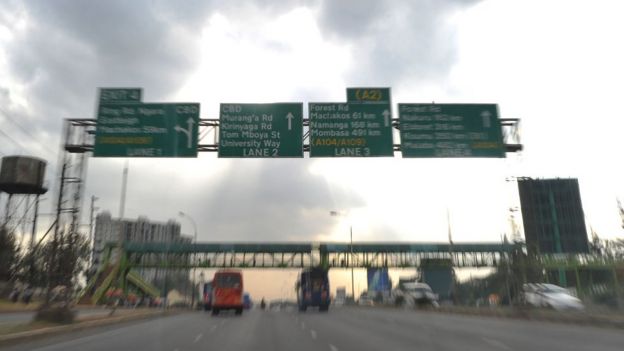 But where are the signs for the toilet?The biggest challenge is to arrive alive at your destination. Over 3,400 people died on Kenyan roads last year, an increase of 13% from 2018.The main causes are speeding, drunk driving and fatigue.If you avoid death or serious injury, you still may not escape the discomfort of the terrible roads.Although there's been a lot of improvement of Kenya's infrastructure in recent years, some of the roads are in poor shape and become unusable during rainy season.As a former British colony, we drive on the left in Kenya, but people are often forced to drive on whatever's left of the roads due to the numerous potholes which scar many roads, including the central business district of the capital Nairobi.However, there's another reason that makes long-distance road travel a nightmare - toilets.When you're squashed in a packed bus, and the call of nature comes, you're in deep trouble.That's because when the authorities built these highways, they did not include public toilets along the way.So, in these instances, drivers stop in the middle of nowhere, and as soon as the door is opened, people dash in different directions, in search of the nearest bush to relieve themselves.
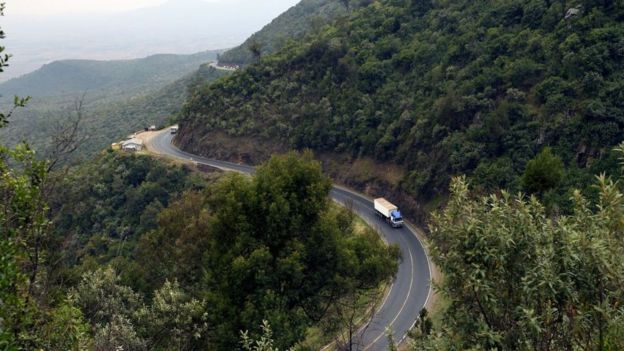 It is not always safe for passengers to relieve themselves by the roadsideIt makes for a disturbing picture of men, women and children forced into a communal squat position.All shame is lost as the multitude that was in a bus focuses on one grave priority - emptying bladders and bowels.
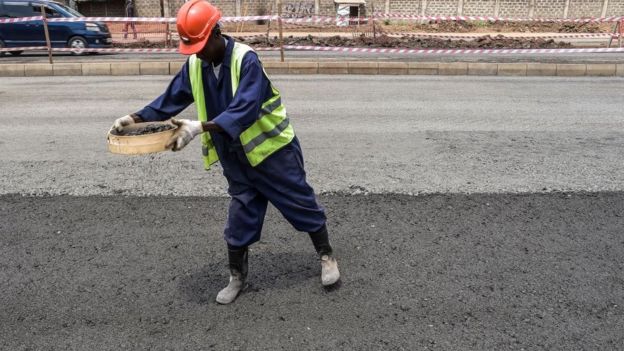 Lots of new roads have been built in Kenya, now toilets will have to be added tooBut now help has come through the actions of one man who went to court to compel the government to bring an end to this kind of suffering.Adrian Kamotho Njenga sued four public entities arguing they had breached the constitution by failing to provide free toilet facilities along public highways.The four bodies - the Council of Governors, which brings together the governors of all 47 counties, the Kenya National Highways Authority, the Kenya Rural Roads Authority and the Kenya Urban Roads Authority - all rejected the accusation and turned to a blame game.Some said Mr Njenga had not shown details of how exactly they had violated the constitution regarding public toilets. Others argued that they do not have a constitutional mandate to provide sanitation services.But like an impatient man pressed by the call of nature, Mr Njenga continued to push for a solution from the court.He argued that as a result of the failures of the public entities, road users on public highways had no way of disposing of human waste flowing from human biological functions, and end up relieving themselves in bushes and on the roadside, which is inhuman and degrading.
But where are the signs for the toilet?The biggest challenge is to arrive alive at your destination. Over 3,400 people died on Kenyan roads last year, an increase of 13% from 2018.The main causes are speeding, drunk driving and fatigue.If you avoid death or serious injury, you still may not escape the discomfort of the terrible roads.Although there's been a lot of improvement of Kenya's infrastructure in recent years, some of the roads are in poor shape and become unusable during rainy season.As a former British colony, we drive on the left in Kenya, but people are often forced to drive on whatever's left of the roads due to the numerous potholes which scar many roads, including the central business district of the capital Nairobi.However, there's another reason that makes long-distance road travel a nightmare - toilets.When you're squashed in a packed bus, and the call of nature comes, you're in deep trouble.That's because when the authorities built these highways, they did not include public toilets along the way.So, in these instances, drivers stop in the middle of nowhere, and as soon as the door is opened, people dash in different directions, in search of the nearest bush to relieve themselves.
It is not always safe for passengers to relieve themselves by the roadsideIt makes for a disturbing picture of men, women and children forced into a communal squat position.All shame is lost as the multitude that was in a bus focuses on one grave priority - emptying bladders and bowels.'Unfortunate meal'
Some students I mentor from a college in the coastal region of Mombasa told me how they recently went on a trip to central Kenya, a distance of about 700km (435 miles).Before leaving Mombasa, they had a meal, which unfortunately upset their stomachs."With no toilets along the way, our bus driver was forced to make several stops near bushes and forests for us to attend to the upheavals in our tummies," explained one of the students. "It was the most uncomfortable 10-hour journey I'd ever had".
Lots of new roads have been built in Kenya, now toilets will have to be added tooBut now help has come through the actions of one man who went to court to compel the government to bring an end to this kind of suffering.Adrian Kamotho Njenga sued four public entities arguing they had breached the constitution by failing to provide free toilet facilities along public highways.The four bodies - the Council of Governors, which brings together the governors of all 47 counties, the Kenya National Highways Authority, the Kenya Rural Roads Authority and the Kenya Urban Roads Authority - all rejected the accusation and turned to a blame game.Some said Mr Njenga had not shown details of how exactly they had violated the constitution regarding public toilets. Others argued that they do not have a constitutional mandate to provide sanitation services.But like an impatient man pressed by the call of nature, Mr Njenga continued to push for a solution from the court.He argued that as a result of the failures of the public entities, road users on public highways had no way of disposing of human waste flowing from human biological functions, and end up relieving themselves in bushes and on the roadside, which is inhuman and degrading.No toilets = torture
He even quoted from the Bible's fifth book, Deuteronomy, in which Moses commands the Israelites who were travelling to the promised land, to designate a place outside their camp where they could go to relieve themselves.And just in case the court was not persuaded to rely on the Bible as an authority in determining a constitutional matter, Mr Njenga explained the lack of toilets was subjecting commuters to suffer "immense biological, metabolical and physiological torture, when faced with a call of nature while travelling on Kenyan roads".Now these are words I don't think about when answering the call of nature, myself.But they sound quite serious, and in the end the judge agreed with Mr Njenga, and instructed the authorities concerned to create and implement a policy for the provision of toilets and other sanitation facilities along the Kenyan road network.So, we're all looking forward to the day when as commuters, we'll stop hopping about in the bushes to avoid stepping on human mess in the search for a clear spot, to bring relief to our bodies.For now, in the absence of the "constitutional" toilets, the beautiful wildlife that can be seen near the roads from Nairobi to Kisumu in the west, or to Mombasa at the coast, will continue to witness some ugly scenes as humans invade their space to dispose of their waste.DISCLAIMER: The Views, Comments, Opinions, Contributions and Statements made by Readers and Contributors on this platform do not necessarily represent the views or policy of Multimedia Group Limited.
DISCLAIMER: The Views, Comments, Opinions, Contributions and Statements made by Readers and Contributors on this platform do not necessarily represent the views or policy of Multimedia Group Limited.
Latest Stories
-
Meet us halfway – Trade Minister tasks private sector with AfCFTA success
2 hours -
After more than 14 years at Atletico Madrid, what next for Simeone?
2 hours -
Conquering the World – Building on the foundations laid by Otto Addo
2 hours -
[Watch Live] Kwaw Kese, Kwami Eugene, Tinny, Keche and others thrill fans at Gomoa Easter Carnival
3 hours -
Gomoa Easter Carnival: Experts charge indigenes to own festival to ensure sustainability
4 hours -
Gomoa Easter Carnival: Edem Agbana and Joy Prime fans shower festival with huge endorsements
5 hours -
Gathering of Royals 2026: Empowering women, boosting tomato production
6 hours -
Gov’t to overhaul free zones into manufacturing hubs for local production – Trade Minister
6 hours -
Ghana losing $2.5bn yearly from raw exports – Trade Minister reveals
6 hours -
Mahama unveils plans for Kwahu Airport, Convention Centre
6 hours -
World’s oldest leader, Paul Biya to get a deputy for first time in 43-year rule
7 hours -
Search for missing US airman continues as Trump threatens ‘hell’ if Iran does not reach deal
7 hours -
US says it has arrested relatives of late Iranian general Qasem Soleimani
7 hours -
La Liga: Real Madrid’s title hopes hang in the balance as Mallorca snatch stoppage-time winner
7 hours -
FA Cup: Haaland hat-trick powers Man City past Liverpool into semi-finals
7 hours