

Audio By Carbonatix
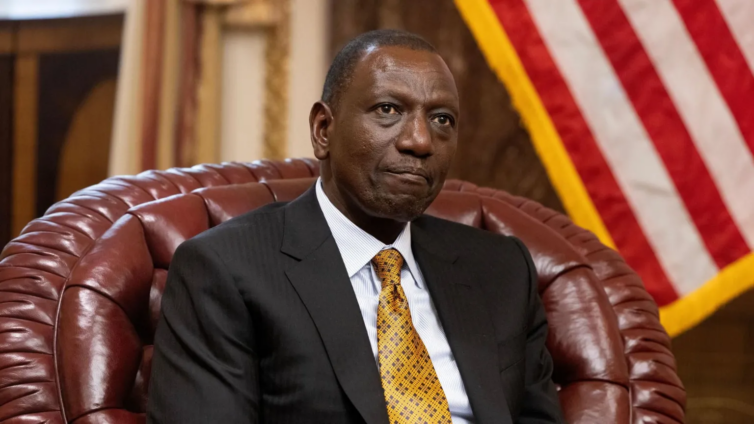
After a day of protest, turmoil and bloodshed, Kenyan President William Ruto addressed the nation with a message of sadness and strength.
Saying "legitimate" protests against his policies had been "hijacked by a group of organised criminals," he warned his government would use all means at its disposal to prevent a repeat of the violence – "at whatever cost".
"Today's events mark a critical point on how we respond to threats to our peace," he said. "We will ensure a situation of this nature does not recur again."
The president’s message was an attempt to seize back control after days of street protests which have grown in strength and number. On Tuesday, they escalated with at least five people shot dead and hundreds injured.
But in the longer term some around Mr Ruto must fear that things might not be so simple, and that the prospect of tough choices remain.
Elected in 2022 pledging to cut corruption, shore up the country's faltering economy and help the poor, the embattled Mr Ruto now faces an unprecedented rebellion against a bill he says he is an essential part of his plan to build the nation.
It might be easier to know which way to turn if the opposition Mr Ruto faces were confined within parliament.
An astute political player, deputy president for almost a decade before being elected to the top spot, Mr Ruto has years of experience wrangling politics to get things done.
Now though, the forces massed against him are something truly beyond his control.
A movement which grew organically out of discontent expressed on social media has grown into a powerful rebellion which has filled the streets of towns across the country.
In the capital, the Nairobi governor's office, city hall and the country's parliament were this afternoon all set ablaze.
The protestors had started the day threatening a "total shutdown".
And at the end of a day of chaos and panic across the country, often set against the sound of teargas and at times live fire from police, there is no doubt their fury has been heard.
In response, Mr Ruto has chosen not to yield to the demands of the demonstrators by abandoning his budget – but has pushed back against them in an effort to calm the country.
Some in his government might wonder whether that position can hold, and where it leaves his controversial finance bill in the longer term.
Mr Ruto has argued the raft of new taxes are essential to control Kenya's debt - a huge sum of more than $80bn (£63bn), which costs the country more than half of its annual tax revenues to service
Kenya secured a restructuring of its international debt commitments earlier this year – something which immediately pushed a surge in the value of its currency.
Increasingly seen as one of Africa’s leading statesmen, recently returned from a state visit to the White House, Mr Ruto understands the importance to his nation’s economy of avoiding a default on its debt payments.
For those in his government the calculation was that controlling the state finances by increasing the tax burden was preferable to cutting public services.
The bill, due to become law next Monday, originally brought in dozens of new or increased taxes on everything from car ownership and financial transactions to sanitary pads.
Several of the most contentious taxes have already been dropped following consultation with the public.
But the controversy over the budget follows other revenue-raising measures introduced by Mr Ruto, including increased taxes for healthcare and low-cost housing.
And for those on the street, there's a third solution available to the government beyond cutting services or raising taxes.
Many blame the country’s financial woes on corruption, with taxpayers wary of paying more amidst a lack of trust over the transparency of the state.
For Mr Ruto it is perhaps the shadows of this past that make his current position so difficult.
He may be a new president, and with a focus on green energy and tech he’s certainly got new ideas about where he wants to take Kenya.
But for many on the streets, Mr Ruto’s record as a senior figure in government over a period marred by corruption means it’s hard to trust him with their taxes.
Today’s events in Nairobi leave Mr Ruto seemingly pinned now into a tight corner.
Facing condemnation for what many Kenyans see as a heavy-handed response to protests in the street, he has chosen to take on directly those he blames for letting the demonstrations spiral out of control.
But few of those who came out to have their voices heard in Nairobi and across the country show any sign of giving up.
When Mr Ruto addressed the nation in his inauguration speech last year, he spoke directly to the country’s politically active youth.
“My political journey,” he told them, “similarly began as a young campaign volunteer, fresh out of university."
“Your experience and lessons learnt should form the basis for your leadership journey.”
Now it is a confrontation with a youth-led movement that poses what many consider to the be biggest challenge to authority in Kenya since the country’s independence in 1963.
The next days for Mr Ruto will be crucial, with a showdown likely to continue between his government and many of its people.
Latest Stories
-
We can tackle multiple priorities – Sam George defends Anti-LGBTQ Bill push
18 minutes -
Statement: Ghana Chamber of Mines’ Response to Claims in Joe Jackson’s “Ananse Stories about the Economy of Ghana”
20 minutes -
GES opens 2026 teacher recruitment for licensed B.Ed graduates
22 minutes -
Ghana must value skilled trades, build resilient learners — Ibn Chambas
30 minutes -
Ghana must rethink education around relevance, resilience and responsibility — Ibn Chambas
33 minutes -
Prince Harry faces defamation lawsuit from charity he co-founded
35 minutes -
South Korea deploys thermal cameras to track escaped zoo wolf
37 minutes -
Calls for royal meeting with Epstein survivors grow ahead of US visit
40 minutes -
Ibn Chambas advocates blend of technology and human values in education
42 minutes -
UMA improves healthcare access in Asutifi North with GH₵700k ‘Kim Taylor Legacy’ Walkway
46 minutes -
Scholarships Authority and Fanaka University offer sponsorship for procurement and supply chain studies
50 minutes -
Bisa Kdei drops new single ‘Go N Look’ featuring Medikal
56 minutes -
Benin facing rising terrorism in north as French military presence faces growing criticism
57 minutes -
UEW Public Lecture Series 2026: Education debate ‘about the soul of Ghana’s future’ — Dr Ibn Chambas
58 minutes -
EU fingerprint and photo travel rules come into force from today
1 hour