


Audio By Carbonatix
Archbishop Ndingi Mwana a'Nzeki, who is being buried on Tuesday following his death at the age of 89, admitted to telling one lie in his long and colourful life as a cleric who campaigned for justice and peace in Kenya.
It was when he helped Nobel Peace laureate Prof Wangari Maathai evade the security forces during a brutal government crackdown on human rights activists in the early 1990s.
Archbishop Mwana a'Nzeki was part of the plan which saw Prof Maathai disguise herself as a sick Muslim Somali woman, before being driven some 200km (125 miles) through several security force checkpoints to his home in Nakuru town in Kenya's famous Rift Valley region.
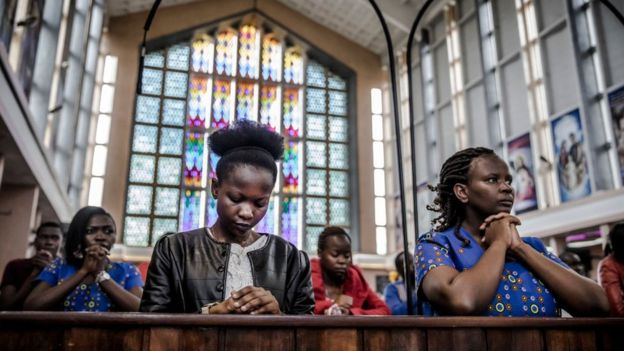
Prof Maathai, a prominent human rights and environmental campaigner, wore the Muslim hijab, and stared blankly at security officers after her driver - a priest - was forced to stop at a roadblock.
"Is she sick?" the officers asked. The priest replied in the affirmative, and the officer allowed them to drive on.
Prof Maathai then emerged alongside the archbishop to address a meeting the next day.
'You die only once'
The authorities blocked it from going ahead but the archbishop was undeterred - their political guile and defiance had gained huge publicity, to the embarrassment of then-President Daniel arap Moi's government.
Bishop Maurice Crowley, who knew the cleric for 40 years, remembers him as a man "who took on the powerful people of the earth, fearlessly and without rancour".
"He always remained friends with those who he would have regarded as doing wrong in order to correct them, and people listened to him," Bishop Crowley adds.
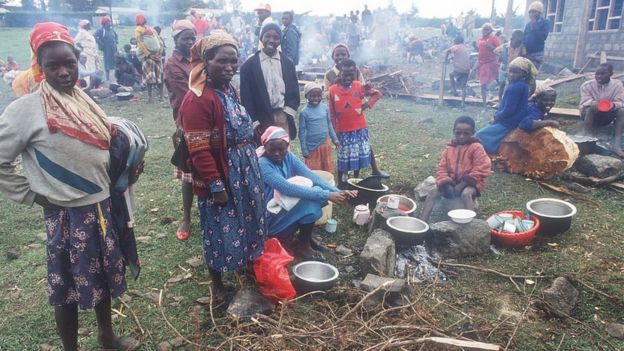
To his followers, Archbishop Mwana a'Nzeki will be most remembered for the help he gave them when ethnic violence swept through the Rift Valley in the early 1990s.
Tens of thousands of people were displaced, and he hired lorries to take them to churches where they were given refuge.
Archbishop Mwana a'Nzeki remained outspoken, accusing the-then ruling party, Kanu, of fuelling the violence in an attempt to drive out opposition supporters and retain its grip on power.
"I have information that youths are being trained to cause mayhem and eject anti-Kanu supporters... The government must uphold the constitution by providing security," he once said at a church service.
His friends warned him that he risked death, but he brushed aside their concerns by saying: "You die only once."
In an interview in 2000, Archbishop Mwana a'Nzeki said that was the most difficult period in his life.
"I saw innocent people being persecuted… and killed. Houses were burnt while people denounced the comments I made," he said.
Other than his credentials as a fighter for justice and peace, Archbishop Mwana a'Nzeki also championed African culture and customs within the Catholic Church.
He often wore a distinctive cap that had been given to him by an Ethiopian colleague. Its appearance was unlike the skullcap normally worn by Catholic bishops.
Father Lawrence Njoroge, who worked with him, says the bishop enjoyed "African and classical music, with a special liking for Fadhili William, Fundi Konde, W Amadeus Mozart and Ludwig van Beethoven".
Controversy over condoms
Archbishop Mwana a'Nzeki advocated for African customary marriages to be recognised by the Catholic Church.
"Many of our Christian faithful have finalised their marriage according to the African customs of their own tribe but for different reasons they have not yet come to the Church for sacramental marriage.
"In the meantime, they are considered by the Church to be living in concubinage because their traditional marriage has no canonical value," he said in a paper published in 1994.
Despite his best efforts to bring about change, Archbishop Mwana a'Nzeki failed to forge consensus around the issue, leaving many African Catholics to live, in the view of their Church, in sin.
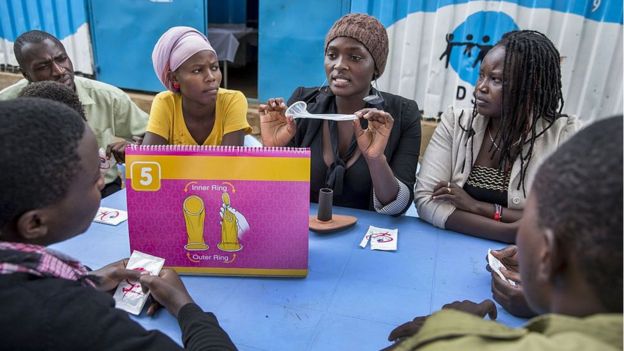
Archbishop Ndingi was also known for his strong opposition to the use of condoms, despite the World Health Organization (WHO) encouraging the use of contraceptives to tackle the HIV/Aids pandemic.
"Aids... has grown so fast because of the availability of condoms," he told his congregation in 2003, causing an outcry among activists who said they had been prevented from distributing condoms because of the Church's opposition.
Archbishop Mwana a'Nzeki, born on Christmas Day in 1931, was the lastborn of a family of five children. He was ordained as a priest in 1961, serving the Church until his retirement in 2007.
He died on 30 March of health complications related to old age, and will be buried at the crypt in Nairobi's Holy Family Minor Basilica.
He celebrated mass at the basilica, but it is now shut because of the coronavirus outbreak.
With the funeral restricted to 100 people, his tens of thousands of followers will have no choice but to follow proceedings on television.
The Kenya Conference of Catholic Bishops (KCCB) has promised them that the archbishop will still receive a "befitting church send-off".
Latest Stories
-
Germany suspends military approval for long stays abroad for men under 45
2 minutes -
Liverpool face uphill Champions League task after PSG thrashing in Paris
3 minutes -
‘Ketamine Queen’ sentenced to 15 years in Matthew Perry overdose death
13 minutes -
Atletico Madrid stun 10-man Barcelona to seize Champions League semi-final advantage
47 minutes -
Black Stars coach to be announced by next week – Sports Minister
57 minutes -
Chiefs, queen mothers and principal elders of Odau group denounce ‘rebellious Etweresohene’, pledges allegiance to Okyenhene
1 hour -
KNUST library dress code sparks online backlash over strict rules
1 hour -
Cultural Diplomacy in Action: Ghanaian youth leaders present symbolic smock to U.S. Chargé d’Affaires
1 hour -
Ghana Card payment activation under review – NIA breaks silence on financial integration
2 hours -
Ofori-Atta’s ICE release on bail positive; he poses no risk – Amanda Clinton
2 hours -
Ken Ofori-Atta’s passport seized after bail, set to reappear in US Court on April 27
2 hours -
Stuck contraceptives risk HIV surge – Ghana HIV/AIDS Network President warns
2 hours -
Edmond Boateng elected Secretary of Honorary Consular Corps of Ghana
2 hours -
Omanhene Kwabena Asante slams GIADEC CEO over alleged discrimination in mining concessions
3 hours -
Majority of Ghanaian importers lack awareness of cargo insurance – Gyampo
3 hours