

Audio By Carbonatix
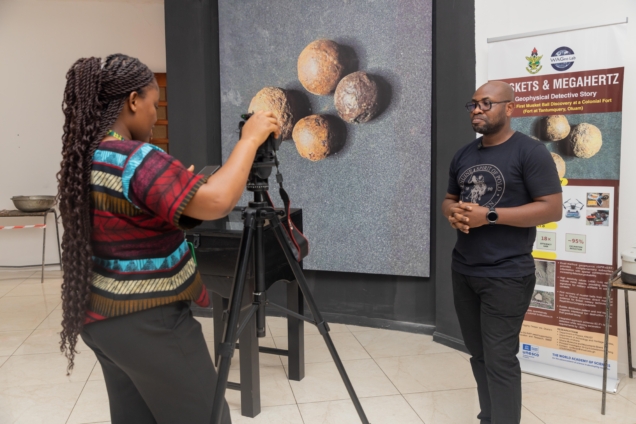
Researchers at the Kwame Nkrumah University of Science and Technology, Kumasi (KNUST) have recovered what they describe as Ghana’s first musket balls discovered at a colonial fort by Ghanaian scientists, marking a milestone in the country’s archaeological research.
The 18th-century musket balls each measuring about 1.8 centimetres in diameter were unearthed at Fort Tantumquery in Otuam in the Central Region using a combination of drone mapping, Ground Penetrating Radar and Electrical Resistivity Tomography.
The research team says the integrated approach achieved an 83.3% feature-detection accuracy rate while reducing excavation work by 95% compared with conventional methods a significant gain in efficiency.
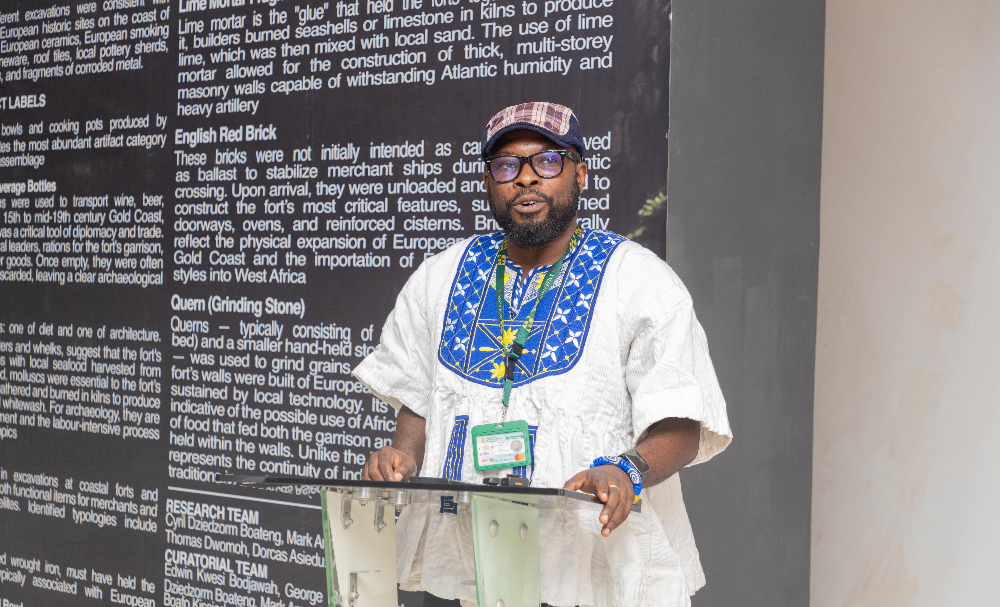
“This represents a major shift in how we investigate heritage sites in Ghana,” said Dr. Cyril Dziedzorm Boateng, Principal Investigator and Head of the West Africa Geophysics Lab at KNUST’s Department of Physics. “We have demonstrated that advanced geophysical technology can work effectively in our local soil conditions, allowing us to uncover history without disturbing the site unnecessarily.”
Fort Tantumquery was established in the 1720s by the Royal African Company as part of a network of coastal forts linked to trade and the transatlantic slave trade.
The recovered musket balls provide physical evidence of the fort’s military activity and are believed to be the first of their kind documented at any of Ghana’s colonial forts.
“Only a few of our coastal forts have been studied with modern scientific methods,” Dr. Cyril Boateng added. “This work shows how innovation can help us document heritage before it is lost to natural erosion or development.”
The project was funded through the SG-NAPI award supported by the German Ministry of Education and Research (BMBF) through UNESCO-TWAS.
It brought together KNUST’s Department of Physics, the University of Ghana’s Department of Archaeology and Heritage Studies, and the Ghana Museums and Monuments Board.
Speaking on behalf of the Pro-Vice Chancellor, Professor Samuel Asare-Nkansah, Dean of the Faculty of Pharmacy and Pharmaceutical Sciences, said, “This project demonstrates what is possible when institutions move beyond territorial thinking and commit to a shared purpose. It validates KNUST’s vision of combining science, heritage, and innovation to produce research with real impact.”
Dr. Samuel Nilirmi Nkumbaan, Head of the Department of Archaeology and Heritage Studies at the University of Ghana, emphasized the collaborative and public-facing nature of the project. “By integrating geophysics with archaeology, we are creating new ways for students, researchers, and the public to explore Ghana’s history while preserving its cultural sites,” he said.
The breakthrough could transform how archaeological investigations are conducted in Ghana and across West Africa allowing for smarter, less invasive excavation while preserving fragile heritage sites for future generations.
The findings are being showcased in an exhibition titled “Muskets and Megahertz: A Geophysical Detective Story” at the KNUST Museum (Opoku Ware II Museum).
The exhibition, which opened on February 26 and runs until March 31, features the musket balls, photographs of recovered artefacts, and explanations of the technology used. Admission is free.
Latest Stories
-
A-Plus backs Mahama’s leadership but rejects NDC label
26 minutes -
Ghanaian women divided over natural and permed hair choices
29 minutes -
Supreme Court to launch month-long 150th anniversary events
29 minutes -
Volta chiefs condemn EOCO over alleged disregard for court ruling in Kwamigah-Atokple case
30 minutes -
Ghana steps up fight against banana, plantain diseases
32 minutes -
Women farmers need tailored pensions – Zanetor
36 minutes -
MP, MCE provide street bulbs and solar panels to lighten Evaloe Adjomoro-Gwira constituency
37 minutes -
ECG upgrades infrastructure, assures reliable, stable power supply
39 minutes -
Aggrieved cocoa farmers urge Parliament intervention
44 minutes -
Ghana launches first maternal mental health policy
47 minutes -
Mahama issues three calls to action at One Health Summit
52 minutes -
KNUST secures $2.3m funding for research activities
56 minutes -
Ayigboe residents fear disaster as ECG delays repairs on live faulty cables
1 hour -
PIAC urges investment as oil production falls
1 hour -
World Bank projects 4.8% growth for Ghana, 9% inflation by end-2026
1 hour