

Audio By Carbonatix
An economist at the Kwame Nkrumah University of Science and Technology (KNUST), Kumasi Prof. Mohammed Hadrat Yusif, has called for sweeping reforms to Ghana’s monetary policy framework, including granting operational independence to the Bank of Ghana (BoG).
According to him, such reforms are essential to restoring macroeconomic stability and supporting long-term national development.
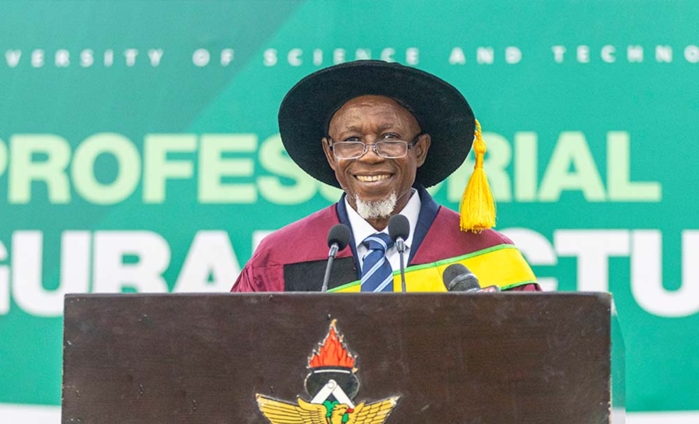
Delivering his Professorial Inaugural Lecture, Prof. Yusif examined Ghana’s monetary policy history and its persistent structural weaknesses.
The lecture, titled “Monetary Policy in Ghana: Revisiting the Tobin’s Model,” traced the economic divergence between Ghana and peer countries like South Korea and Malaysia, nations that were at similar levels of development at independence but have since outpaced Ghana in growth and stability.
“Ghana’s monetary policy has failed. Inflation is high, debt levels are unsustainable, and the infrastructure needed for sustainable development remains inadequate,” he stated.
Prof. Yusif observed that although the BoG was established in 1957 to stabilise prices, manage exchange rates, and control money supply, Ghana continues to face significant economic challenges.
He cited a sharp rise in public debt as evidence of policy failure. Domestic debt as a percentage of GDP, he noted, rose from 35% in 2016 to 90% in 2024, while external debt increased from 20% to 50% in the same period.
In 2024, Ghana’s inflation stood at 22.5%, compared to rates below 2.5% in countries like South Korea, Malaysia, and Singapore.
Prof. Yusif partly blamed the situation on what he described as the Ministry of Finance’s dominance over the central bank, which he argued undermines the BoG’s independence.
“The Bank of Ghana should be allowed to operate free from political interference. Monetary policy must be compatible with the broader macroeconomic goals of the country,” he said.
Among his proposals were a shift from inflation targeting to nominal GDP targeting, a review of the Fiscal Responsibility Act (2018) and the Bank of Ghana Act (2002), and greater investment in research and development.
He also called for deeper collaboration between the BoG and academic institutions such as KNUST to support evidence-based policy making.
Prof. Yusif underscored the importance of public-private partnerships for infrastructure development, responsible gold and cocoa production, and stronger support for small and medium enterprises (SMEs), especially in the context of the Africa Continental Free Trade Area (AfCFTA).
Latest Stories
-
Gender Ministry supports Harriet Amuzu in ongoing abuse case
12 minutes -
AG joins plaintiff to scrap OSP ?: We should be mindful of the mischief in this – Bobby Banson
18 minutes -
Samson Lardy Anyenini questions willingness of Attorneys-General to prosecute political colleagues
20 minutes -
It is only fair the OSP is heard in Supreme Court case – Bobby Banson
26 minutes -
Asiedu Nketia resumes Ashanti tour, second leg kicks off on Sunday
35 minutes -
NLA denies salary cut claims, threatens legal action over reports
39 minutes -
BoG Governor honoured for stabilising cedi, improve inflation
41 minutes -
Kyebi Easter Homecoming 2026: A resounding success!
1 hour -
Trade Minister applauds GUTA as a pillar of economic growth; Prez Mahama honoured
2 hours -
President’s brother’s takeover of Damang Mines is ‘untidy’ – Alhassan Tampuli
2 hours -
It’s not true that gov’t decided not to renew the lease for Gold Fields – Bobby Banson
2 hours -
Ghana to boost tomato production with 60-hectare irrigated farms and processing initiatives
2 hours -
E&P’s takeover process of Damang Mines was very clean – Inusah Fuseini
2 hours -
Damang takeover: There is not going to be any job loss; it is a lease change – Bobby Banson
3 hours -
Gold Fields didn’t stop mining at Damang mines; such claims are untrue – Bobby Banson
3 hours