


Audio By Carbonatix
Lebanon's government stepped down on Monday night, less than a week after a massive explosion in Beirut killed more than 160 people and sparked days of violent protests.
Prime Minister Hassan Diab addressed the nation, announcing his resignation and that of his government in the wake of the blast, which he called a "disaster beyond measure."
In an impassioned speech, Diab berated Lebanon's ruling political elite for fostering what he called "an apparatus of corruption bigger than the state."
"We have fought valiantly and with dignity," he said, referring to members of his cabinet. "Between us and change is big powerful barrier."
Diab compared Tuesday's explosion to an "earthquake that rocked the country" prompting his government to resign. "We have decided to stand with the people," he said.
Three cabinet ministers had already quit, along with seven members of parliament.
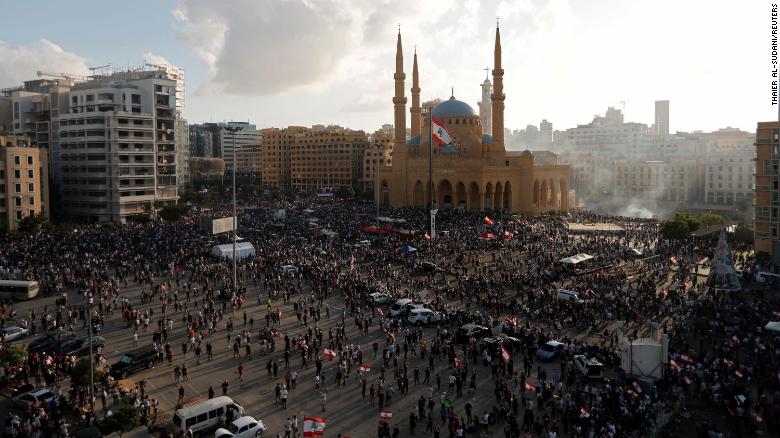
Violent protests erupted outside the prime minister's office in the run-up to the scheduled speech on Monday evening.
Dozens of protesters hurled stones, fireworks and Molotov cocktails at security forces who responded with several rounds of tear gas. Some demonstrators tried to scale the blast walls outside Parliament Square.
Lebanon was already suffering through its worst economic crisis in decades, coupled with rising coronavirus rates, and the government has been plagued by accusations of corruption and gross mismanagement.
Tuesday's blast, which damaged or destroyed much of the Lebanese capital and was linked to a long-neglected stash of potentially explosive chemicals, was the last straw for many Beirut residents.
Diab, a self-styled reformer, was ushered into power last December, two months after a popular uprising brought down the previous government. His government is composed of technocrats and had been supported by major political parties, including the Iran-backed political and militant group Hezbollah.
Now the country will be tasked with finding its third prime minister in less than a year, to contend with the spiralling crises Lebanon faces on a number of fronts.
Lebanon's currency has lost around 70% of its value since anti-government protests began last October. Poverty has soared, with the World Bank projecting that more than half of the country's population would become poor in 2020.
The government had been seen as powerless in the face of a growing banking crisis. The state has not passed a capital controls law, exacerbating the country's severe liquidity crunch.
The majority of people in the country have been subject to stringent and arbitrary cash withdrawal limits for nearly a year. Meanwhile, billions of US dollars are widely believed to have been withdrawn from Lebanon by the country's economic elite, further depleting foreign currency reserves.
Lebanon's financial woes were exacerbated earlier this year by government-imposed lockdowns, designed to stop the spread of the coronavirus pandemic but which also brought the country's ailing economy to a screeching halt.
Diab's ministers had repeatedly accused the ruling class of disrupting their plans for reform.
Politicians aligned with the country's banking elite torpedoed the government's IMF-endorsed economic program, which had been expected to dig into bank profits.
The protests over the weekend were some of the largest and most violent the city has seen in nearly a year. The city convulsed with anger as protesters occupied several government ministries and threw stones and shards of glass at security forces. Police fired hundreds of rounds of tear gas as well rubber bullets and, in some cases, live fire.
United Nations Secretary General Antonio Guterres called for a "credible and transparent" investigation into the explosion.
French President Emmanuel Macron hosted an international donors' conference on Sunday. US President Donald Trump and 15 other heads of state were present, pledging approximately $300 million in aid to Lebanon.
Guterres called on the donors to "give speedily and generously" to help the recovery efforts.
Latest Stories
-
US warns citizens to reconsider Nigeria travel on safety grounds
14 minutes -
Ivan Toney questions refereeing in Saudi Pro League title race after Al-Ahli draw
15 minutes -
Angola appoint Aliou Cissé as new head coach
27 minutes -
Virtual Security Africa showcases digital security vision at Kwahu Business Forum
32 minutes -
EBID strengthens regional integration role amid global economic uncertainty
58 minutes -
Two assault rifles, ammunition retrieved in Police probe of Tamale gang attack
1 hour -
EBID records strong financial growth with $722m disbursements in 2025 – President, Dr George Donkor
1 hour -
EBID to mobilise $2.69bn under new 2026–2030 growth strategy – Dr George Donkor
1 hour -
An open letter to telcos, regulators and security agencies on mobile money fraud in Ghana
1 hour -
Mobile Money Merchants are driving fraud
1 hour -
Alban Bagbin declines minority’s motion to investigate sale of gold reserves at BoG
1 hour -
NACOC leadership tours drug testing centres in Accra
1 hour -
OSP’s power to prosecute without AG’s authorisation unconstitutional – AG files at Supreme Court
1 hour -
Seven African referees selected for World Cup 2026 as Ndala, Issa Sy miss out
2 hours -
Why diaspora investors are using Accra real estate to hedge against global uncertainty in 2026
2 hours