

Audio By Carbonatix
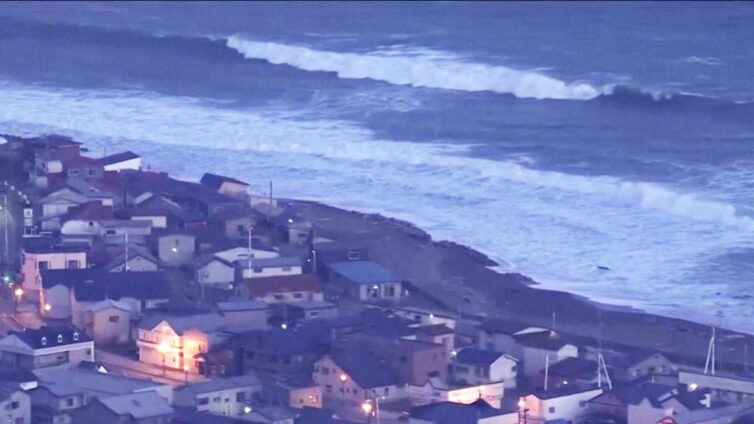
A strong magnitude 7.5 earthquake has struck off northern Japan, prompting authorities to issue a tsunami warning for waves of up to 3 metres (10 feet).
The quake hit on Monday at 4:53pm local time (07:53 GMT) in waters off Iwate prefecture on Japan’s Pacific coast, according to the Japan Meteorological Agency (JMA). It was felt across a wide area, shaking buildings in Tokyo, hundreds of kilometres (miles) to the south.
The JMA warned that the first tsunami waves could reach parts of the northern coastline immediately. “Evacuate immediately from coastal regions and riverside areas to a safer place such as high ground or an evacuation building,” the agency said.
“Tsunami waves are expected to hit repeatedly. Do not leave safe ground until the warning is lifted.”
Live footage from public broadcaster NHK showed no immediate signs of damage at several ports in Iwate.
Prime Minister Sanae Takaichi said the government had set up a crisis management team and was working to assess the impact of the earthquake.
“For those of you who live in areas for which the warnings have been issued, please evacuate to higher, safer places such as higher ground,” Takaichi told reporters.
She added that officials were still trying to confirm whether there had been any casualties or damage to property.
Japan is one of the world’s most earthquake-prone countries, sitting on the Pacific “Ring of Fire”, where several tectonic plates meet. It experiences about 1,500 earthquakes each year and accounts for almost 18 percent of the world’s seismic activity.
Memories remain strong of the devastating magnitude 9 earthquake and tsunami that struck northeastern Japan in 2011, killing about 18,500 people and triggering the Fukushima nuclear disaster.
Authorities have also raised concerns in recent years over the risk of a strong earthquake along the Nankai Trough, an 800km (497-mile) undersea trench south of Japan where the Philippine Sea plate is sliding beneath the continental plate.
The JMA issued rare “megaquake” advisories in 2024 and again in December last year, after strong offshore tremors heightened fears of a future catastrophic event.
Latest Stories
-
Ghana ‘showing up differently’ on global stage – Joyce Bawah Mogtari
16 minutes -
Ghana’s tuna industry in crisis as 20 hook-and-line vessels collapse
56 minutes -
South Tongu MP launches apprenticeship programme for 159 young people
1 hour -
The Pusiga connection behind Gertrude Atongi’s work in New York
2 hours -
Teachers took promotion exams in December to beat government clearance deadline – GNAT
2 hours -
NPA launches 2026 staff welfare week with focus on teamwork and employee wellbeing
2 hours -
Ghana, Saint Kitts and Nevis sign labour deal to strengthen protections for Ghanaian nurses
2 hours -
Delayed promotions put teachers’ retirement benefits at risk – GNAT
2 hours -
No ‘Bawumia candidates’ in NPP executive elections – Anthony Karbo
2 hours -
Over 3,000 displaced as flooding overwhelms Hohoe communities
2 hours -
Sunyani East NPP executives begin reconciliation drive ahead of 2028 polls
2 hours -
Agric Minister engages Ga Mantse on agriculture transformation agenda
2 hours -
Aayalolo expansion targets private car users, not trotro operators – Mahama Ayariga
2 hours -
KNUST, GMTF explore AI partnership to transform healthcare delivery
2 hours -
MTTD records 9,000 preventable crashes, over 900 deaths in eight months
2 hours