

Audio By Carbonatix
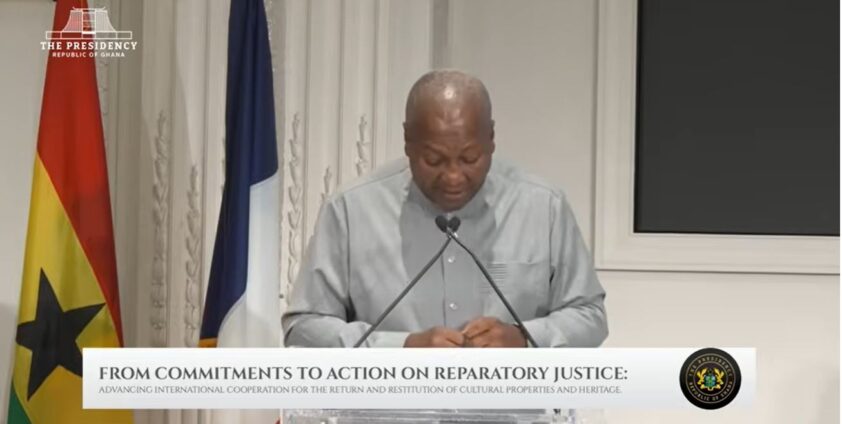
President John Dramani Mahama has outlined three key pillars that Ghana is proposing to advance the global reparatory justice agenda and move from recognition of historical injustices to concrete action.
Speaking at a High-Level Side Event on the Next Steps, hosted on the sidelines of the 81st United Nations General Assembly in New York, President Mahama said the next phase must focus on implementation of the Accra Next Steps Commitments on Reparatory Justice.
He said the commitments provide a blueprint for translating the UN’s recognition of the historical injustices associated with the trafficking and enslavement of Africans into practical measures.
“We must move from acknowledgement to action, from commitments to implementation.”
The first pillar, he said, is the creation of a permanent and institutionalised global system for restitution.
President Mahama called on the United Nations and countries holding African cultural property to establish clear and standardised legal and diplomatic mechanisms to facilitate provenance research, improve access to archives and reduce legal barriers to restitution.
He also called for the unconditional return of human remains as an immediate priority.
The second pillar focuses on building Africa’s capacity to receive, preserve and manage its returning cultural heritage.
President Mahama rejected arguments that restitution should be delayed until African countries develop adequate facilities to preserve the artefacts.
“Capacity constraints must never be used as a justification for continued possession. Capacity must serve as a bridge to return, not a barrier to justice.”
He said Africa was already developing the necessary infrastructure through initiatives including the African Union’s Great African Museum and the AU-EU Museum Partnership.
The third pillar is to position cultural heritage as an engine of economic and social development.
President Mahama urged multilateral development banks, international financial institutions, foundations and private-sector partners to invest in Africa’s cultural infrastructure, including regional archives, conservation laboratories, digitisation projects and professional training.
He argued that properly preserved and showcased cultural heritage could contribute to education, national identity, tourism and the creative economy.
President Mahama’s proposals follow the UN General Assembly’s adoption of Resolution 80/250 on March 25, which Ghana has described as a significant step in advancing the global reparatory justice agenda.
Latest Stories
-
20% digital tax is not E-Levy – GRA boss
8 minutes -
Defence Minister calls for intelligence-sharing and regional cooperation to tackle maritime insecurity
11 minutes -
Afenyo-Markin failed to comply with procedural rules in defamation suit – Sammy Gyamfi’s lawyers
22 minutes -
GRA recovered GH¢1.3bn out of about GH¢1.4 bn unpaid VAT from ECG – Anthony Sarpong
24 minutes -
KMA to extend daily toll collection to nights and weekends
26 minutes -
Ghana secures second consecutive term on UN Human Rights Council
30 minutes -
KATH Catheterisation lab targets December completion amid specialist staffing concerns
31 minutes -
Government working to address economic challenges driving youth into galamsey – Mahama
41 minutes -
Domestic Capital Africa campaign targets US$600bn pension funds for SME growth
41 minutes -
Women leaders’ wisdom and work deserve recognition – Mahama
51 minutes -
NRSA to refund surplus from auctioned vehicles of non-subscribers after deducting towing costs
53 minutes -
Ghana must integrate AI into mainstream education – DigiMarkt Project Board
53 minutes -
Armwrestling: Ghana unveils World Armwrestling Championship squad, appeals for travel support
53 minutes -
NPRA cites pensions college, data bank to justify 10-storey building project
59 minutes -
16 arrested as security team recovers guns, ammunition at Gbane mining site
59 minutes