

Audio By Carbonatix
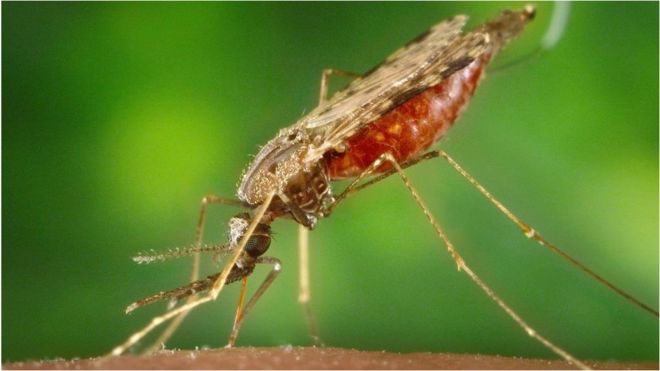
Scientists have discovered a microbe that completely protects mosquitoes from being infected with malaria.
The team in Kenya and the UK say the finding has "enormous potential" to control the disease.
Malaria is spread by the bite of infected mosquitoes, so protecting them could in turn protect people.
The researchers are now investigating whether they can release infected mosquitoes into the wild, or use spores to suppress the disease.
What is this microbe?
The malaria-blocking bug, Microsporidia MB, was discovered by studying mosquitoes on the shores of Lake Victoria in Kenya. It lives in the gut and genitals of the insects.
The researchers could not find a single mosquito carrying the Microsporidia that was harbouring the malaria parasite. And lab experiments, published in Nature Communications, confirmed the microbe gave the mosquitoes protection.
Microsporidias are fungi, or at least closely related to them, and most are parasites.
However, this new species may be beneficial to the mosquito and was naturally found in around 5% of the insects studied.
How big a discovery is it?
"The data we have so far suggest it is 100% blockage, it's a very severe blockage of malaria," Dr Jeremy Herren, from the International Centre of Insect Physiology and Ecology (icipe) in Kenya told the BBC.
He added: "It will come as a quite a surprise. I think people will find that a real big breakthrough."
More than 400,000 people are killed by malaria each year, most of them children under the age of five.
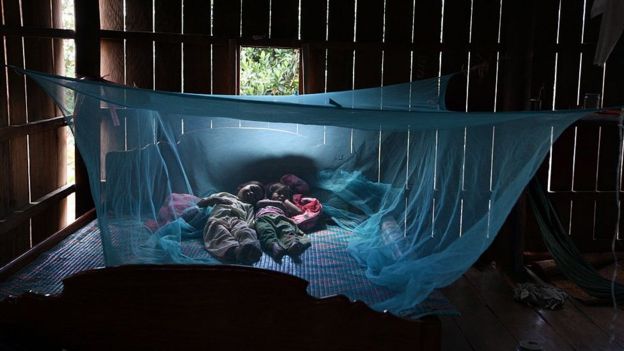
While huge progress has been made through the use of bed nets and spraying homes with insecticide, this has stalled in recent years. It is widely agreed new tools are needed to tackle malaria.
How does the microbe stop malaria?
The fine details still need to be worked out.
But Microsporidia MB could be priming the mosquito's immune system, so it is more able to fight off infections.
Or the presence of the microbe in the insect could be having a profound effect on the mosquito's metabolism, making it inhospitable for the malaria parasite.
Microsporidia MB infections appear to be life-long. If anything, the experiments show they become more intense, so the malaria-blocking effect would be long-lasting.
When can this be used against malaria?
At the very least, 40% of mosquitoes in a region need to be infected with Microsporidia in order to make a significant dent in malaria.
The microbe can be passed between adult mosquitoes and is also passed from the female to her offspring.
So, the researchers are investigating two main strategies for increasing the number of infected mosquitoes.
- Microsporidia form spores which could be released en masse to infect mosquitoes
- Male mosquitoes (which don't bite) could be infected in the lab and released into the wild to infect the females when they have sex
"It's a new discovery. We are very excited by its potential for malaria control. It has enormous potential," Prof Steven Sinkins, from the MRC-University of Glasgow Centre for Virus Research, told the BBC.
This concept of disease control using microbes is not unprecedented. A type of bacteria called Wolbachia has been shown to make it harder for mosquitoes to spread dengue fever in real-world trials.
What happens next?
The scientists need to understand how the microbe spreads, so they plan to perform more tests in Kenya.
However, these approaches are relatively uncontroversial as the species is already found in wild mosquitoes and is not introducing something new.
It also would not kill the mosquitoes, so would not have an impact on ecosystems that are dependent on them as food. This is part of other strategies like a killer fungus that can almost completely collapse mosquito populations in weeks.
Latest Stories
-
Miss Diaspora Ghana 2026 launched to deepen diaspora ties and drive development
1 minute -
US warns citizens to reconsider Nigeria travel on safety grounds
26 minutes -
Ivan Toney questions refereeing in Saudi Pro League title race after Al-Ahli draw
27 minutes -
Angola appoint Aliou Cissé as new head coach
39 minutes -
Virtual Security Africa showcases digital security vision at Kwahu Business Forum
44 minutes -
EBID strengthens regional integration role amid global economic uncertainty
1 hour -
Two assault rifles, ammunition retrieved in Police probe of Tamale gang attack
1 hour -
EBID records strong financial growth with $722m disbursements in 2025 – President, Dr George Donkor
1 hour -
EBID to mobilise $2.69bn under new 2026–2030 growth strategy – Dr George Donkor
1 hour -
An open letter to telcos, regulators and security agencies on mobile money fraud in Ghana
1 hour -
Mobile Money Merchants are driving fraud
2 hours -
Alban Bagbin declines minority’s motion to investigate sale of gold reserves at BoG
2 hours -
NACOC leadership tours drug testing centres in Accra
2 hours -
OSP’s power to prosecute without AG’s authorisation unconstitutional – AG files at Supreme Court
2 hours -
Seven African referees selected for World Cup 2026 as Ndala, Issa Sy miss out
2 hours