

Audio By Carbonatix
A public financial management expert has called on journalists and policymakers to actively manage public expectations on government spending, warning that ensuring macroeconomic stability demands hard fiscal trade-offs.
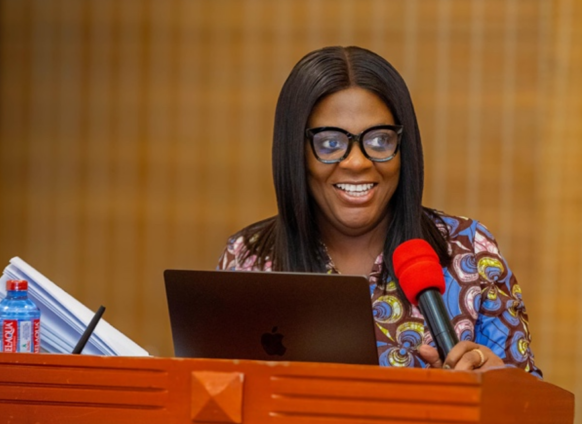
The Senior Expert in Public Financial Management at the Legon Leadership Academy of the University of Ghana, Eva Esselba Mends, made the remarks at a capacity-building workshop for members of the Parliamentary Press Corps in Koforidua.
Delivering a training workshop to parliamentary reporters, the former Chief Director at the Ministry of Finance, argued that demands for increased public expenditure must be weighed against the need to protect key macroeconomic indicators among them low inflation and a stable currency.
"Many people celebrate a stronger cedi or falling inflation but rarely reckon with the fiscal discipline that underpins those gains," she alluded to, cautioning that spending beyond government revenue widens the fiscal deficit and deepens dependence on public borrowing.
"If pressure mounts and government decides to increase the deficit and borrow more just to satisfy demands, all the indicators will shift," she warned, adding that excessive borrowing risks stoking inflation and driving up interest rates outcomes that erode the very stability citizens value.
Ms. Mends also flagged the fiscal risk posed by unplanned financial commitments from state-owned enterprises, noting that such liabilities routinely revert to the central government, disrupting budget projections and straining the public purse.
The workshop, organised by the Parliament of Ghana with support from the World Bank and the Foreign, Commonwealth & Development Office (FCDO), is aimed at deepening journalists' grasp of public financial management and sharpening reporting on national budgets and fiscal policy.
Director of Media Relations at Parliament, David Sebastian Damoah, said the training was designed to equip parliamentary reporters with the analytical tools to interpret fiscal data and translate complex financial matters for public consumption.
He stressed that parliamentary journalism must extend beyond chamber debates to encompass critical oversight functions including budget scrutiny, fiscal accountability and public financial management.
The two-day programme forms part of broader efforts to strengthen the media's role as a watchdog in Ghana's governance and public finance ecosystem.
Latest Stories
-
YEA clears majority of beneficiary arrears, assures completion of outstanding payments
17 minutes -
AfCFTA key to building globally competitive African businesses – Zambia envoy urges Ghanaian CEOs
30 minutes -
Albert Kobina Mensah, soil pollution and remediation: Risk assessment, phytoremediation, revegetation
35 minutes -
GIFEC supports national rollout of One Million Coders Programme with laptop presentation
43 minutes -
Old Tafo MP rolls out street lights project to boost security and night-time economy
51 minutes -
Telecel Ghana CEO urges urgent education reform and stronger industry-academia partnership at UEW Public Lecture
1 hour -
Nigerian army general and several soldiers killed in assault on military base in northeast
1 hour -
Dagbamete chief urges completion of road project, expansion of vocational training
1 hour -
Urgently cancel Truedare AI Customs deal over cost concerns – Joseph Cudjoe to Mahama
1 hour -
Poor safety habits to blame for recurring boat fatalities — GMA boss, Kamal-Deen Ali
1 hour -
Owabi 75% blocked, Barekese loses 40% capacity as siltation, plastics threaten water supply crisis
2 hours -
Ashanti RCC seeks to clear unauthorised garages under new car mall initiative
2 hours -
DPS International steals spotlight at Ghana Interschool Festival Part 2
2 hours -
Republic Bank Ghana PLC leverages Kwahu Business Forum deliberations
2 hours -
Ghana and Artemis II: Hospitality, Love, and Conquest
2 hours