

Audio By Carbonatix
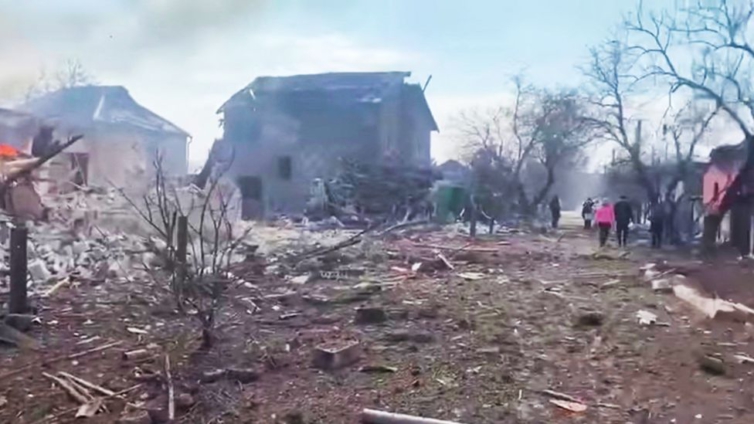
The Russian bombardment of some places in Ukraine is so intense that towns and cities are being forced to unceremoniously bury dozens of civilian victims in mass graves.
Nowhere is this grim reality of war more apparent than in Mariupol, a key port city devastated by constant shelling, where several burial sites have been hastily dug in the past two weeks.
"We can't bury [the victims] in private graves, as those are outside the city and the perimeter is controlled by Russian troops," Mariupol's deputy mayor Serhiy Orlov told the BBC by phone.
Locations include a retired city cemetery that has now been re-opened, Mr Orlov said.
On Sunday, the city council said the civilian death toll had risen above 2,100. The heavy Russian shelling has prevented any mass evacuation from Mariupol, despite efforts to open a safe exit route.
Mr Orlov could not give a total for dead civilians buried in mass graves, but said 67 bodies were at one site. "Some we can't identify but some had documents."
Thousands of residents are hiding in cellars and in some cases, he said, people are burying family members privately in courtyards or gardens.
The battered city's street cleaners and road repair teams were collecting bodies in the streets, he said, as municipal services had collapsed. "Some people were killed during those collections. We've had no electricity, or heating, sanitation, water, food for 11 days," he said.
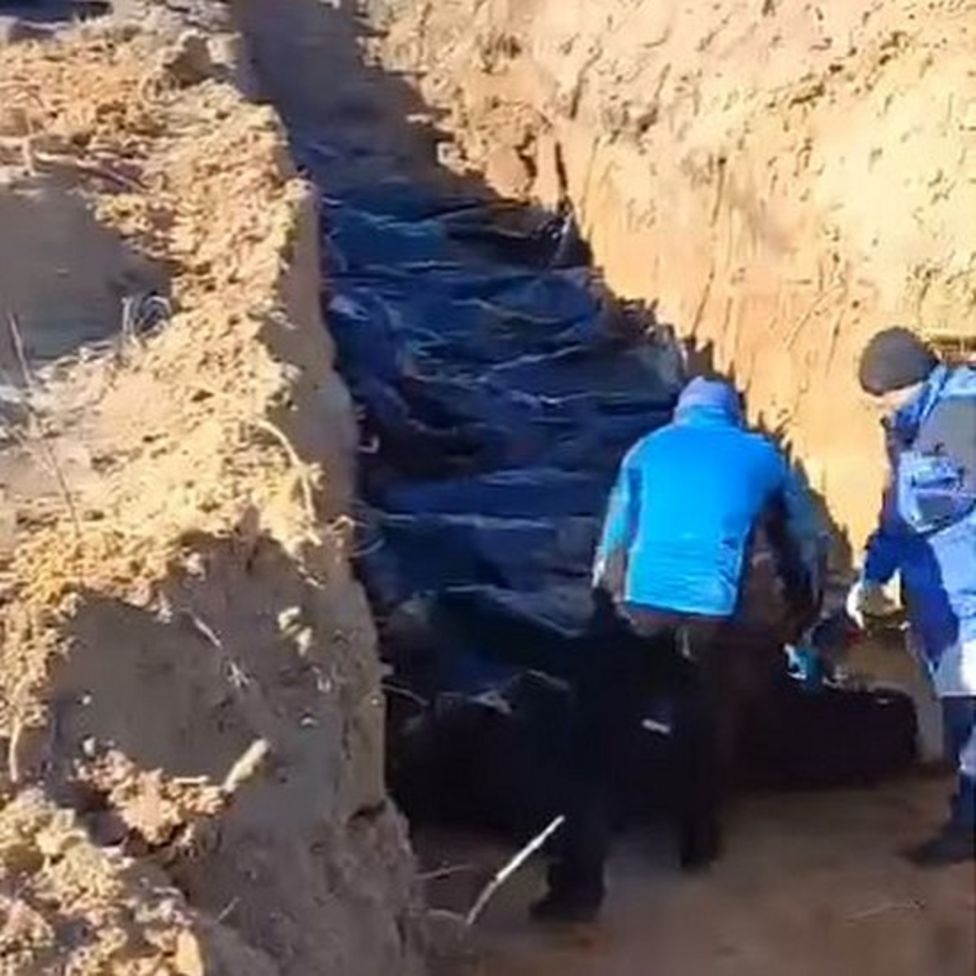
Four-hundred miles to the north west, on the edge of the capital Kyiv, a mass grave was dug near a church in the town of Bucha, local MP Mykhailyna Skoryk-Shkarivska said. It contains more than 60 bodies.
Video of the burial was posted on Facebook by a doctor working in nearby Irpin, Andriy Levkivsky. Doctors buried the victims, who had been brought to Irpin hospital.
Ms Skoryk-Shkarivska told the BBC that a "ritual service" was conducted at the hospital before burial. Not all had been identified and "nobody knows exactly where the relatives are," she said.
"Now we're discussing with volunteers how to create a digital system to identify people and trace missing relatives," she said.

Russian troops captured the hospital on Saturday and told the doctors to leave, she said, speaking by phone from western Ukraine. Bucha and half of Irpin are now in Russian hands, she said.
The return of mass graves is a shock for Ukrainians. Many have bitter family memories of World War Two, when Jews and Soviet partisans were murdered by Nazis, and the Holodomor - the famine created in Ukraine by Soviet seizure of grain and livestock in the 1930s.
"My uncle is 92 and even he compared it with his childhood in the war," said Ms Skoryk-Shkarivska, who emphasised it is "important for us to bury relatives traditionally, the Christian way, with praying".
"Even now in war people sometimes ask priests to do that," she said.
In northern Ukraine the cities of Kharkiv, Chernihiv and Sumy are surrounded by Russian troops and relentless shelling has killed many civilians there too.
On 6 March Oleksandra Matviichuk, a civil liberties campaigner, tweeted a photo of coffins in a trench, accompanied by the message: "Thus, civilians killed in the Russian bombing of Chernihiv are buried in trenches. Since the main city cemetery in Yatsevo is under constant shelling by the Russian occupiers, the victims are buried in the Yalivshchyna forest."
Oleksandr Lomako, secretary of Chernihiv city council, told the BBC that victims of Russian air raids and shelling were being buried in a temporary cemetery. He confirmed that the city's main cemetery was now inaccessible, with Russian troops surrounding the city on three sides, the nearest about 10km (six miles) away.
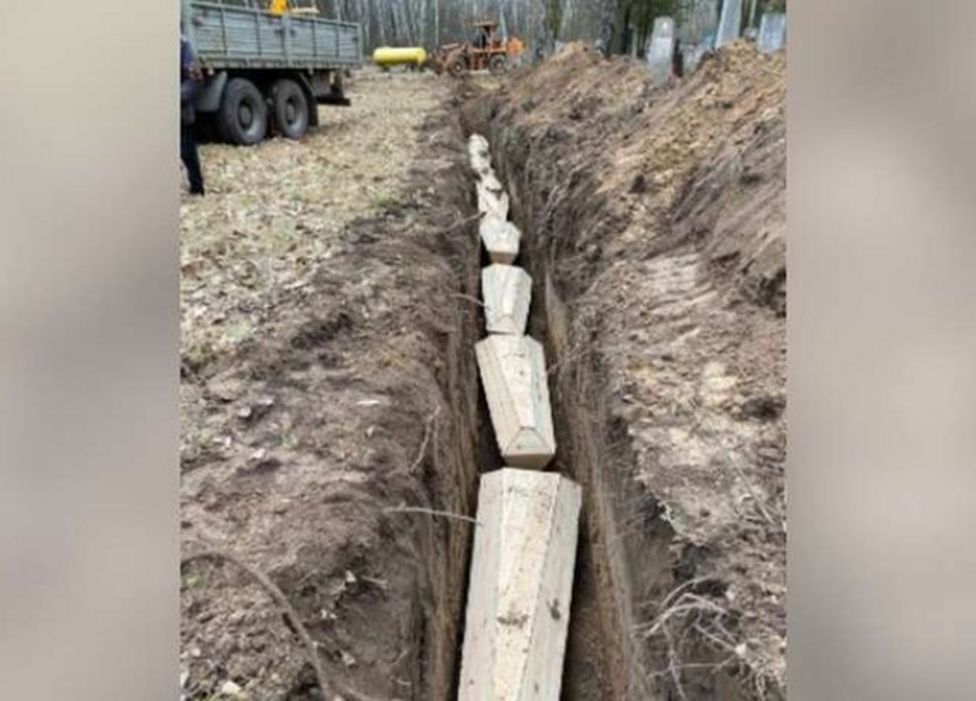
"After the war we will rebury the dead," he said, estimating the city's civilian death toll in the Russian bombardment to be about 200.
One air raid killed 45 people in Chernihiv - the worst toll, Mr Lomako said - adding that nightly bombing was killing seven civilians on average. "The planes drop three to four bombs on residential blocks. Also one hit the hospital, but it is still working. Dozens of housing blocks have been destroyed on the edge of the city."
As well as evidence of mass burials, there are accounts of makeshift graves.
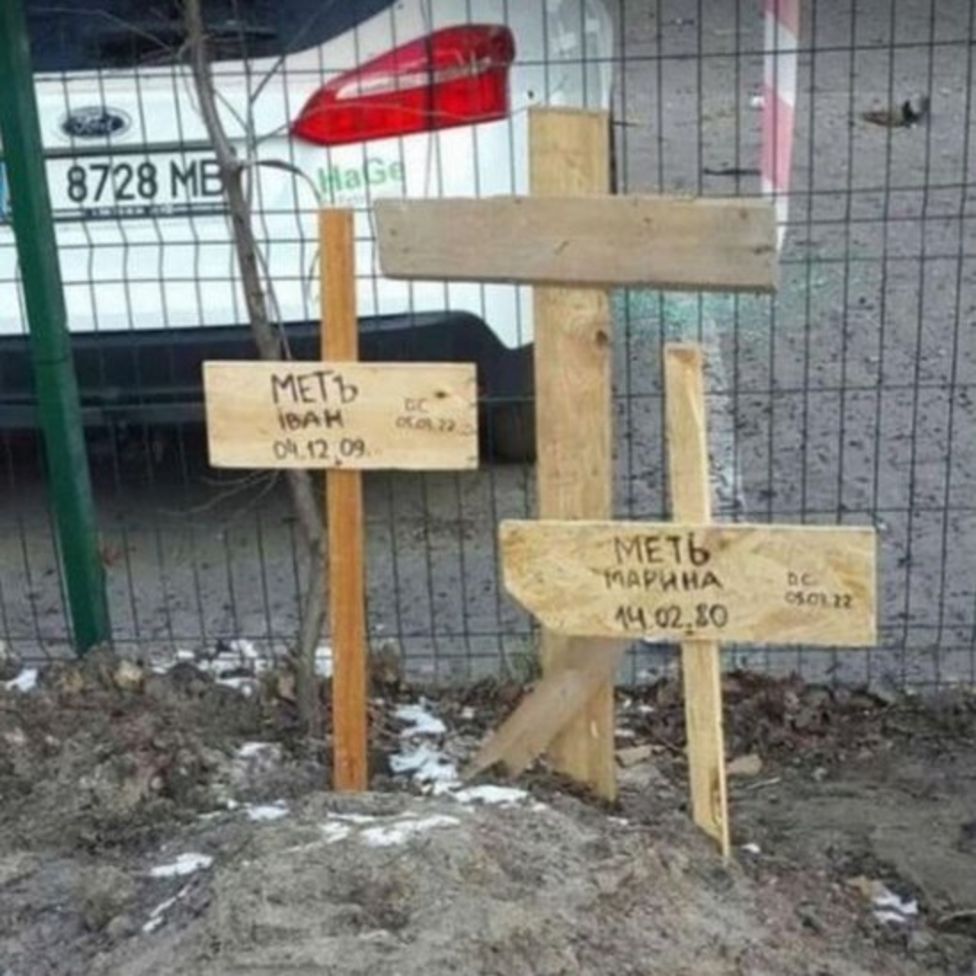
A mother and son were buried in the courtyard of their new apartment block in Irpin, which has been heavily shelled by the Russians. A photo of the grave was widely shared by Ukrainians, and a tweet by journalist Olga Rudenko showed Marina Met and her son Ivan enjoying life in Kyiv before the invasion.
For those whose loved ones have suffered the effects of siege and shelling at the hands of invading forces, burial in makeshift graves will no doubt feel like the final indignity.
Latest Stories
-
Gomoa Easter Carnival: Edem Agbana and Joy Prime fans shower festival with endorsements as masquerades and ‘street anthems’ ignite Day 3
2 hours -
Gov’t to overhaul free zones into manufacturing hubs for local production – Trade Minister
3 hours -
Ghana losing $2.5bn yearly from raw exports – Trade Minister reveals
3 hours -
President Mahama unveils plans for Kwahu Airport, Convention Centre
3 hours -
World’s oldest leader, Paul Biya to get a deputy for first time in 43-year rule
4 hours -
Search for missing US airman continues as Trump threatens ‘hell’ if Iran does not reach deal
4 hours -
US says it has arrested relatives of late Iranian general Qasem Soleimani
4 hours -
La Liga: Real Madrid’s title hopes hang in the balance as Mallorca snatch stoppage-time winner
4 hours -
FA Cup: Haaland hat-trick powers Man City past Liverpool into semi-finals
4 hours -
FA Cup: Chelsea thrash Port Vale to reach Wembley semi-final
4 hours -
Gov’t to boost tourism in coastal communities through infrastructure, sanitation – Vice President
4 hours -
Universities management urged to involve alumni in curricula development, career guidance to reduce unemployment after school
5 hours -
Vice President Opoku-Agyemang enstooled as Development Queen of Kedzi
5 hours -
Globen School @30: From humble beginnings to a hub of innovation and excellence
5 hours -
Children’s health and happiness take centre stage at 2026 Giggle Fun Fest in Peki Avetile
5 hours