

Audio By Carbonatix
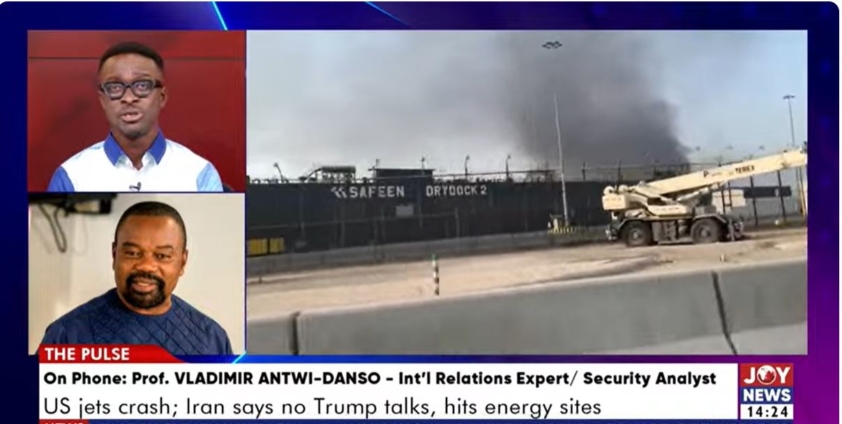
International relations expert and security analyst Prof Vladimir Antwi-Danso has urged urgent global action to preserve multilateralism amid escalating tensions in the Middle East conflict involving the United States, Israel and Iran.
Speaking in an interview on JoyNews’ The Pulse on Monday, 2 March, he warned that failure to strengthen the international system could deepen global divisions and fuel further instability.
Current Middle East Escalation
The latest crisis erupted on 28 February 2026, when the United States and Israel launched coordinated military strikes on Iran, targeting key military and nuclear-related infrastructure in a major escalation of long-standing tensions. The offensive was met with swift missile and drone retaliation from Iran across the region, including attacks on Israeli territory and United States bases in Gulf states. The confrontation has also drawn in allied militia groups such as Hezbollah, whose strikes on northern Israel and subsequent counter-attacks have widened the scope of the conflict.
The violence has disrupted air travel, impacted global oil markets and raised fears of broader regional involvement, while the United Nations Security Council and world leaders have called for de-escalation and diplomatic engagement.
A Critical Moment for Multilateralism
According to Prof Antwi-Danso, the present crisis presents a critical opportunity for Europe and the wider international community to rally behind the principles of the United Nations and reinforce the global multilateral order.
“This is the time to save multilateralism. This is the time for Europe to bring the rest of the world back to the table to protect the UN system. Without that system, we will see more unilateralism — and unilateralism splits the world,” he said.
He argued that despite public statements suggesting restraint, continued warnings, sanctions and asset freezes signal that tensions remain high. Prof Antwi-Danso cautioned that sustained pressure without collective diplomatic engagement risks worsening the crisis rather than resolving it.
“If the West teams up with the rest of the world to pursue genuine diplomacy, we will have more peace,” he stated, emphasising the need for coordinated international engagement rather than fragmented geopolitical alignments.
Risks of Unilateral Approaches
The analyst stressed that isolating diplomatic processes and pursuing unilateral strategies could undermine global peace efforts. He noted that unilateral responses tend to fracture international cooperation, making it harder to resolve complex conflicts and uphold international law.
In this context, Prof Antwi-Danso’s remarks reflect broader concerns about the erosion of effective multilateral mechanisms when powerful states act independently or rely solely on bilateral alignments.
Broader Implications
The Middle East confrontation has already produced significant ripple effects. Shipping through the strategic Strait of Hormuz, which handles about 20% of the world’s seaborne oil trade, has been severely disrupted, pushing up energy prices and pressuring global markets.
Prof Antwi-Danso’s call reinforces the argument that only a strengthened international system rooted in UN-led diplomacy can mitigate the economic, political and humanitarian fallout from such conflicts.
“This is the time to save multilateralism. Without the UN system, we are going to see more unilateral actions in the world,” he warned.
Latest Stories
-
Police recover stolen Honda CR-V in Kumasi within 48 hours
15 seconds -
Apetorku Gbodzi 2026 Festival opens in Dagbamete with development focus
15 minutes -
President Mahama arrives in Lyon to co-chair One Health Summit
22 minutes -
Beverly View Plus Hotel draws crowds amid coastal Easter rush in Volta
22 minutes -
Maiden Zongo Festival held in Wa amid calls to tackle drug abuse among the youth
44 minutes -
FDA warns of fake HIV test kits on Ghanaian market
1 hour -
Africa urged to build resilient health systems as donor support tightens
1 hour -
Easter gesture: Ablakwa settles medical bills for 85 North Tongu constituents
3 hours -
Africa must harness its population strength—Titus-Glover
3 hours -
Visa-free access doesn’t mean unlimited stay – Lom Ahlijah
3 hours -
From Golgotha to Kwahu: The Easter Migration of the Faithful and the Faithless
5 hours -
How the Ghanaian onion traders’ standoff with Nigeria unfolded and threatened local supply
5 hours -
No compensation for demolished structures on 24-Hour Economy market lands — Gov’t to structure owners
5 hours -
Financial Institutions must back local enterprises to spur growth – Deputy Minority Whip
5 hours -
Photos: Gomoa Easter Carnival 2026 ends in a burst of colour and celebration
5 hours