

Audio By Carbonatix
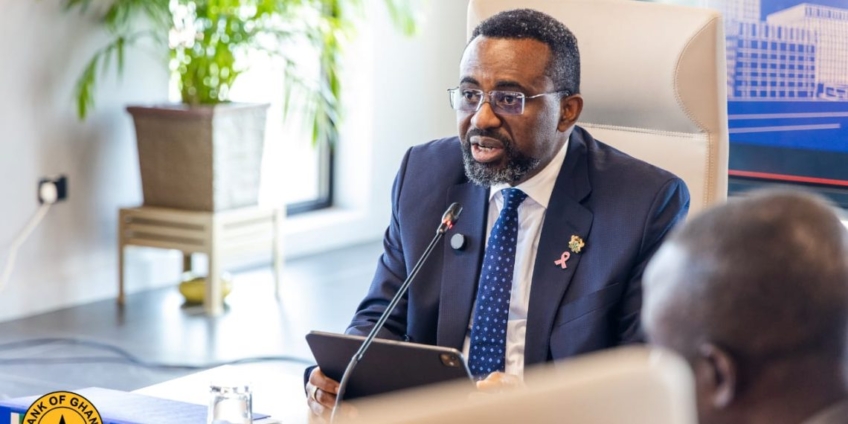
Governor of the Bank of Ghana, Dr Johnson Asiama, has cautioned that rising tensions in the Middle East could undermine Ghana’s progress in reducing inflation, despite recent improvements in the country’s macroeconomic indicators.
Speaking at the opening of the 129th meeting of the Monetary Policy Committee (MPC), Dr Asiama noted that developments in the global environment since the committee’s last meeting could influence the direction of monetary policy in the coming days.
He explained that the escalation of conflict in the Middle East has begun to disrupt key global energy and shipping routes, creating volatility in international oil markets.
According to him, these developments introduce new uncertainties into the outlook for global inflation.
Dr Asiama warned that higher oil prices driven by geopolitical tensions could translate into increased domestic inflation through imported costs. “For Ghana, the transmission channels are clear. Sustained oil price increases could raise the risk of imported inflation and tighten global financial conditions,” he said.
He added, however, that the uncertainty could also bring some advantages for Ghana, particularly through rising gold prices.
“Geopolitical uncertainty tends to support gold prices. Given the importance of gold in our export earnings, this could improve our trade balance,” the Governor noted.
Despite this potential benefit, Dr Asiama stressed that the overall balance of risks remains tilted towards inflationary pressures, which the committee must factor into its policy decisions.
The Governor also highlighted the country’s current inflation situation, noting that Ghana’s inflation rate has now fallen below the Bank of Ghana’s target band.
“At 3.3 per cent, inflation is not only within the target band but has fallen below its lower limit,” he said, adding that this development presents a fresh policy challenge for the committee.
Dr Asiama further revealed that the MPC will also review the government’s newly announced Ghana Accelerated National Reserve Accumulation Programme (GANRAP), which aims to significantly increase the country’s foreign reserves.
The initiative seeks to raise international reserves to the equivalent of 50 months of import cover by 2028, compared with the current level of about 5.8 months.
While he described stronger reserves as vital for strengthening Ghana’s economic resilience, he noted that such programmes could have implications for liquidity conditions, the central bank’s balance sheet and the conduct of monetary policy.
Touching on the financial sector, the Governor said Ghana’s banking industry remains stable, profitable and well-capitalised, with improvements recorded in asset quality over the past year. However, he pointed out that credit growth remains subdued.
According to him, the committee will examine whether the slow pace of lending is due to supply-side constraints within banks, such as risk appetite and capital buffers, or weak demand from potential borrowers.
Dr Asiama concluded that although Ghana’s economic conditions have improved considerably, policymakers must remain cautious in the face of global uncertainties.
“The question before the committee is not whether conditions have improved. They have indeed improved significantly across the board,” he said.
Latest Stories
-
Give to Gain: Why digital inclusion for women must centre accessibility and lived experience
22 seconds -
The Hunger Project-Ghana hands over motorcycles to GHS to strengthen maternal and child healthcare
4 minutes -
Ghana’s banking sector strong but credit growth remains subdued – BoG Governor
9 minutes -
Fuel price hikes inevitable while Ghana depends on oil import – COMAC
12 minutes -
Karpowership Ghana supports Muslim community with food distribution at Sekondi Naval Base mosque
12 minutes -
World Bank MD praises Ghana’s economic turnaround
16 minutes -
Hindsight: Ibrahim Tanko’s chase for historic double and the ugly noises in the room
17 minutes -
Star-studded lineup announced for maiden Gomoa Easter Carnival
17 minutes -
Oil marketers suffering from unstable pricing window – COMAC
20 minutes -
Telecel Ghana trains 1,000 girls in coding for International Women’s Month
21 minutes -
Rising gold prices from geopolitical tensions could support Ghana’s trade balance – Dr Asiama
22 minutes -
What is wrong with us? When public urination and defecation become normal, and dignity becomes optional
23 minutes -
‘Give to gain’ to empower yourself, others and the community – Telecel Ghana CEO
27 minutes -
Kenyans will no longer fight for Russia in Ukraine, Mudavadi says in Moscow
27 minutes -
Divaloper renews partnership with KGL Foundation to expand STEM training for girls
27 minutes