

Audio By Carbonatix
There is a high rate of migration of the youth, who are mostly fishers and crop farmers, to other parts of the country and some parts of the world to seek better opportunities. This has been attributed to the fact that they can no longer depend on fishing or farming as a result of extreme weather conditions such as strong winds, recurrent flooding, erratic rainfall, and rising temperatures.
This situation has contributed to individuals becoming homeless, while others travel to other communities for different economic activities.
According to a survey conducted by the Ghana National Canoe Marine, Shama Apo in 2016 had a canoe frame survey of 948 fishermen with 195 canoes, while the latest survey in 2022 recorded 546 fishermen with only 94 canoes. The research indicates that within six years, Shama Apo has recorded a drop of over 400 fishermen.

This story takes a critical look at issues of coastal migration by fisherfolk due to unbearable climate change effects on fishing. It also explores what the government and other organizations are doing to help fishermen, as well as some factors that force fisherfolk to migrate to other places or countries.
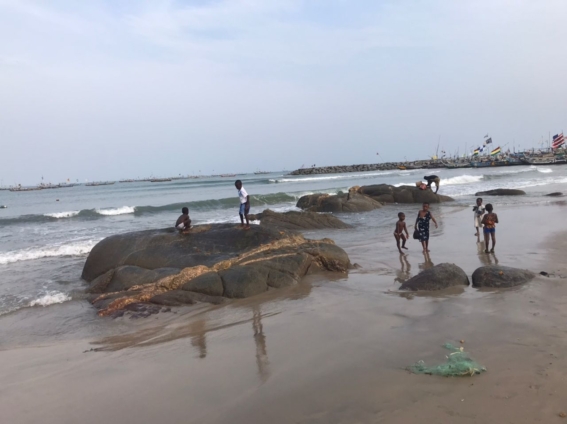
Shama Apo is a coastal fishing community located in the Shama Municipal area in the Central Region of Ghana. The residents’ major economic activity is fishing.
Nana Enu Bassal, the Chief Fisherman in Shama Apo, explains some impacts of climate change effects on their fishing.
Nana Enu Bassal, the chief fisherman at the Shama Apo landing site, gives reasons for the significant drop in the number of fishermen and canoes at the landing site.
"The waves have driven the fishes away, forcing the fishermen to migrate to other places. This situation has occurred at many fishing communities, when the waves are aggressive, we are not able to fish we have to wait until it calms down before we can move. If you are not careful, your machine will be destroyed by the waves.”
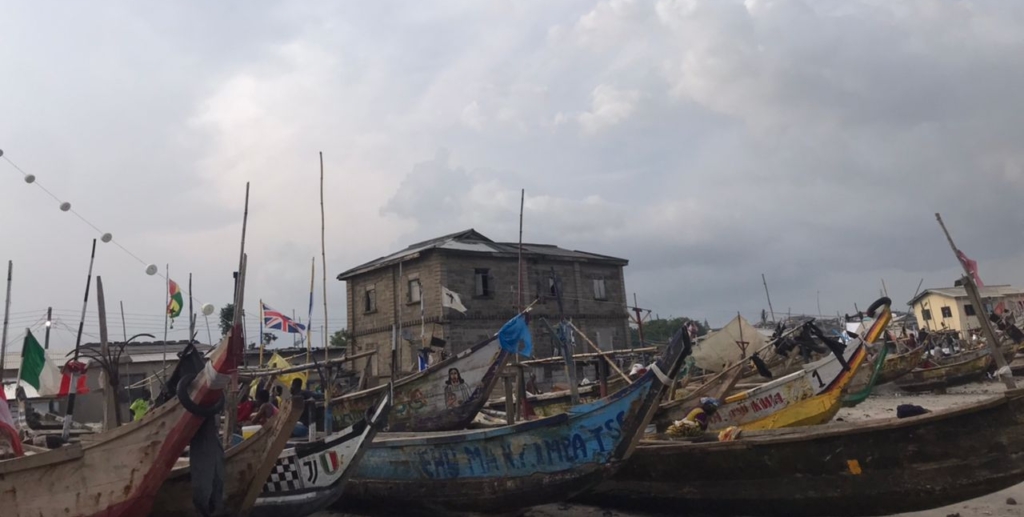
Kweku Abbeiku also explains some dangers they encounter when there are aggressive tidal waves.
Kweku Abeiku, a canoe owner operating at the Shama Apo landing site, explains the dangers in fishing during high tidal waves. “We find it very difficult to get to the sea. When the waves become aggressive, we try to bring everything under control, but if we fail the boat will capsize and we will lose at least half of our catch.”
He said that they spend days and weeks going to places where they can get a big catch. “Wherever there is enough fishes we go there and sometimes stay for some period before we return.”
The chief called on the government to support them in their fishing work.
Nana made a passionate appeal to the government, individuals, and agencies to come to their aid in order to sustain their fishing work: “We need government to support us with the petrol and we will be glad if government could support the fishermen at least ten to fifty million Ghana cedis.”
The Shama District NADMO administrator, Mr. Martin, speaks on the effects of climate change within the coastal area and its impacts on fishing communities.
Mr. Martin Evy accepts the fact that climate change effects such as high temperatures, erratic rainfall, flooding, storms, and tidal waves have become a global change, and this has a great impact on the fishing business.
“Climate change has become a general phenomenon and our district is not exceptional. The effects of climate change on our coastal environment are the tidal waves issues so very often the catch has been very low along the coast which has often results to migration by the fisher folks to other place and countries.”
According to Mr. Martin, despite having inadequate resources to help the fishermen, they provide them with some interventions.
Mr. Martin Evy reveals that even though there are not enough resources for the government to support the fishermen, the government is doing its best to keep the fishing industry running.
“There is an intervention where government is putting up sea defence walls which have really reduced the effects of climate change on the coastal communities when it comes on the issues of tidal waves and provide relief items for the fishermen.”
He also adds that Friends of the Nations, a non-governmental organization, has also created many mangroves for new species, and land has been secured for the relocation of some communities around the coastal areas.
Dr. Victor Owusu, a Senior Lecturer at the University of Education, Winneba, highlighted some factors that are causing this coastal migration and some consequences of it.
According to Dr. Victor Owusu, there are several factors that push fishermen in coastal communities to migrate to other places, which include the following: low catch, incidences of flooding, tidal waves in the fishing areas, and erosion. These factors, among others, make fishermen leave the fishing business to look for better alternatives for their survival.
Concerted efforts must be made to increase environmental rehabilitation, invest in the agricultural sector, strengthen education, and create awareness on the climate change impact on fishing. This will help to attain the National Adaptation Plan on building resilient economies and societies toward achieving Sustainable Development Goal 8, which is decent work and economic growth, and Sustainable Development Goal 13, which is climate action.
This story is brought to you by JoyNews in partnership with CDKN Ghana and the Centre for Climate Change and Sustainability Studies at the University of Ghana, with funding from the CLARE R4I Opportunities Fund.
Latest Stories
-
Rural health worker laments overwhelming burden at CHPS compounds
3 minutes -
Katon Meet to stream Accra stadium Katon Praise Concert worldwide
4 minutes -
Gov’t considers exploring local raw materials to stabilise production costs of sachet water prices
33 minutes -
Mahama in Paris: Turning Diplomacy into Delivery
35 minutes -
Middle East crisis shows Ghana needs to diversify energy sources – Energy expert
1 hour -
Government of Ghana Internal Revenue Generation cannot fund Big Push in Four Years
1 hour -
EPCG Moderator urges leaders to serve with courage and humility in Easter message
2 hours -
The Cobra at the gate: When good intentions overrun the system
2 hours -
Easter service disrupted in Nyanyano as suspected land guards storm church event
2 hours -
Price surge exposing NDC gov’ts dishonesty -Titus Glover
2 hours -
Afigya Kwabre North MP urges Finance and Energy Ministers to submit energy sector report
2 hours -
Deliver quality or face sanctions — GETFund administrator cautions contractors
3 hours -
Kwahu Easter festivities trigger condom shortages; Health teams boost awareness
3 hours -
Victims of a legend: The women Daddy Lumba left behind
3 hours -
Mahama vows to prioritise roads, social amenities in Savannah region
3 hours