

Audio By Carbonatix
The Minister for Lands and Natural Resources, Emmanuel Armah-Kofi Buah, has announced that the Minerals Commission Act is currently undergoing a comprehensive review aimed at promoting equity, sustainability, and shared prosperity within Ghana’s mining sector.
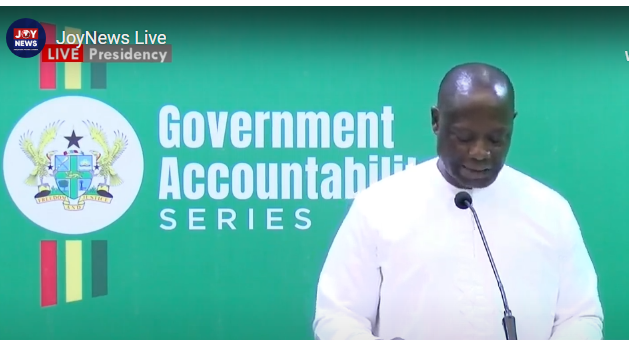
Addressing the Government Accountability Series at the Jubilee House on Tuesday, 23 July, Mr Buah highlighted the central role of mining in Ghana’s economy and the urgent need for legal reforms to ensure all stakeholders, especially local communities, benefit fairly.
“The mining sector is the lifeline for millions of Ghanaians. Ghana is blessed with an abundance of minerals, gold, diamonds, bauxite, iron, salt, and others. These natural resources are under unprecedented global strain due to rapid population growth, urbanisation, escalating demand for raw materials, and the compounding effects of climate change,” he said.
Mr Buah noted that President John Dramani Mahama’s government is prioritising reforms to ensure the country harnesses its mineral wealth more equitably.
“The Government of President John Dramani Mahama recognises that for Ghana to fully harness the benefits of its mineral wealth, the law must be strengthened to ensure equity, sustainability, and shared prosperity for all stakeholders, especially our communities, which bear the direct brunt of mining activities.”
He disclosed that the review process, which involves extensive stakeholder consultation, is 85% complete. The review covers both the Minerals and Mining Act, 2006 (Act 703), as amended, and the Minerals and Mining Policy of 2014.
Outlined below are key reforms under consideration:
Reducing the tenure of prospecting licences from being held in perpetuity to a defined, minimal period.
Lowering the upper limit for mining leases from the current 30 years to an agreed shorter duration.
Abolishing Development Agreements and introducing mandatory Community Development Agreements (CDAs), requiring companies to contribute an agreed percentage of gross revenue to fund development projects in mining communities.
Establishing a three-tier mineral rights regime by introducing a medium-scale licence category.
Reviewing stability agreements, either by reducing the maximum term from the current 15 years or abolishing them entirely, to be limited only to capital-intensive investments.
Removing the automatic right to renew licences where companies fail to meet specified conditions.
Mr Buah reaffirmed government’s commitment to fairness, transparency, and inclusivity in shaping the future of Ghana’s mining sector.
“Under the leadership of President John Dramani Mahama, and with extensive stakeholder engagements that include traditional authorities, civil society groups, and academia, government is committed to ensuring that the review of the Act corrects the imbalances of the past and secures a brighter future for the benefit of all Ghanaians.”
Latest Stories
-
AGI commends government’s move to resolve the power crisis in Volta and Oti Regions
28 minutes -
IBAG president alleges political interference driving kickbacks in insurance sector
1 hour -
Trump agrees to two-week ceasefire, Iran says safe passage through Hormuz possible
1 hour -
Dozens killed as Angola flood death toll rises
2 hours -
Russia confirms deaths of 16 Cameroonians fighting in Ukraine war, Yaounde says
2 hours -
Plan to scrap presidential elections puts Zimbabweans at loggerheads
2 hours -
Guinea-Bissau transporters strike over higher fuel prices
2 hours -
Iran ceasefire deal a partial win for Trump – but at a high cost
2 hours -
Oil slides below $100 after Trump announces two-week ceasefire
2 hours -
Madagascar declares state of emergency over energy situation due to Iran war
3 hours -
Ex-Meta worker investigated for downloading 30,000 private Facebook photos
3 hours -
World Bank says Nigerian economy to grow in 2026 but Iran war lifts inflation
3 hours -
Ringleader of suspected human trafficking network arrested in Ethiopia
3 hours -
Alexander-Arnold fails to ease Tuchel concerns as Kane stars
3 hours -
Amad backs Carrick for Manchester United job
3 hours