

Audio By Carbonatix
Extreme misogyny will be treated as a form of extremism under new government plans, the Home Office has said.
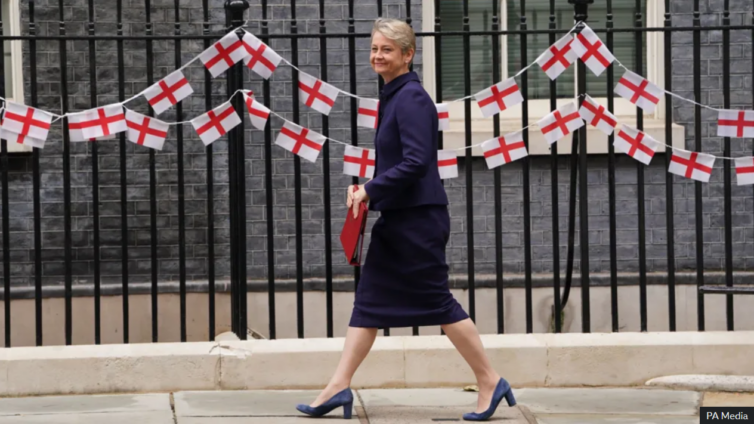
Yvette Cooper, the home secretary, has ordered a review of the UK's counter-extremism strategy to determine how best to tackle threats posed by harmful ideologies.
The analysis will look at hatred of women as one of the ideological trends that the government says is gaining traction.
Ms Cooper said there has been a rise in extremism "both online and on our streets" that "frays the very fabric of our communities and our democracy".
The review will look at the rise of Islamist and far-right extremism in the UK, as well as wider ideological trends, including extreme misogyny or beliefs which fit into broader categories, such as violence.
It will also look at the causes and conduct of the radicalisation of young people.
Ms Cooper said the strategy will "map and monitor extremist trends" to work out how to disrupt and divert people away from them.
It will also "identify any gaps in existing policy which need to be addressed to crack down on those pushing harmful and hateful beliefs and violence", she said.
Ms Cooper said that action against extremism has been "badly hollowed out" in recent years.
The work will inform a new counter-extremism strategy, which was promised in Labour's manifesto and which the Home Office says will "respond to growing and changing patterns" of extremism across the UK.
It is not clear how long this "rapid review" will take. It is one of a number of policy reviews Labour has announced since coming to power in July, including the Strategic Defence Review, spending review and a review of the National Curriculum.
Critics might argue that some reviews are a proxy for actual action, but Labour has pointed out that there has been no new Counter Extremism Strategy since 2015, and that an assessment of new and emerging threats is overdue.
This is also not the first time the government has considered misogyny as a form of extremism.
For some years there has been concern around "Incel culture", an online movement of mainly young men who describe themselves as "involuntarily celibate" and blame women and "alpha males" for their problems.
A mass shooting in Plymouth in 2021 by 22-year-old Jake Davison, who killed five people before fatally shooting himself, was linked to Incel ideology.
At the time no further policy action was taken, but incidents like that one, and also the rise of social media influencers such as Andrew Tate - a self-proclaimed misogynist - may have pushed the new government to think again.
Latest Stories
-
Discussions on petroleum taxes review ongoing with Finance Minister – Jinapor
6 minutes -
BMW Club Ghana partners National Road Safety Commission for “Stay Alive” Easter road safety campaign
11 minutes -
Health Ministry launches World Health Day 2026, urges science-based action
26 minutes -
MMFL anchors MTN Group’s fintech push in Ghana
35 minutes -
Ghana’s economy shows recovery signs, but risks persist – S&P maintains stable outlook
51 minutes -
SWAG commemorates its 8th anniversary with a public lecture
54 minutes -
Ibrahim Mahama claims Police Commander failed to stop alleged assault
56 minutes -
Damang lease award to E&P followed due process — Minerals Commission
1 hour -
Today’s Front pages: Wednesday, April 8, 2026
1 hour -
Julian Opuni reaffirms Fidelity Bank support for industry-led skills training at DTI Berekuso campus
1 hour -
CAF President arrives in Dakar to meet Senegalese President, football authorities over AFCON title saga
1 hour -
Pastor arrested over viral threats against Vice-President
1 hour -
2026 Success Africa Summit: MTN’s Adwoa Wiafe challenges youth to act with purpose, not just pursue titles
1 hour -
Nurse laureate launches Cancer Care Africa Foundation to tackle late diagnosis, workforce gaps
2 hours -
Ghana to lose GH¢18.15bn in revenue by 2027 from abolishing Covid levy, E-levy – CPS study
3 hours