

Audio By Carbonatix
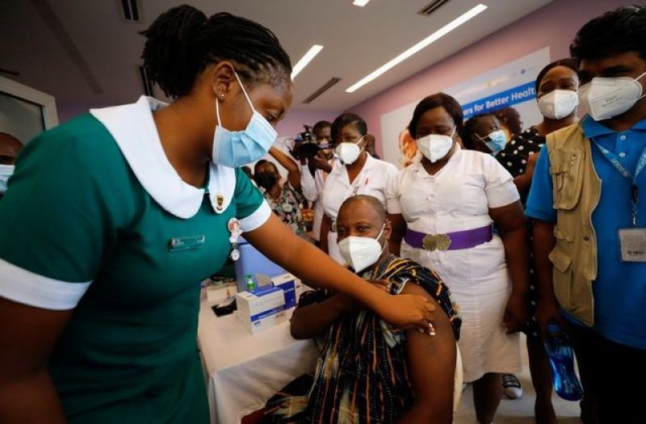
More than 100,000 people have received their second dose of the AstraZeneca Covid-19 vaccine as of Sunday, May 23, data from the Ghana Health Service (GHS) has shown.
The exercise, which began on May 19, is expected to inoculate about 360,000 persons who received their first jab from March 1 to 9, this year.
Dr Franklin Asiedu-Boeko, Director of Public Health at the GHS, said those who received their first jab from March 10, would have their second dose in the next phase.
He told the Ghana News Agency (GNA) in an interview in Accra that 380,000 doses of vaccine had been specifically allocated to those in the first phase and said the exercise would not end on May 26 as stated earlier.
Dr Asiedu-Boeko described the exercise as impressive despite the failure of an online application introduced to make the exercise more effective.
“We are happy about the process so far because, despite complaints about the side effects of the vaccine, people are still interested in getting inoculated," he said.
Dr Asiedu-Boeko assured the public that government was still making efforts to acquire more vaccines to get more people vaccinated.
He assured the public that the plan to vaccinate 20 million Ghanaians before the end of the year was on course.
Dr Asiedu-Boeko reiterated the need for the public to keep adhering to the COVID-19 safety protocols by wearing facemasks, using alcohol-based hand sanitizers, coughing or sneezing into tissues, and washing of hands with soap under running water.
Ghana, on Tuesday, March 2, kicked off its mass COVID-19 vaccination exercise in 42 selected districts in the Greater Accra, Kumasi, and Western regions.
As of Friday, April 30, a total of 849,527 AstraZeneca vaccines had been administered to the public.
Ghana recorded its first case of Covid-19 on March 12, 2020. So far 92,513 cases have been confirmed with 783 deaths. There are 1583 confirmed cases.
The novel coronavirus was first recorded in the Wuhan city of China in December 2019.
Coronaviruses are a large group of viruses that are common among animals. In rare cases, they are what scientists call zoonotic, meaning they can be transmitted from animals to humans, according to the US Centers for Disease Control and Prevention.
It has an incubation period of four to six days and fatal, especially for those with a weakened immune system – the elderly and the very young. It could also result in pneumonia and bronchitis.
Latest Stories
-
Trump seeks $152m to reopen notorious Alcatraz prison
10 minutes -
Ex-Chelsea player Oscar retires with heart issue
19 minutes -
CA Foundation drives constitutional literacy in Kpone Katamanso municipality
24 minutes -
GPRTU to hold talks with Transport Ministry over rising fuel costs
27 minutes -
CUTS International urges gov’t to halt sachet water price hike pending cost review
33 minutes -
Chief Justice: Efficient Judiciary essential to reducing business costs
36 minutes -
Bayern grabs 99th-minute winner to cap superb fightback
36 minutes -
Ahmed Ibrahim urges Ghanaians to reflect Easter values in nation-building
39 minutes -
ECG inefficiencies undermining power supply -Mahama outlines reforms
41 minutes -
Lewandowski scores as Barca fight back to defeat Atletico
42 minutes -
Lack of private sector consultation undermining economic growth – Jerry Ahmed Shaib
46 minutes -
Real Madrid seven points adrift after Muriqi’s late Mallorca winner
46 minutes -
Ghana must lead AfCFTA implementation by example – Trade Minister Ofosu-Adjare
51 minutes -
Strong Judiciary key to business confidence – Chief Justice Baffoe-Bonnie
55 minutes -
Mahama announces 60-Hectare irrigation project to boost tomato production
1 hour