

Audio By Carbonatix
In the village of Ouirgane in the Atlas Mountains, residents gather on piles of debris around the home of a mother and daughter buried underneath.
Like many mountain communities, Ouirgane suffered major losses in the earthquake that struck Morocco on Friday night.
Buildings have been destroyed and most residents are now either sleeping in tents or have left.
Police and rescue workers tell us more than 30 people died here. The cemetery is dotted with new graves covered in branches.
For now, everyone is focused on the two missing women: Fatima and Hajar.
They lived on the ground floor of a three-storey building in the centre of the village.
It now tilts to one side and is surrounded by piles of rubble, and small traces of lives now destroyed: a teapot, a child's Disney rucksack, a floral scarf.
Crowds gather around the building and pray for good news, as rescue workers use a sniffer dog to search for signs of life.
Residents tell us they will not leave until Fatima and Hajar are found, dead or alive.
"In our culture, we eat from the same plate. We share food and we share plates. We're a family," one man says, as a crowd around him nod in agreement.
"They're our sisters," says another.
Among the crowd is Fatima's sister-in-law Khadija, who lived in the top two floors of the building. She was in Marrakesh when the earthquake struck.
She tells us that Fatima's husband was pulled from the debris but later died, while her young son is in hospital after spending hours trapped in the rubble.
She says Fatima and Hajar, 40 and 17, had the "same nature", describing them as "peaceful" people.
"Fatima never argued with anyone, or had problems with anyone," she tells me. "Hajar would keep to herself. She was shy. She was studying and was among the top students."
But hopes of finding them alive are slim, and fade throughout the day.
In the late afternoon, a body is found.
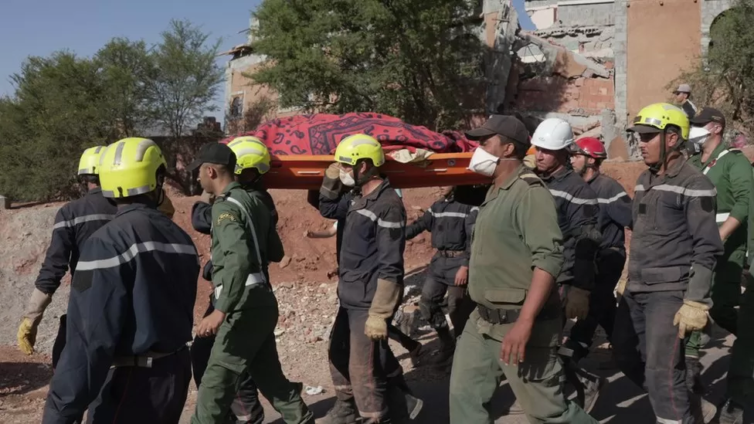
Rescue workers move slowly and carefully as they take the body out of the rubble and onto an orange stretcher, covering it with blankets.
It is Hajar, they say.
They lift the stretcher and carry it through the streets towards a clearing in front of the local cemetery. The crowds follow solemnly behind.
After the body is washed, the stretcher is placed on the ground, and the men file in rows behind it. And then they pray.
After the burial, the crowds file back to the building, waiting for news on Fatima.
No one we speak to now has any hope of finding her alive, but they say it is important that her body is recovered.
"Everyone underground here has been brought out - alive or dead. Fatima is the only one left," one man says.
"I can't eat, I can't sleep, I can't drink until we take Fatima from underground."
"The whole village needs to get her body out. It needs to happen today, not tomorrow," another man says as he walks back from the cemetery.
Fatima's neighbour Said echoes this. "We can't do anything until we get her body out. Please God, let it be today."
Among the crowds is rescue worker Mohamed Khoutari, who is taking a short break after days of searching through the rubble.
"When we started we thought maybe they would be alive but with time we have realised it's not possible," he tells me. "There are no signs of life - no movement, no sound."
But he says the workers must put the same effort into retrieving bodies as finding survivors.
"I cannot move from here until we find Fatima," he says.
As night falls, blankets are passed up to the search teams, and in low murmurs among the crowd, word spreads that Fatima's body has been found.
She is moved onto a stretcher as the Muslim call to prayer rings out through the mountains. Khadija sobs, and is supported by family members.
Residents again follow the stretcher through the streets towards the cemetery.
When the burial is over, they return to makeshift tents, and those who have travelled from outside to help get in their cars and drive away.
The streets fall quiet.
But questions linger over how Ouirgane and other stricken communities can move forward.
"I never imagined that I would see my neighbours pulled from the ground like this," Said says.
"The problem now is the future of this region. What will the future of our village and the people here be?"
Latest Stories
-
Manhyia South MP demands PPA board minutes on ‘Big Push’ sole-sourcing approvals
5 minutes -
Today’s Front pages: Tuesday, April 7, 2026
8 minutes -
President Mahama praises GWL MD Adam Mutawakilu over Damongo Water Project progress
10 minutes -
Ghana–China Forum explores zero-tariff trade opportunities
28 minutes -
What is wrong with us?: A quiet truth we can no longer ignore
41 minutes -
What is wrong with us? : When sirens become symbols of power rather than protection and emergencies
60 minutes -
Businesses scramble to get noticed by AI search
1 hour -
From perk to performance: Why employee wellness must be a core business strategy
2 hours -
Bank of Ghana’s $1.3bn profit from gold sale could help narrow 2025 losses
2 hours -
Odau Twafohene Baffour Osei Afrifa appointed Regent of Akyem Chia
2 hours -
We are focused on engineering low interest rate regime – BoG Governor assures
2 hours -
How Sporting hero Gyokeres could end European run
2 hours -
The attack on Ghanaian traders in Burkina Faso and the blame game: Why Hybrid Security Governance Holds the Key (II)
2 hours -
Bayern face waiting game on ‘very special’ Kane
2 hours -
The Problem with Nutrition Advice on Social Media – Lessons from a study among University Students
2 hours