


Audio By Carbonatix
Few things yield texture and flavour — as well as connection — as affectingly as this kitchen tool, Yewande Komolafe writes.
There are family members we never get to meet, those whose absences are filled by the memories of the people who knew them. I never met my great-grandmother Osunfunke Thomas (nee Olatunji), but I’ve formed an image of her from the story of her passing, as told to me by my mother and her sisters. She was 76, and it happened quite suddenly, as she was crushing aromatics for dinner on a grinding stone.
This memory runs counter to even the few photographs I’ve seen of her. In them, she is slight, less sturdy than I had been led to believe. I may not have known her, or the precise details of her life, but I know of her indomitable spirit.
And I know the grinding stone, called olo in Yoruba, that she was working with on that day in 1982 in Lagos, Nigeria. My grandparents saved it and used it in their homes. And I think about it — and her — whenever I am working ingredients and extracting their essences in my mortar and pestle.
I have an array of devices that perform all of the functions of a good mortar and pestle. I grind five-pound bags of heirloom corn for ogi, a fermented breakfast corn porridge, in a food processor. I run nuts and seeds through a blender to make kunun gyada and other drinks. When I’m making a pepper soup blend from whole spices, I glance first at my mortar and pestle, and then to the spice mill next to it. I grab the mill probably 99 times out of 100.
I don’t have to imagine my great-grandmother’s reaction to that. She lived long enough to know these inventions, and would never touch any of them.
“She would grind her spices fresh every day,” my mother reminds me.
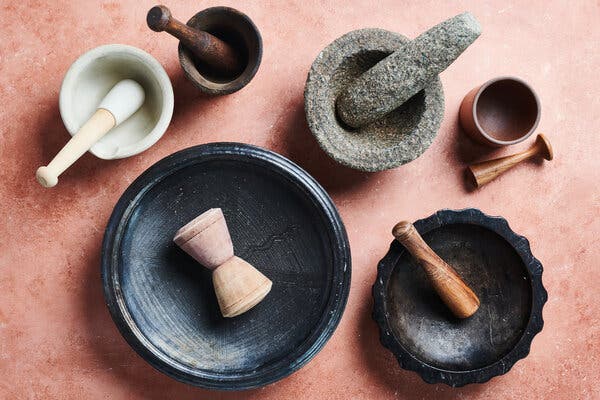
This aversion to gadgets plays an outsize role in the image I have of her and the one shared with me. However laborious the process, Iya Oko, as we call her, Yoruba for “mother from the farm,” swore by the culinary methods that sustained her. Manually grinding spices, herbs, aromatics: That was her ritual.
She never claimed it was the only way, just the best to extract the oils and the aromas from her ingredients. In West African cuisine, and in many of the world’s cuisines, manually pounding and grinding reveals distinct qualities from a variety of ingredients. Pounded yam, banga soup and akara are just a few Nigerian dishes that can be made with shortcuts, but when they’re prepared with traditional mortars and pestles, they take on nuanced textures that machines simply cannot replicate.

Though a modern device can mimic an outcome, it can also erase age-old processes. Kneading dough, shaping dumplings, or grinding and fermenting grains are all physical, even soothing. Iya Oko’s methods, I’d like to believe, were not born of a stubborn disdain for modern equipment; she simply had faith in the methods that had served her well.
And her methods and spirit inspired this recipe, a roast fish with marinade packed with crushed aromatics like lemongrass, ginger, shallots and scotch bonnet chile. Any mild whole fish will take on the flavours well. I use my asanka, a traditional Ghanaian earthenware mortar lined with thin grooves, and a two-sided wooden pestle to gently work the ingredients in. The reward is nuance and texture, and a release of the ingredients’ oils and essences to give a deeper flavour. You may not have an asanka or a grinding stone. Perhaps you’ll consider pulling out the food processor, and you can: The mortar and pestle are optional but strongly encouraged.
And to drink …
The aromas practically leap off the page — rich, herbal, spicy, citrus. You need versatile wines to go with this dish, and riesling is the first to come to mind. Good riesling is capable of pairing with almost anything and will work well with this combination of flavours. You could certainly drink a dry riesling from any top source — Germany, Austria, Alsace, the Finger Lakes, Australia.
A moderately sweet bottle would be delicious, too, like a German kabinett or spätlese. For variety, an Austrian grüner veltliner would complement the lemongrass and ginger flavours, as would a dry, restrained sauvignon blanc. Other options? A textured pinot blanc would be nice, as would a mild silvaner or a white from the Savoie. You could try a dry Chenin blanc too, though I’d steer clear of reds.
Latest Stories
-
Free golf training empowers underprivileged girls in Accra
4 minutes -
Why SIGA’s reset is not a market sin, but a national necessity
7 minutes -
SIGA Directive: Beyond the theatre of institutional displacement
10 minutes -
Boso Odweegyi Festival 2026 launched with call for unity, cultural preservation
10 minutes -
YEA clears majority of beneficiary arrears, assures completion of outstanding payments
48 minutes -
AfCFTA key to building globally competitive African businesses – Zambia envoy urges Ghanaian CEOs
1 hour -
Albert Kobina Mensah, soil pollution and remediation: Risk assessment, phytoremediation, revegetation
1 hour -
GIFEC supports national rollout of One Million Coders Programme with laptop presentation
1 hour -
Old Tafo MP rolls out street lights project to boost security and night-time economy
1 hour -
Telecel Ghana CEO urges urgent education reform and stronger industry-academia partnership at UEW Public Lecture
2 hours -
Nigerian army general and several soldiers killed in assault on military base in northeast
2 hours -
Dagbamete chief urges completion of road project, expansion of vocational training
2 hours -
Urgently cancel Truedare AI Customs deal over cost concerns – Joseph Cudjoe to Mahama
2 hours -
Poor safety habits to blame for recurring boat fatalities — GMA boss, Kamal-Deen Ali
2 hours -
Owabi 75% blocked, Barekese loses 40% capacity as siltation, plastics threaten water supply crisis
2 hours