

Audio By Carbonatix
Muslims across the world are celebrating Eid-ul-Adha to commemorate Prophet Ibrahim’s devotion to Allah (SWT) and his readiness to sacrifice his son, Ismail.
The celebrations, also known as the “Festival of Sacrifice” is the second of the two Islamic festivities, which is celebrated annually worldwide.
Muslims approach God on this day by sacrificing a sheep, a cow, or a camel and distributing the meat to the poor. They unite to pray together with family and friends and show love.
Eid-ul-Adha falls on the tenth day in the twelfth month of the Islamic Lunar Calendar; Dhul-Hijjah, which allows families, loved ones, and communities to fraternise, and is dependent on a legitimate sighting of the moon, following the completion of the annual Holy Pilgrimage of Hajj – which is an obligation for all Muslims.
The command from Allah (SWT) is a test of Prophet Ibrahim’s willingness and commitment to obey his Lord’s command, without question.
At the point of sacrifice, Allah (SWT) replaced Ismail with a ram, which was to be slaughtered in place of his son.
So, during the celebration, the sacrificial animal must be a sheep, lamb, goat, cow, bull, or a camel; the sheep, lamb or goat consist of one share, whereas a bull, cow or camel consist of seven shares per animal. The animal must be in good health and over a certain age to be slaughtered, in a “halal” friendly, Islamic way.
The meat can then be divided into three equal portions per share; one-third for the owner and family, one-third for friends, and the final third to be donated to those in need.
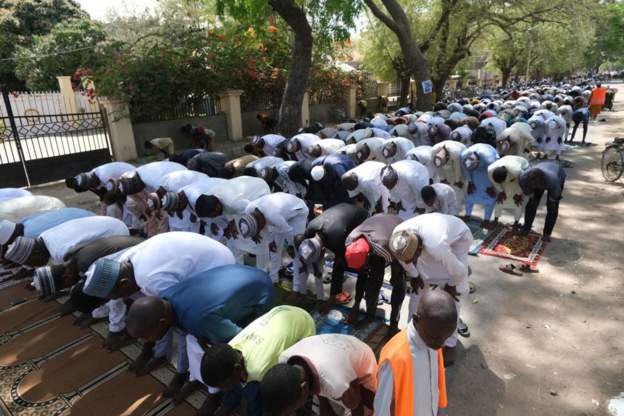
The act of the sacrifice is usually carried out after Eid Prayers, which are performed in congregation at the nearest Mosque on the morning of Eid.
The celebration of Eid-ul-Adha is to last for three days. Traditionally, the day is spent celebrating with family, friends and loved ones, often wearing new attire and the giving of gifts.
Some Muslims, the Ghana News Agency spoke to ahead of the celebrations, thanked Allah for seeing them through the year and prayed that their supplications, together with those who were able to embark on the journey to Hajj, would be answered. Some were excited about the celebration, saying though the prices of animals for sacrifice were high due to the outbreak of Anthrax in Bolgatanga, and the current economic situation, they would still enjoy the celebration.
Latest Stories
-
Keep the money in Ghana – Gov’t enforces local cargo insurance
1 hour -
US Army veteran charged with leaking classified information to journalist
1 hour -
Dr. Dre joins Forbes billionaires list as second-richest hip-hop artist with $1 billion fortune
1 hour -
Trump administration cannot nix legal status of 5,000 Ethiopians, US judge rules
1 hour -
Libya announces new oil and gas discoveries with three major energy companies
2 hours -
Oil rises as investors remain wary US-Iran ceasefire will open supply flow
2 hours -
Police arrest suspect over church threat video
4 hours -
Eight appear in court as police intensify crackdown on illicit drugs in Tamale
4 hours -
Motorist remanded in custody for hitting four-year-old girl
4 hours -
Mobile money vendor robbed at Ziope
4 hours -
Benin’s Finance Minister Wadagni seeks his own mandate in election
4 hours -
GNFS retrieves body of unidentified man from Asylum Down drain
5 hours -
CAF’s Motsepe to visit both Senegal and Morocco amid AFCON fallout
5 hours -
Edmond Boateng takes up secretary role at Honorary Consular Corps of Ghana
5 hours -
Armed men kill 20 and abduct others in northwestern Nigeria villages
5 hours