

Audio By Carbonatix
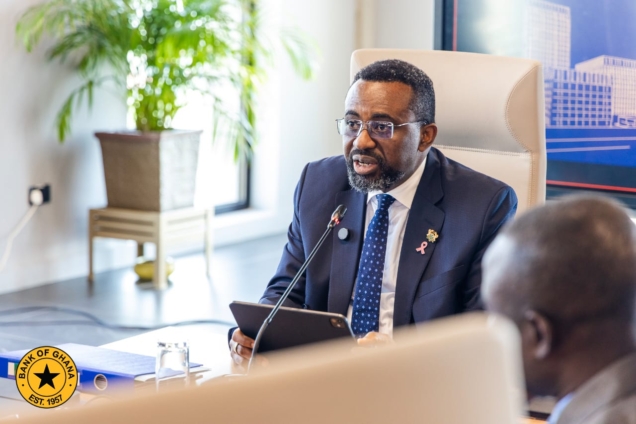
The Governor of the Bank of Ghana has pledged to build an agile central bank ready for emerging risks.
According to him, financial technology and crypto pose real challenges and therefore his outfit is updating legislation, creating capacity, and strengthening its balance sheet to withstand shocks.
Speaking in an interview with the Director of the International Monetary Fund’s Director of Africa Department, Abebe Selassie, the Governor said, “My vision is a central bank with the manpower, agility, and resilience to manage future risks—crypto today, something else tomorrow”.
“My mandate is clear: achieve price and financial stability, and I believe we’re on course. But two priorities stand out. First, tackling dollarisation. I’ve seen this challenge for decades, and making the cedi the sole legal tender is critical for effective monetary policy. My second priority is to build an agile central bank ready for emerging risks.”
To safeguard the independence of the central bank, Dr. Asiama said the Bank of Ghana has introduced legislative reforms to eliminate central bank financing of the government and clearly define emergencies.
“The impact on banks from sovereign exposure has been significant and should never happen again. But corporate bond activity is picking up, and we’re trying to list more banks on the stock exchange to attract long-term capital and strengthen equities”, he mentioned.
“On the central bank side, domestic debt restructuring hit our balance sheet hard, and rebuilding is a medium-term priority. To safeguard independence, we’ve introduced legislative reforms to eliminate central bank financing of the government and clearly define emergencies”, he explained.
In describing the framework for managing foreign exchange, he pointed out that his outfit followed a managed float to smooth volatility, not to dominate the foreign exchange market. “Recent intervention was due to large payments to independent power producers, bondholders, and declining remittances due to currency appreciation”.
He added that conditions have improved with mining inflows now going through banks, and “unused foreign exchange offers flow into reserves”. “We are increasing local processing of commodities to address our reliance on raw materials such as gold, oil, and cocoa”, he concluded.
Latest Stories
-
Friends of Bridget Bonnie Marks her 35th birthday with donation to Kasseh Model Health Centre
33 minutes -
Landfilling waste management creates no value, it’s an economic waste
60 minutes -
Photos: Speaker Bagbin Commissions MPs constituency office under parliamentary decentralisation programme
1 hour -
Black Stars technical advisor Winfried Schäfer sacked as GFA shakes up backroom staff
1 hour -
Wenchi water project almost complete, critical to gov’t agenda – GWL MD
2 hours -
Anti-LGBTQ+ bill not part of government’s legislative agenda – Inusah Fuseini
2 hours -
Anti-LGBTQ Bill: Forget the rumour mongers, I’m a man of action, and will pass the bill – Speaker
2 hours -
Women and children among those killed in Sudanese army shelling of wedding celebration
2 hours -
President Mahama is not sincere with Ghanaians on LGBTQ bill matter – Hassan Tampuli
3 hours -
Gov’t to establish Prison Industrial Hub to equip inmates with income-generating skills – Prison Service boss
3 hours -
Alhassan Tampuli donates cement, roofing sheets to support storm victims in Gushegu
3 hours -
Alhassan Tampuli appeals for urgent support for storm victims in Gushegu
3 hours -
The hypocrisy must stop; pass Anti-LGBTQ+ Bill now – Alhassan Tampuli to Mahama
3 hours -
Imprisonment should be rehabilitative, not punitive – Ghana Prisons boss at UNGA
4 hours -
Ga Adangbe traditional priests petition Mahama over McDan aviation licence revocation
4 hours