

Audio By Carbonatix
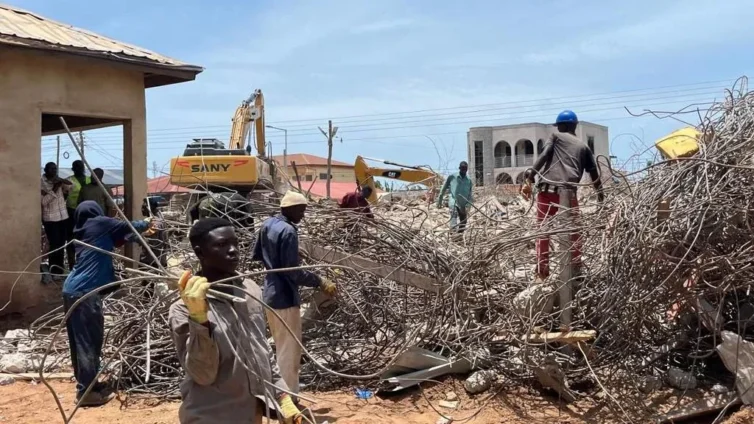
The tragic collapse of an abandoned structure at Accra New Town, with its reported loss of lives and severe injuries, is a painful and sobering reminder of a challenge we can no longer afford to ignore. This is not merely an unfortunate incident—it is a national wake-up call.
My deepest condolences go to the bereaved families, and my thoughts are with all those who have been affected. In moments like this, we must go beyond grief and ask the difficult, but necessary, questions that will help us prevent future occurrences.
This structure, believed to have been initiated over a decade ago as part of a public project, stood incomplete and unattended for years. Over time, it became accessible and was reportedly used for various activities. Its condition, visible to many, posed an obvious risk. The critical question is: how did we allow such a known hazard to persist in the heart of a community?
This is not about assigning blame. It is about confronting a systemic issue within our governance and development processes.
At the heart of this tragedy lies a breakdown in three key areas: accountability, monitoring, and enforcement.
First, every public project must have a clearly defined chain of responsibility—from initiation to completion. When projects stall, there must be designated institutions or officers accountable for securing or repurposing them. Infrastructure cannot be abandoned without consequence.
Second, local authorities must be adequately empowered and resourced to carry out routine inspections of buildings within their jurisdictions. District and municipal assemblies are the first line of defense in identifying structural risks. However, this responsibility must be matched with the necessary logistics, personnel, and legal backing to act decisively.
Third, enforcement of safety standards must be non-negotiable. Where structures pose a danger to human life, swift action must be taken—whether through rehabilitation, restriction of access, or demolition. Delayed action often comes at a far greater cost.
This incident also raises broader national concerns. Across our towns and cities, there are numerous abandoned or uncompleted structures—both public and private—that silently threaten the safety of our citizens. We must ask ourselves: must we always wait for disaster before we act?
As a nation, we must transition from reactive responses to proactive governance. Prevention must become the cornerstone of our development strategy.
To this end, I call for:
• A nationwide audit of all abandoned and uncompleted structures.
• Immediate risk assessments and safety interventions for identified sites.
• Strengthened institutional coordination between central government agencies and local authorities.
• A clear policy framework that ensures no project is left unattended without accountability.
Equally important is community awareness and participation. Residents must feel empowered to report unsafe structures, and authorities must respond promptly to such concerns. Safety is a shared responsibility.
Let me emphasize: this is not a political issue. It is a human issue. The loss of even one life due to preventable circumstances is unacceptable. We must rise above partisanship and focus on building systems that protect our people.
The Accra New Town tragedy must not fade into silence. Let it mark a turning point—a moment when we collectively decide that neglect will no longer be tolerated, and that public safety will always come first.
If we fail to act decisively now, we risk repeating this painful chapter elsewhere.
Let us choose responsibility. Let us choose action. Let us choose life.
By: Alfred Asiedu Adjei, President, National Association of Local Authorities of Ghana (NALAG)
Latest Stories
-
Ghana must value skilled trades, build resilient learners — Ibn Chambas
7 minutes -
Ghana must rethink education around relevance, resilience and responsibility — Ibn Chambas
10 minutes -
Prince Harry faces defamation lawsuit from charity he co-founded
12 minutes -
South Korea deploys thermal cameras to track escaped zoo wolf
13 minutes -
Calls for royal meeting with Epstein survivors grow ahead of US visit
17 minutes -
Ibn Chambas advocates blend of technology and human values in education
18 minutes -
UMA improves healthcare access in Asutifi North with GH₵700k ‘Kim Taylor Legacy’ Walkway
23 minutes -
Scholarships Authority and Fanaka University offer sponsorship for procurement and supply chain studies
26 minutes -
Bisa Kdei drops new single ‘Go N Look’ featuring Medikal
33 minutes -
Benin facing rising terrorism in north as French military presence faces growing criticism
34 minutes -
UEW Public Lecture Series 2026: Education debate ‘about the soul of Ghana’s future’ — Dr Ibn Chambas
35 minutes -
EU fingerprint and photo travel rules come into force from today
1 hour -
Anti-LGBTQ+ Bill: Ghanaians demand expedited passage, not dialogue – Ntim Fordjour to Mahama
1 hour -
EU airline industry warns of fuel shortages if Strait of Hormuz stays closed
1 hour -
White House staff told not to place bets on prediction markets
1 hour