

Audio By Carbonatix
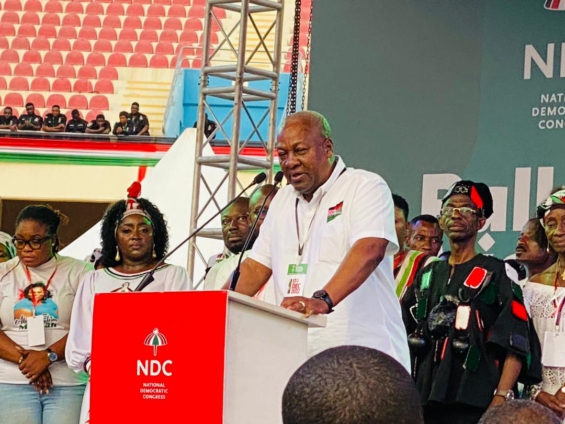
The opposition National Democratic Congress (NDC) is most likely to win the 2024 presidential elections, Fitch Solutions has stated in its analysis titled “Positive Shift in Ghana's Political Risk Profile Following IMF Programme Approval”.
According to the UK-based firm, the rapid deterioration of economic conditions in 2022 and slow progress in the fight against perceived corruption will exacerbate anti-incumbency sentiment among the electorate
“The rapid deterioration of economic conditions in 2022 and slow progress in the fight against perceived corruption – in a July 2022 Afrobarometer study, 85.0% of Ghanaians believed the government was doing a poor job in tackling corruption - will exacerbate anti-incumbency sentiment among the electorate”.
“In addition, the IMF has voiced concerns over President Nana Akufo-Addo’s flagship Free Senior High School programme (introduced in 2017), labelling it as “poorly targeted”. Potential modifications to the programme in order to rein in spending could weaken the NPP’s campaign agenda, increasing the chances of an NDC win”, it added.

Risks to Ghana’s IMF programme are limited
Despite its view that a government change is likely after the 2024 general election, Fitch Solutions said “we believe that risks to Ghana’s IMF programme are limited. Previous NDC governments have requested IMF loans (Ghana’s 2015-2019 IMF programme was started under an NDC government) and current NDC leadership has expressed support for Ghana’s re-engagement with the IMF”.
Given the limited risks to the IMF programme, it revised Ghana’s 'policy continuity' score in Short-Term Political Risk Index (STPRI) to 70.0 out of 100, from 62.5 previously.
Social unrest to go down
Despite fiscal consolidation efforts under the IMF programme, Fitch Solutions said economic stabilisation and moderating price growth will yield net positive outcomes for Ghanaian households.
“While the government has raised taxes including income taxes and VAT in first-half of 2023, a more stable exchange rate, easing inflation and a stronger external position will gradually normalise economic conditions”.
“We believe that this will lower protest activity in the second half of 223, after the number of protests and riots increased by 17.2% year-on-year in first-half of 2023. To reflect this, we have revised up the 'social stability' score in our Short-Term Political Risk Index (STPRI) to 47.5 out of 100, from 40.0 previously (a higher score implies lower risk)”.
Ghana’s headline STPRI score now stands at 63.1, from 59.4 before. The country remains a regional outperformer, with the average Sub-Saharan Africa STPRI score standing at 50.3, implying that political risks remain relatively contained in Ghana.
Latest Stories
-
Angola appoint Aliou Cissé as new head coach
2 minutes -
Virtual Security Africa showcases digital security vision at Kwahu Business Forum
7 minutes -
EBID strengthens regional integration role amid global economic uncertainty
33 minutes -
Two assault rifles, ammunition retrieved in Police probe of Tamale gang attack
39 minutes -
EBID records strong financial growth with $722m disbursements in 2025 – President, Dr George Donkor
41 minutes -
EBID to mobilise $2.69bn under new 2026–2030 growth strategy – Dr George Donkor
45 minutes -
An open letter to telcos, regulators and security agencies on mobile money fraud in Ghana
45 minutes -
Mobile Money Merchants are driving fraud
1 hour -
Alban Bagbin declines minority’s motion to investigate sale of gold reserves at BoG
1 hour -
NACOC leadership tours drug testing centres in Accra
1 hour -
OSP’s power to prosecute without AG’s authorisation unconstitutional – AG files at Supreme Court
1 hour -
Seven African referees selected for World Cup 2026 as Ndala, Issa Sy miss out
1 hour -
Why diaspora investors are using Accra real estate to hedge against global uncertainty in 2026
2 hours -
GWL urges public support to stem water thefts
2 hours -
Fire guts 2-storey apartment at Ashaley Botwe
2 hours