

Audio By Carbonatix
More than 150 people have been killed after an earthquake struck remote western Nepal on Friday.
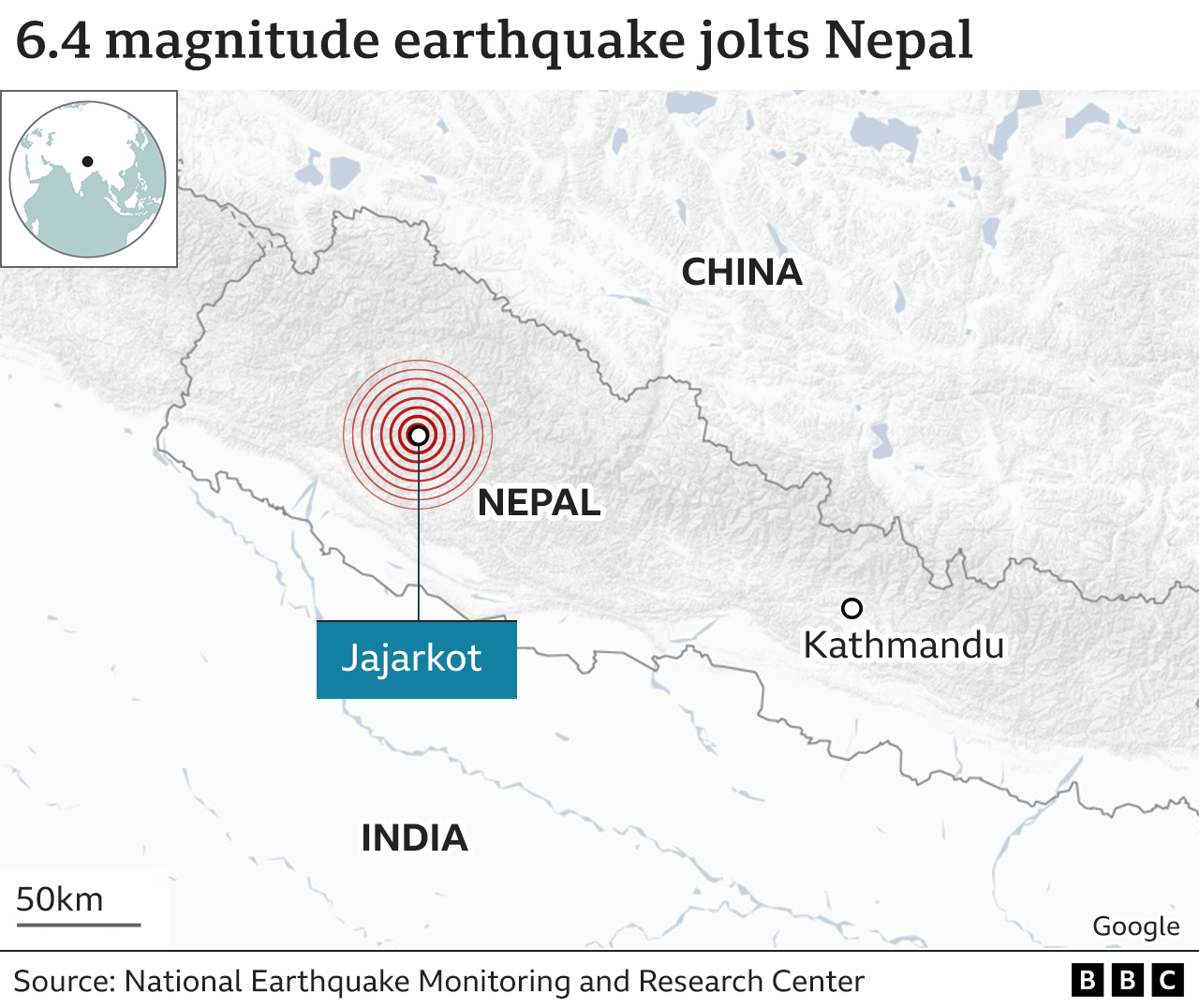
Security forces have been deployed to help rescue efforts in the rugged districts of Jajarkot and West Rukum, 500km (310 miles) west of Kathmandu.
Strong tremors were felt far away in the Nepalese capital and in cities in neighbouring India, including Delhi.
The government said about 375 people had been injured. Jajarkot's hospital is packed with the wounded.
Some people have had to be airlifted as far as Kathmandu, but officials are worried about getting others out after nightfall.
One survivor, Geethakumari Bista, told the BBC that rescuers saved her elder daughter, but she lost her younger daughter.
"We three were in the same room on the top floor. Everything happened so suddenly. We couldn't understand what was happening," she recalled.
After their house collapsed, they were buried in the rubble.
"People shouted around. The armed police came and I shouted: 'I am alive, too'... First, they rescued my elder daughter by carrying her out and taking her downstairs. Unfortunately, they couldn't save my younger one. She was 14 years old."
Three more tremors were felt within an hour of the quake. Local authorities urged people to stay outside for at least 24 hours as minor aftershocks are being reported in the areas.
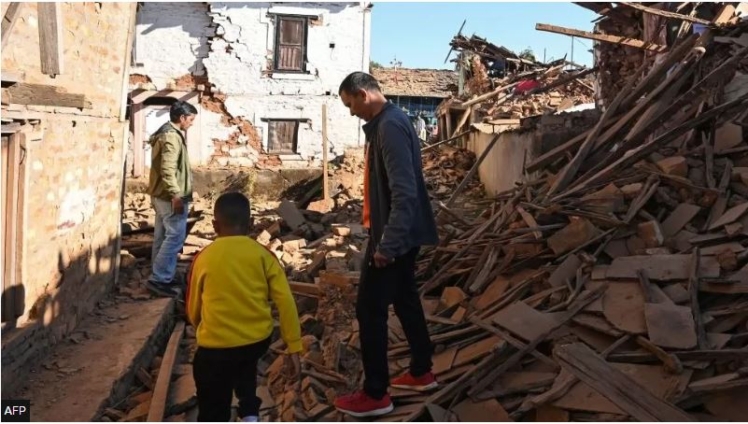
Video footage on local media showed crumbled facades of multi-storied brick houses. People were pictured digging through rubble in the dark to pull survivors from the remains of collapsed buildings in posts on social media.
Unicef Nepal said that they were assessing the damage and the toll of the disaster on children and families.
Nepal's Prime Minister, Pushpa Kamal Dahal, arrived in the affected region on Saturday, after expressing his "deep sorrow" at the loss of life and property wrought by the quake, on social media platform X. He said he had ordered security agencies to immediately launch rescue and relief operations.
A cabinet meeting on Sunday is expected to decide whether to accept foreign assistance for relief and rescue. Officials said many countries, including Nepal's neighbours China and India, had offered humanitarian help.
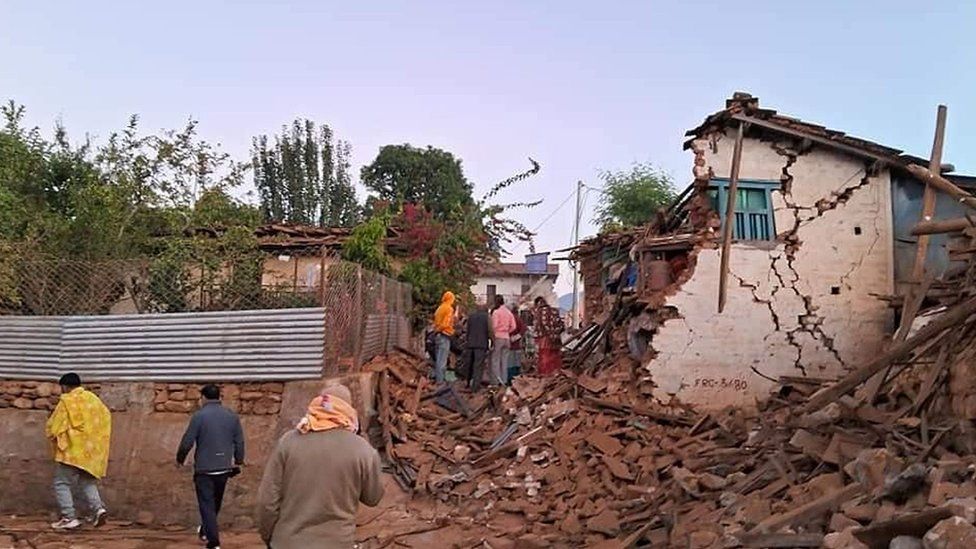
Search and rescue operations are being hampered by roads becoming blocked by landslides that were triggered by the quake.
"Houses have collapsed. People rushed out of their homes. I am out in the crowd of terrified residents," said a police official from the region, Santosh Rokka, who spoke to Reuters immediately after the earthquake.
"We were sleeping. We felt like dying," says Laxman Pun, an earthquake survivor. Their house has been damaged and they could survive "with much difficulty", he told BBC Nepali. "We don't know where we will be able to stay. We will probably need tents."
"Our house shook back and forth like a swing. As we rushed outside, there were houses falling and dust everywhere. We couldn't see anything and so we again moved inside. We came out after the tremors stopped," said Siddha Bohora, a bank manager from Jajarkot.
In Athaviskot municipality, one of the areas worst affected by the earthquake, three people who had critical injuries were sent to hospitals in Surkhet by an army helicopter for further treatment.
Municipality chief Ravi KC warned that because of the cold weather, the victims who lost their houses will "suffer more". The municipality has a population of about 35,000 and hundreds of houses were completely damaged, according to KC.
Local government officials, police and army have been deployed for rescue operations, as there are still bodies left to be recovered from the rubble.
The earthquake was recorded at 23:47 local time (18:02 GMT), according to Nepal's Monitoring and Research Centre.
The US Geological Survey measured the earthquake at a magnitude of 5.6 and said it was a shallow earthquake, meaning it happened closer to the earth's surface.
Nepal is situated along the Himalayas, where there is a lot of seismic activity.
Last month, a 6.3-magnitude earthquake was registered in the western district of Bajhang, resulting in injuries.
In 2015, the country suffered two devastating earthquakes in which 9,000 people were killed and 22,309 injured.
The first, on 25 April 2015, was a 7.8-magnitude quake which caused most of the damage and loss of life. A large number of aftershocks followed, including one that measured 7.3 in May of that year.
The quakes destroyed or damaged more than 800,000 houses mainly in the western and central districts, according to the International Federation of Red Cross and Red Crescent Societies (IFRC).
Government buildings, some stretches of roads and Kathmandu Valley's famous historic monuments - Unesco world heritage sites - were destroyed or damaged, with many villages north of Kathmandu flattened.
Latest Stories
-
Guinea-Bissau transporters strike over higher fuel prices
24 minutes -
Iran ceasefire deal a partial win for Trump – but at a high cost
35 minutes -
Oil slides below $100 after Trump announces two-week ceasefire
44 minutes -
Madagascar declares state of emergency over energy situation due to Iran war
55 minutes -
Ex-Meta worker investigated for downloading 30,000 private Facebook photos
1 hour -
World Bank says Nigerian economy to grow in 2026 but Iran war lifts inflation
1 hour -
Los Angeles Stadium workers urge FIFA to bar ICE from World Cup
5 hours -
Vinicius hails Lamine Yamal for condemning anti-Muslim fan chants
5 hours -
Barcelona’s Flick to defend ’emotional’ teen Lamine Yamal against criticism
5 hours -
FIFA opens disciplinary probe against Spanish FA after Islamaphobic chants
5 hours -
‘We’ve become quite experienced in negativity’ – Liverpool’s Slot
5 hours -
Legendary manager Lucescu dies days after resigning
6 hours -
One dead as train travelling 99mph collides with lorry in France
6 hours -
Airlines cut flights and hike fares as fuel prices surge
6 hours -
Kane inspires Bayern to first-leg advantage over Real Madrid at Bernabéu
6 hours