

Audio By Carbonatix
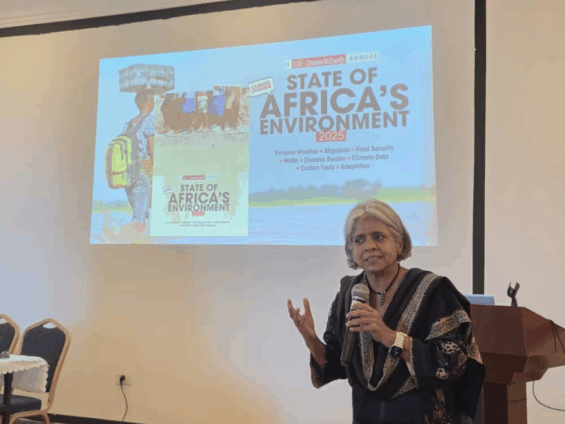
A new report by the Centre for Science and Environment (CSE) in India, titled “State of Africa’s Environment Report 2025”, has painted an alarming picture of Africa’s climate and environmental future.
The report released today in Ethiopia warns that the continent is facing its most devastating five-year period yet, as weather, climate, and water-related disasters intensify.
The 152-page report highlights that between 2021 and 2025, Africa experienced unprecedented losses—marked by rising temperatures, deadly floods, prolonged droughts, and food system shocks.
Africa’s climate crisis is intensifying. In only 15 years, extreme weather has touched the lives of 412 million people, with over half of those cases concentrated in the past five years. Since 2021, more than 41,500 deaths have been recorded, while droughts alone have devastated 178 million lives.
For instance, in Kenya and Ethiopia, repeated droughts have left pastoralist communities unable to feed their herds, wiping out livelihoods and forcing mass migrations. In West Africa, flash floods in Nigeria and Ghana submerged entire communities, displacing families overnight.
Director of CSE, Sunita Narain, said it is time to fulfill commitments, take responsibility, and bring others into the fight against global environmental challenges driven by climate change.
The report warns that Africa could face the world’s highest rate of climate-related displacement if urgent measures are not taken. Nearly 265 million people were forced into internal migration in the past year alone, and projections show up to 5 per cent of Africa’s population of some two billion people could become environmental migrants by 2050.
Director of the Addis Ababa Liaison Office to the AU and UNECA, Dr. Rita Bissoonauth, emphasized that climate change is not only an environmental crisis but also a question of inequality.
She called on journalists to “humanize climate stories, track financing, and amplify local solutions,” noting that the communities hardest hit are often those least responsible for the crisis.
Experts stressed the importance of turning Africa’s vulnerabilities into strengths. Director General of Ethiopia’s Bio and Emerging Technology Institute, Professor Kassahun Tesfaye, highlighted the potential of a sustainable bioeconomy that harnesses Africa’s crops, forests, livestock, and microorganisms within a circular, regenerative system.
While the continent bears the heaviest costs of a crisis it did little to create, the report says, it is also uniquely positioned to lead with homegrown solutions.
Latest Stories
-
Brandon Asante and Coventry all but promoted to Premier League despite Sheffield Wednesday draw
13 minutes -
GPL 2025/26: Late Kwartemaa strike downs Hearts in Tema
19 minutes -
Ghana Faces Sierra Leone Moment as Prosecutorial Powers come under strain
29 minutes -
Don’t consume fish or seafood from Tema Shipyard until further notice – FDA warns
34 minutes -
Why volunteering might be Africa’s most underrated career accelerator
40 minutes -
ActionAid Ghana raises concern over gender gaps in Feed Ghana Programme
42 minutes -
Windstorm wreaks havoc in Gushegu, displacing nearly 2,000 residents and damaging schools
45 minutes -
Friends of Bridget Bonnie Marks her 35th birthday with donation to Kasseh Model Health Centre
2 hours -
From Ekumfi Kokodo to the Pulpit Stage: Essi Donkor’s gospel journey takes shape
2 hours -
Landfilling waste management creates no value, it’s an economic waste
2 hours -
Photos: Speaker Bagbin Commissions MPs constituency office under parliamentary decentralisation programme
2 hours -
Black Stars technical advisor Winfried Schäfer sacked as GFA shakes up backroom staff
2 hours -
Wenchi water project almost complete, critical to gov’t agenda – GWL MD
3 hours -
Anti-LGBTQ+ bill not part of government’s legislative agenda – Inusah Fuseini
3 hours -
Anti-LGBTQ Bill: Forget the rumour mongers, I’m a man of action, and will pass the bill – Speaker
3 hours