

Audio By Carbonatix
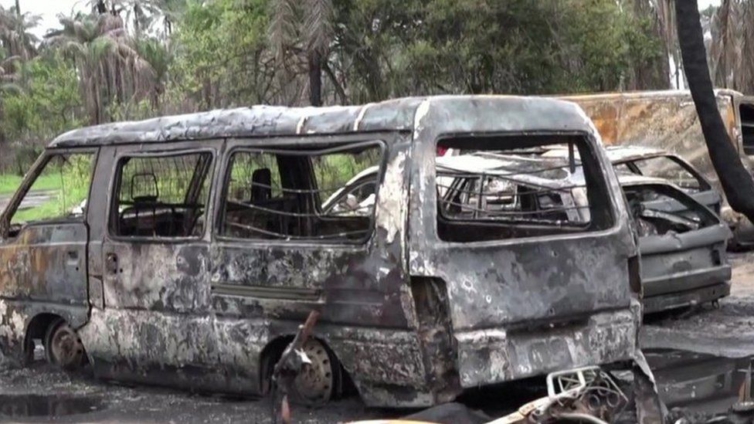
Nigeria's president has said the country is in "shock and trauma" following the deaths of at least 100 people from an explosion at an illegal oil refinery.
President Muhammadu Buhari described the incident in Imo state, southern Nigeria, as a "catastrophe and a national disaster".
Many victims were burnt beyond recognition.
The police are now looking for the owner of the illegal refinery.
The damage to fishing and farming caused by the oil industry over the decades and the failure to share the oil wealth has led some to find other ways to make money.
Illegal refining is attractive as in parts of the oil-rich Niger Delta it is seen as being relatively easy to pull off, despite efforts to halt the practice.
Dozens of people were thought to have been working at the refining plants when they were caught in the huge fire.
The death toll has risen as emergency workers go through the scene. Ifeanyi Nnaji of the National Emergency Management Agency told BBC Igbo that the number killed now stood at 109.
"We learnt many bodies are in nearby bushes and forests as some illegal operators and their patrons scampered for safety," he earlier told the AFP news agency.
Charred human remains, as well as fragments of belongings, such as flip flops, bags and clothing, were witnessed across the scene of the disaster by a journalist for the Reuters news agency.
In a statement on Sunday, Mr Buhari offered his condolences to families of the victims and said those responsible for the explosions must be caught and brought to justice.
The authorities have been struggling to curb the proliferation of illegal plants where stolen crude oil is refined. The president ordered security forces to intensify efforts to shut these refineries.
It is not yet clear what caused the explosion that happened sometime overnight into Saturday, but accidents have been common in the past at similar dangerous sites where safety measures are not enforced.
There have been concerns over a lack of precautions at such facilities as well as over the environmental pollution they cause.
But Nigeria's official oil refineries do not work to capacity, causing frequent fuel shortages and price increases across the country.
Latest Stories
-
Hip-hop pioneer, Afrika Bambaataa, dies aged 68
2 minutes -
Let OSP defend itself in Supreme Court case — Prof Prempeh
11 minutes -
Emmanuel Kweenu Haizel aka Simpa Panyin
12 minutes -
Police foil planned highway robbery in Ashanti Region, one suspect shot dead
18 minutes -
Sunyani Technical University dismisses 3 students over examination malpractice
1 hour -
NPRA prosecutes 11 employers, recovers GH¢27m in 2025
1 hour -
NAIMOS cracks down on illegal mining activities along River Tano
1 hour -
2026 World Cup: Officials selected are the world’s very best – FIFA defends referees list
1 hour -
NAIMOS taskforce embarks on major anti-galamsey operations at GREL plantation and along Ankobra River
2 hours -
Akufo-Addo arrives in Cotonou to lead ECOWAS mission to observe Benin presidential election
2 hours -
AMA, Mexican Embassy renew commitment to strengthen bilateral cooperation, deepen sister-city ties
2 hours -
Bolt pushes for expanded support for women-owned enterprises
2 hours -
Hubtel hosts leaders of the UK Department for Business and Trade
2 hours -
Today’s Front pages : Friday, April 10, 2026
3 hours -
‘We don’t have time’ – Fianoo calls for Schäfer to lead Black Stars temporarily
3 hours