

Audio By Carbonatix
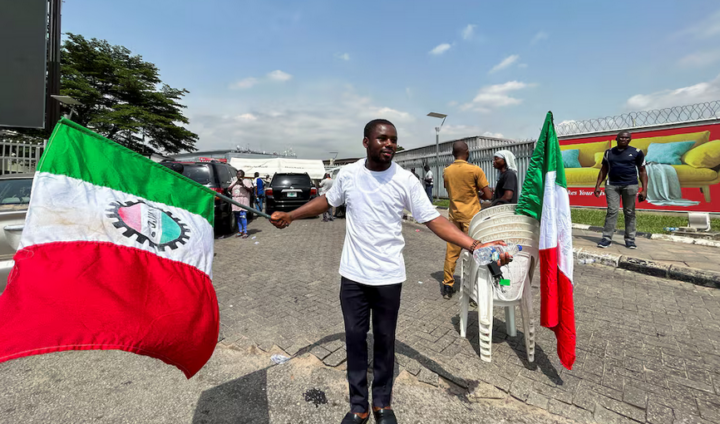
Nigeria's main labour unions on Monday shut down the national grid and disrupted flights across the country as they began an indefinite strike over the government's failure to agree a new minimum wage.
The strike began after talks broke down between the government and the country's two biggest union federations, the Nigerian Labour Congress (NLC) and the Trade Union Congress (TUC), over increasing the minimum wage. It is the fourth since President Bola Tinubu took office last year.
The Transmission Company of Nigeria (TCN) said union members drove operators away at the country's power control rooms and shut down at least six substations, eventually shutting the national grid at 02:19 am (0119 GMT).
Nigerian airline Ibom Air said it was suspending flights until further notice due to the strike, while another, United Nigeria, said airports across the country had been shut down and striking workers had permitted none of its flights to operate.
Electricity and aviation unions said in a statement on Monday they had directed members to withdraw their services in compliance with the indefinite strike.
Oil unions also threatened to halt oil production, but Nigeria's oil regulator chief Gbenga Komolafe said contingencies were in place to ensure output was not disrupted.
Since taking office Tinubu, has embarked on Nigeria's boldest reforms, which has fuelled a rise in inflation to an almost 30-year high and worsened a cost-of-living crisis in Africa's most populous nation.
He has been under pressure from unions to offer relief to households and small businesses after scrapping subsidies on petrol, which kept fuel cheap but cost the government $10 billion a year.
"We have a responsibility to strike a measured and realistic balance in this effort to arrive at a new minimum wage for Nigerians," said Information Minister Mohammed Idris, after talks with union leaders reconvened on Monday afternoon.
Unions declared the indefinite strike on Friday after talks for a new minimum wage meant to cushion the impact of reforms collapsed. They had demanded a sixteen-fold raise in the minimum wage to 494,000 naira ($333.23) a month from 30,000 naira, and vowed to continue the strike until a new minimum wage was in place.
Unions have also demanded the reversal of an electricity tariff hike effected in April for better-off consumers who use the most power, as the government tries to wean the economy off subsidies.
The TCN said it was making efforts to recover and stabilise the national grid, but unions were obstructing grid recovery nationwide.
On Thursday, Nigeria's privatisation body said the country had secured a World Bank loan of $500 million for its electricity sector.
($1 = 1,482.4800 naira)
Latest Stories
-
Current account stability to mitigate pressure on cedi; currency to end year at GH¢11.40 to a dollar
39 seconds -
T-bills auction: Government records 32% undersubscription; interest rates rise again
3 minutes -
Economy to remain relatively insulated from fallout of US–Iran conflict – Fitch Solutions
4 minutes -
[Watch Live] Shatta Wale, Kofi Kinaata, and others ignite the grand finale of Gomoa Easter Carnival
2 hours -
Berekum Chelsea edge Aduana FC in Bono derby to boost survival hopes
6 hours -
‘They can’t control the team’ – Ernest Thompson doubts local coaches for Black Stars role
6 hours -
Ghana-born midfielder Seidu realises ‘dream’ with Atlético Madrid debut
6 hours -
GPL 2025/26: Bubakari strikes late to hand All Blacks vital win over Dreams FC
6 hours -
Fatal crash on Kintampo–Tamale highway claims four lives
6 hours -
2025–26 FA Cup Semifinal Draw: Chelsea, Man City Learn Wembley Opponents
7 hours -
GPL 25/26: Gold Stars back on top after beating Nations FC
8 hours -
GPL 2025/26: Heart of Lions roar back with victory over Vision FC in Kpando
8 hours -
Solomon Agbasi: Hearts keeper in stable condition after concussion
8 hours -
GPL 2025/26: Late Salim Adams penalty earns Medeama draw at Bechem
9 hours -
Hearts pip Young Apostles 1-0 to end 5-game winless run
9 hours