

Audio By Carbonatix
The Executive Secretary of the National Media Commission (NMC), George Sarpong has urged the media to place Ghana’s peace above all else in their professional duties.
He stressed that a peaceful Ghana is essential for development, stating, “You are better off living in a peaceful Ghana with your preferred candidate losing than in a country up in flames.”
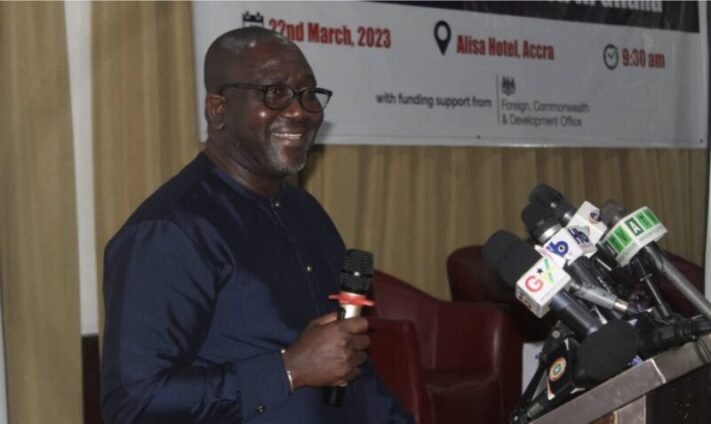
Mr. Sarpong made this call during a one-day dialogue with media practitioners, including radio and television hosts, producers, and political/current affairs programme presenters, held in Accra.
The event was organised by the Media Foundation for West Africa (MFWA) with funding from the U.S. Embassy in Ghana. It brought together media professionals from both public and private sectors.
The dialogue aimed to promote the use of respectful language in the media and tackle disinformation and misinformation.
“You are the ones we rely on to build peace in Ghana,” Mr. Sarpong remarked.
He also emphasized that democracy fosters development, as competing political parties often implement programs and infrastructure to legitimize their rule.
“Where there is no incentive for people to do anything to stay in power, they will not do anything,” he added.
Mr. Sarpong acknowledged the commitment of most producers and presenters to ethical journalism but also pointed out that a small minority of media professionals disregard these principles, often making their actions more conspicuous.
He urged those upholding the ethical standards to remain steadfast, reminding them that their efforts are valuable.
“Don’t think the peaceful moves you make don’t matter,” he said.
Dr. Kojo Impraim, Programme Director for Media for Peace and Sustainable Development at the Media Foundation for West Africa (MFWA), reinforced the importance of producers and presenters in shaping civil discourse within the media.
He shared findings from MFWA research, highlighting concerns that some media outlets give political figures a platform to act irresponsibly, which contributes to heightened political tensions in the country.
Findings from MFWA’s August 2024 report, Monitoring Indecent Language on Radio 2024, revealed that show moderators intervened to correct indecent language in only five per cent of cases, leaving 95 per cent unaddressed.
A follow-up report for September showed a slight improvement, with moderators attempting interventions in only 10 per cent of cases, leaving 90 per cent unaddressed.
Dr. Impraim explained that the organization had conducted the research every election year since 2012.
The goal, he said, was to reduce the incidence of abusive language on media platforms, reject divisive narratives, and encourage respectful political discourse.
Some participants in the dialogue highlighted the issue of media ownership by political figures, noting that media outlets are often used as tools to promote political agendas.
They suggested that indecent language persists, particularly during election periods, because journalists are pressured by media owners to allow such behaviour.
Participants also pointed to economic incentives and the low remuneration of journalists as factors that contribute to unethical conduct in the media.
Mr. Benjamin Alexander Davis, Chair of the Department of Multimedia Journalism at Morgan State University in the United States, advised the participants to differentiate between political propaganda and factual reporting, stressing the importance of prioritizing accuracy over speed.
He also encouraged media practitioners to work closely with the government to implement regulations that ensure a safe media environment for all.
Mr. Davis also urged journalists to keep abreast of advancements in Artificial Intelligence (AI) and 5G technology, noting that these innovations offered opportunities to reach more specific and hyper-local audiences.
Madam Gloria Hiadzi, Executive Secretary of the Ghana Independent Broadcasters Association (GIBA), expressed concern over the growing prevalence of disinformation and misinformation, which she warned posed a significant threat to peace and democratic governance.
She called on journalists and media personnel to adhere to ethical standards and help foster a media environment that serves the public good.
Madam Hiadzi said GIBA recognised the vital role the media played in Ghana’s democracy, providing a platform for citizens to engage in meaningful discussions on issues affecting them.
She also highlighted the importance of ongoing professional training to empower media personnel in fulfilling their roles effectively.
Mr. Matthew Asada, Press Attaché at the United States Embassy in Ghana, affirmed that the U.S. government had long supported Ghana’s democracy.
He mentioned that the U.S. was working to strengthen Ghanaian institutions, including the Coalition of Domestic Election Observers (CODEO), the Media Foundation for West Africa (MFWA), the Ghana Journalists Association (GJA), and Dubawa.
Latest Stories
-
Mahama endorses ADB at Kwahu Business Summit
58 minutes -
Every gram will be tracked – Gold Board unveils traceability push to deal with illegally-mined gold
1 hour -
Analysis: Why the Bank of Ghana sold half its gold reserves
1 hour -
Buy wrong gold, face prosecution – Gold Board CEO cracks down on rogue dealers
1 hour -
Africa pushes integrated health agenda ahead of One Health Summit in Lyon
2 hours -
We own the strategy, its not head office decision – GCB MD positions bank as engine of Ghana’s economy
2 hours -
No more waiting for head office – GCB boss pushes Ghana-first banking
2 hours -
Mahama lauds Julius Debrah for shaping Kwahu Business Forum
3 hours -
Why actors beg in difficulty – Patience Ozokwor on Nollywood financial struggles
3 hours -
Any man who apologises to woman deserves to suffer – Brymo
3 hours -
Nigerian artistes no longer put effort into making music – Omah Lay claims
3 hours -
‘I’m now skeptical about going into politics’ – Davido
3 hours -
Nigeria’s Seplat Energy resumes operations as oil workers halt strike action
4 hours -
Nigeria launches manhunt after abductions by bandits in northwest Zamfara
4 hours -
Kenya fuel executives resign as state probes supply chain irregularities
4 hours