

Audio By Carbonatix
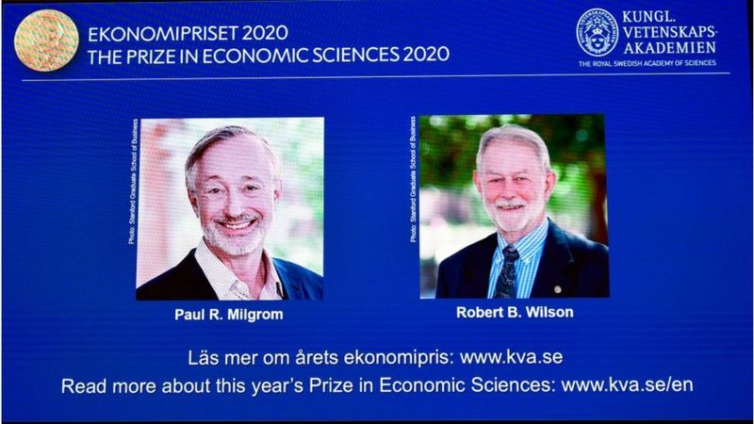
Paul Milgrom and Robert Wilson have won the 2020 Nobel Economics Prize for their work on auction theory.
The Stanford University game theorists have helped in developing formats for the sale of aircraft landing slots, radio spectrums, and emissions trading.
The Royal Swedish Academy of Sciences said their work "benefitted sellers, buyers and taxpayers" worldwide. Game theory uses mathematics to study decision-making, conflict, and strategy in social situations.
"This year's laureates in economic sciences started out with fundamental theory and later used their results in practical applications, which have spread globally. Their discoveries are of great benefit to society," said Peter Fredriksson, chair of the prize committee.
Prof Wilson developed a theory for auctions where the value of the object on the block is uncertain beforehand but ends up being the same for everyone - for example, the value of radio frequencies, or the volume of a mineral in a particular area.
He also developed a theory as to why rational bidders tend to place maximum bids that are below what they estimate the actual value of the object to be: they are worried about the so-called "winner's curse" - overpaying to win the auction.
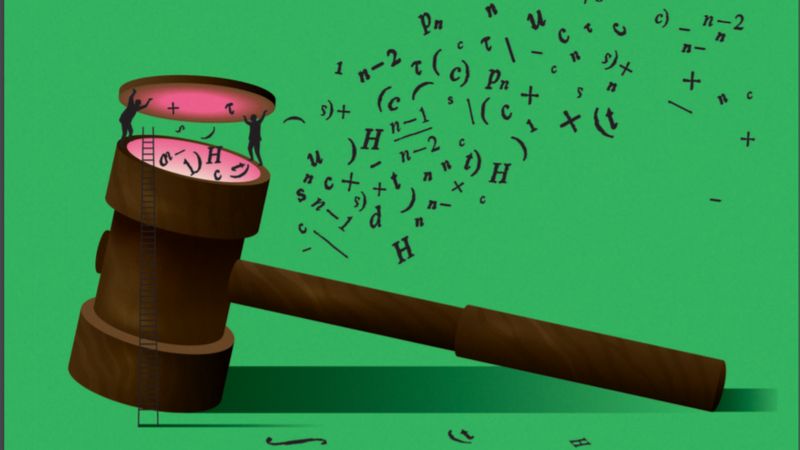
Prof Milgrom put together a theory which takes into account not only auctions where the object turns out to have the same value for all the bidders, but also for auctions where the object is valued differently by different bidders.
He demonstrated that the seller should get a higher revenue when bidders learn more about each other's estimated values during bidding.
The professors invented new formats in response to more complicated auctions where the seller is motivated not only by maximising revenues, but also by the amount of societal benefit that can be achieved, for example, in a radio frequency auction for telecoms operators.
The prize, worth 10m Swedish crowns (£887,000), is not one of the original five Nobel awards created in the 1895 will of industrialist and dynamite inventor Alfred Nobel, but was established by Sweden's central bank and first awarded in 1969.
The prize has been won in the past by economists including Paul Krugman and Milton Friedman, and last year was won by poverty-fighting couple Abhijit Banerjee and Esther Duflo.
Latest Stories
-
Tecco Mensah writes: Why football fans must look beyond statistics
37 minutes -
Police recover stolen Honda CR-V in Kumasi within 48 hours
1 hour -
Apetorku Gbodzi 2026 Festival opens in Dagbamete with development focus
1 hour -
President Mahama arrives in Lyon to co-chair One Health Summit
2 hours -
Beverly View Plus Hotel draws crowds amid coastal Easter rush in Volta
2 hours -
Maiden Zongo Festival held in Wa amid calls to tackle drug abuse among the youth
2 hours -
FDA warns of fake HIV test kits on Ghanaian market
2 hours -
Africa urged to build resilient health systems as donor support tightens
3 hours -
Easter gesture: Ablakwa settles medical bills for 85 North Tongu constituents
4 hours -
Africa must harness its population strength—Titus-Glover
4 hours -
Visa-free access doesn’t mean unlimited stay – Lom Ahlijah
4 hours -
From Golgotha to Kwahu: The Easter Migration of the Faithful and the Faithless
6 hours -
How the Ghanaian onion traders’ standoff with Nigeria unfolded and threatened local supply
6 hours -
No compensation for demolished structures on 24-Hour Economy market lands — Gov’t to structure owners
6 hours -
Financial Institutions must back local enterprises to spur growth – Deputy Minority Whip
6 hours