

Audio By Carbonatix
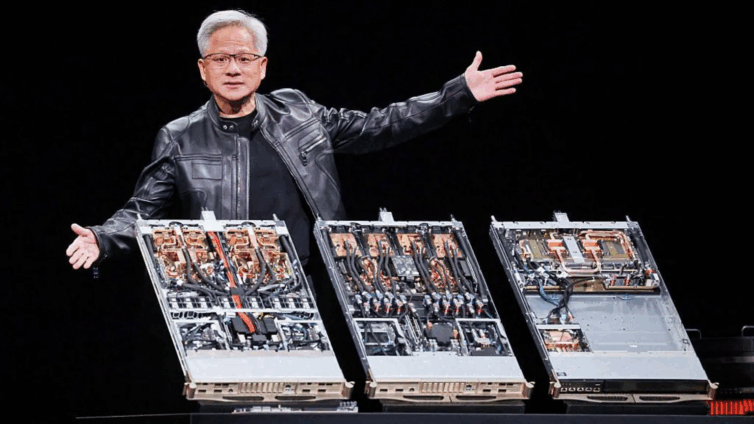
Nvidia boss Jensen Huang has blasted US rules that blocked exports of advanced computing chips to China, arguing that they were backfiring against American companies.
At a press conference at the annual Computex conference in Taipei, Taiwan, he called the policies a "failure".
His comments come just days after the Trump administration said it was dropping rules blocking exports to China entirely and restricting sales to dozens of other countries.
The measures, announced in the final days of Joe Biden's presidency, drew fierce pushback from tech companies, including Nvidia.
The US started imposing controls on exports related to semiconductors during Trump's first term, citing concerns about letting technology with potential military use fall into the hands of companies connected to the Chinese government.
The Biden administration tightened the restrictions significantly.
During Biden's four-year tenure, Nvidia's share of the Chinese market dropped from 95% to 50%, Mr Huang said on Tuesday.
He argued that the restrictions had pushed Chinese companies toward home-grown alternatives, spurring Chinese investment in the industry.
"The fundamental assumptions that led to the AI diffusion rule in the beginning, in the first place, have been proven to be fundamentally flawed," he told reporters.
Mr Huang's comments reflect an ongoing debate in the US over how to balance global business interests with economic and national security concerns, against a backdrop of tensions with China.
Trump has spearheaded sweeping trade tariffs, despite objections from business groups.
But he has taken a more mixed approach to the tech industry, from which he drew critical support during last year's re-election campaign.
The decision to drop the most expansive Biden-era rule helped facilitate AI deals between firms such as Nvidia and countries including Saudi Arabia, which was announced during Trump's tour of the Middle East last week.
But the White House has tightened restrictions in other ways, barring US firms from sales of advanced technology to dozens of new companies, mostly from China.
Last month, the Commerce Department said it would impose new licensing requirements for exports of certain Nvidia chips.
It has said it intends to replace the Biden-era restrictions with its own approach.
It also recently issued an alert to US firms, warning them that using Huawei chips risked violating US rules.
Beijing has since pushed back against that move, accusing the US of undermining the framework agreed during trade talks in Switzerland earlier this month.
Latest Stories
-
Photos: President Mahama’s high-level session on reparatory justice at United Nations
20 minutes -
‘Likely to cause financial loss’ – Minority demands OSP, CHRAJ probe into old BoG office contract
26 minutes -
Ghana is home to most slave structures in Africa – Mahama
44 minutes -
Scrutinise sole-sourced contracts beyond percentages – Edem Senanu cautions gov’t
48 minutes -
5 secrets that will make your living room look expensive, according to pro designers
57 minutes -
Recording Encounters with Security Forces in Ghana Wrong? – Forced Deletion of Evidence?
58 minutes -
About 1,200 businesses in Burma Camp to start paying for electricity as gov’t scraps exemption
1 hour -
Ghana’s Next Big Reform should be Migration
1 hour -
There’s no such thing as a slave – Mahama urges global rethink at UN
1 hour -
EOCO’s case crumbles as High Court clears Gabriel Tanko Kwamigah-Atokple
1 hour -
UN slavery resolution a pathway to healing and justice – Mahama
2 hours -
Mahama warns against modern-day erasure of black history in schools, media
2 hours -
At Nobi Agriculture, scale and systems redefine farming in Ghana
2 hours -
TCL named official electronics sponsor of UG Corporate Football League
2 hours -
Hon Stanley Basil Bade Carboo aka Nene Opertoto II
2 hours