


Audio By Carbonatix
The 5th Edition of the Open Forum on Agricultural Biotechnology (OFAB), Ghana Chapter media awards ceremony came off in Accra.
The WAEC Heights event was under the theme “Credible and balanced Science Reporting in Readiness for Biotech Seed Development”.
The event was to honour and acknowledge hard-working journalists promoting Agricultural Science as well as Biotechnology in the country.
The Former Director of Biotechnology and Nuclear Agricultural Research Institute, Ghana Atomic Energy Commission (GAEC) Prof. Kenneth Danso, in his welcome address, acknowledged the efforts of the media in disseminating information relating to Agricultural Science.
He said it was only through the delivery of accurate science reporting that people will come to appreciate and understand the work of scientists, particularly when it comes to agricultural biotechnology.
According to him, when journalists teamed up with scientists, it will help to address food security threats in the country and beyond.
“Biotechnology is there to solve human problems,” Prof. Danso noted, pointing out that information on the technology could only be made understandable to the public by journalists.
“The OFAB Media Awards, an initiative of the African Agricultural Technology Foundation (AATF), is to provide an opportunity to enhance knowledge-sharing and awareness creation of agricultural biotechnology that will raise understanding and appreciation of the technology and contribute to building an enabling environment for informed and timely decision making” he pointed out.
A former awardee of the contest, Ama Amankwah Baafi, a staff writer with the Graphic Communications Group Limited, encouraged Ghanaian journalists to prioritise science-based agricultural reporting.
“Agriculture needs to be given the necessary attention as it is often touted as the bedrock of the economy,” she said.
She noted, “As Ghanaian journalists, we have a serious and a big role to play in correcting the misconceptions about the use of science and biotechnology in agriculture in Ghana.”
According to Mrs Baafi, many countries had achieved a lot with agricultural biotechnology and that it was about time Ghanaian journalists “put out the facts on (GMOs) so people will appreciate it better.”
She expressed the concern that agricultural biotechnology reporting had received less media attention; hence many people had taken advantage of the situation to peddle falsehoods about the technology.
“The topic seems to have been relegated to the background or given limited attention and it is, therefore, time to change the narrative by reporting the facts and not rumors about what pertains within the sector,” Mrs. Baafi, the multiple award-winning journalist noted.
She further encouraged journalists to use their platform to facilitate dialogue on sustainable agricultural practices in Ghana, saying “it is only by creating the platform for dialogues on agric Biotechnology that we could effect policy changes”.
She also appealed to agricultural scientists not to shy away from journalists but to collaborate with them in order to make information on agricultural technologies more understandable to the public.
“Our dear agric scientists, I will also appeal to you not to shy away from the media but open up to us so we can understand the issues better and report on them,” Mrs Baafi appealed.
The National Coordinator for OFAB-Ghana, Dr Richard Ampadu-Ameyaw, said the establishment of OFAB-Ghana has helped to publish credible information on agricultural biotechnology in the country.
He added that OFAB-Ghana only engages with various stakeholders during conferences, workshops, and stakeholder meetings, to bridge the gap between scientists, policymakers and the public.
Dr Ampadu-Ameyaw said considering the threats posed by Climate Change, it was necessary to find innovative solutions such as agricultural biotechnology to address the issues of agriculture in the world, particularly in Africa.
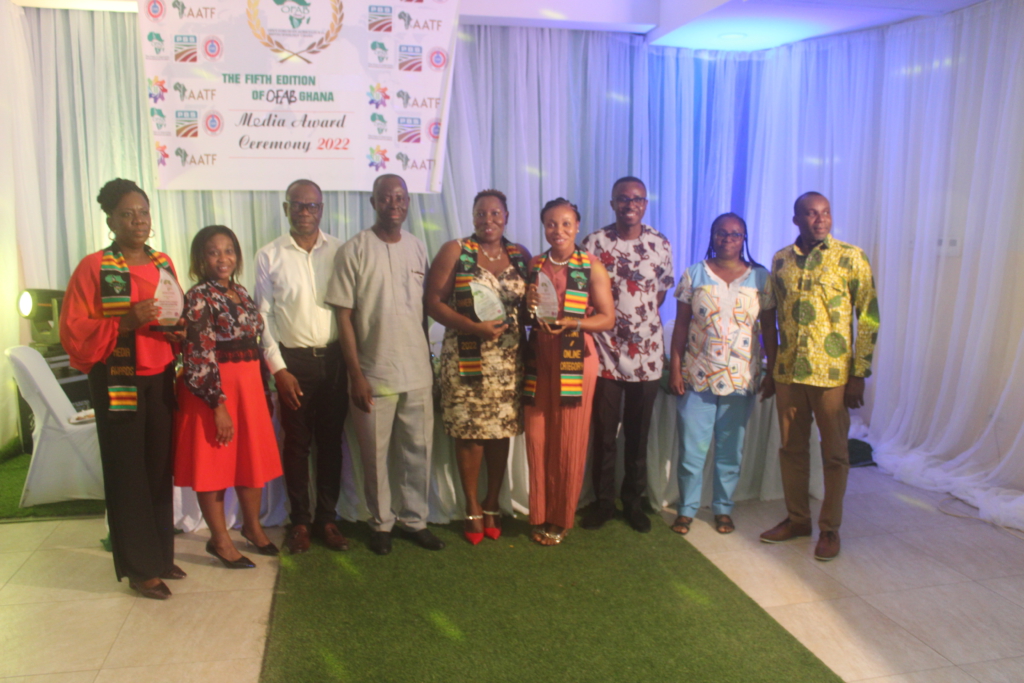
Three female journalists were last Thursday honoured at the Open Forum Agricultural Biotechnology (OFAB) media awards for their dedication to science reporting, particularly on emerging technologies in agriculture.
They are Benedicta Gyimaah Folley of the Ghanaian Times; Gloria Anderson of GTV, and Joyce Gyekye of Radio Ghana.
Folley won the print category of the contest whereas Anderson and Gyekye won the TV and Radio categories respectively. They were awarded with plaques, cash prices and hampers.
Their reportage focused on agricultural biotechnology, particularly on genetically modified organisms (GMOs) and how it could contribute to Ghana's food security.
Latest Stories
-
Prudential Life settles GH¢100,000 medical bills under its PRUCares Valentine Experience Initiative
4 hours -
Wa West Picnic: Peter Lanchene Toobu champions peace, health and unity in landmark celebration
4 hours -
Dr Mensah Market flooded after downpour in Kumasi
4 hours -
Armed men reportedly storm Adjen Kotoku Onion Market amid tensions
5 hours -
Tecco Mensah writes: Why football fans must look beyond statistics
6 hours -
Police recover stolen Honda CR-V in Kumasi within 48 hours
6 hours -
Apetorku Gbodzi 2026 Festival opens in Dagbamete with development focus
7 hours -
President Mahama arrives in Lyon to co-chair One Health Summit
7 hours -
Beverly View Plus Hotel draws crowds amid coastal Easter rush in Volta
7 hours -
Maiden Zongo Festival held in Wa amid calls to tackle drug abuse among the youth
7 hours -
FDA warns of fake HIV test kits on Ghanaian market
8 hours -
Africa urged to build resilient health systems as donor support tightens
8 hours -
Easter gesture: Ablakwa settles medical bills for 85 North Tongu constituents
10 hours -
Africa must harness its population strength—Titus-Glover
10 hours -
Visa-free access doesn’t mean unlimited stay – Lom Ahlijah
10 hours