

Audio By Carbonatix
"Port-au-Prince is in panic mode," a friend in the Haitian capital texted me.
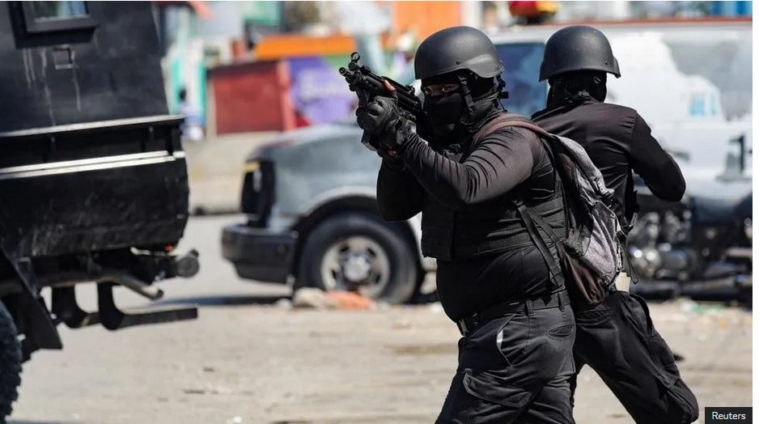
Residents of Petionville, a wealthier area of of the city, are shaken after their most violent day so far in the country's spiralling security crisis.
More than a dozen bullet-ridden bodies lay in the street - the victims of the latest gang rampage.
As well as the early morning killing spree, the home of a judge was also attacked - a clear message to the country's elites vying for power.
All this in what is supposedly the safe part of town.
Unicef's executive director, Catherine Russell, has called the situation in Haiti "horrific" and likened the lawlessness to the post-apocalyptic film, Mad Max.
Certainly the latest violence in Port-au-Prince is a reminder, if any were needed, that Haiti remains closer to anarchy than stability.
In that malaise, the UN has also estimated, because of the closure of so many hospitals in the capital, some 3,000 pregnant women were at risk of having to give birth with no maternity care.
We visited the maternity ward of Cap Haitien's public hospital. The first cries of Baby Woodley, just a day old, were the same as those of children born anywhere: for food and for comfort.
But as most children born there, she will grow up to find that such essentials are far from guaranteed in Haiti.
Lying in an adjacent bed, Markinson Joseph was recovering from giving birth two days ago to a baby boy. Through an interpreter, she told me that she would get her baby out of the country altogether if she got the chance.
"But me and my husband don't have the money to flee," she said.
Dr Mardoche Clervil, the hospital's obstetrician, showed us around dark and empty wards and said that the gangs' control of the roads in and out of Port-au-Prince was making it tough to find enough fuel to keep the lights on, or the ceiling fans whirring.
More importantly, it has also hampered efforts to bring in the drugs and equipment they need.
He said that pregnant women had travelled from Port-au-Prince to give birth in the relative safety of Cap-Haitien.
"As you can see we have enough beds and staff," he said, motioning to the team of nurses and interns behind him. "But quite often the patients just can't reach us, either because of their socio-economic problems or because of the violence."
For some, it has had terrible consequences.
Louisemanie was eight-and-a-half months pregnant when she came into hospital. By then, she had dangerously high blood pressure and lost the baby.
Preeclampsia is treatable had she been properly monitored or the baby been delivered early. Louisemanie was only too aware that her loss was avoidable.
"They've had me on drugs since early January but I've transferred between three different hospitals," she said, meaning her complicated pregnancy was ultimately left to chance.
Across the country, the humanitarian need is now critical and the aid response so far has been painfully slow.
The essential things of life - food, water and safe shelter - are increasingly hard to find for millions.
In Port-au-Prince, Farah Oxima and her nine children were forced from their home in a violent gang-controlled neighbourhood to another part of the city. They are just some of the more than 360,000 internally displaced people in the conflict.
As she filled up plastic jerry cans with water from a standpipe in the street, the 39-year-old admitted she was struggling to provide the food and water her young children needed.
"I don't know what to do, I'm watching the country collapse," she said.
To her, the idea that a transitional council can impose some form of order or security in the short-term seems completely impossible.
"Only God can change this place because from where I'm sitting I can't see where any other change is coming from."
Latest Stories
-
Dr. Dre joins Forbes billionaires list as second-richest hip-hop artist with $1 billion fortune
39 minutes -
Trump administration cannot nix legal status of 5,000 Ethiopians, US judge rules
49 minutes -
Libya announces new oil and gas discoveries with three major energy companies
59 minutes -
Oil rises as investors remain wary US-Iran ceasefire will open supply flow
1 hour -
Police arrest suspect over church threat video
3 hours -
Eight appear in court as police intensify crackdown on illicit drugs in Tamale
3 hours -
Motorist remanded in custody for hitting four-year-old girl
3 hours -
Mobile money vendor robbed at Ziope
4 hours -
Benin’s Finance Minister Wadagni seeks his own mandate in election
4 hours -
GNFS retrieves body of unidentified man from Asylum Down drain
4 hours -
CAF’s Motsepe to visit both Senegal and Morocco amid AFCON fallout
4 hours -
Edmond Boateng takes up secretary role at Honorary Consular Corps of Ghana
4 hours -
Armed men kill 20 and abduct others in northwestern Nigeria villages
4 hours -
Gambia appoints British barrister to prosecute gruesome Jammeh-era crimes
5 hours -
Girl group Flo on entering into their ‘bombastic, confident, strong’ era
5 hours