

Audio By Carbonatix
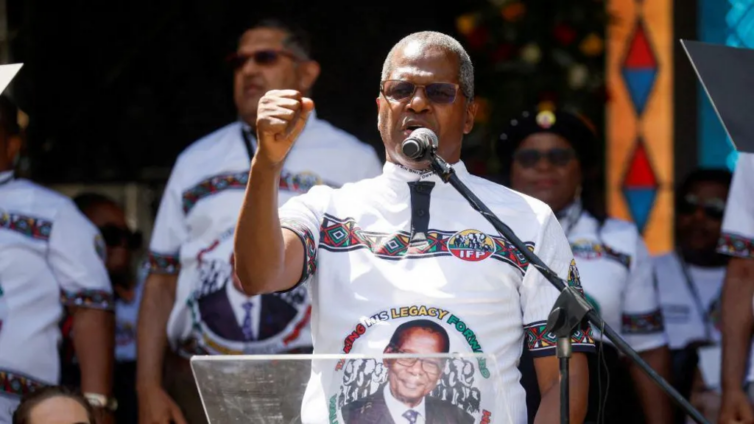
The leader of South Africa's Inkatha Freedom Party (IFP) says his party has agreed to form part of a government of national unity that includes the African National Congress (ANC) and the biggest opposition party, the Democratic Alliance (DA).
Velenkosini Hlabisa told reporters at a media briefing in Durban on Wednesday: "The only options were to become part of the government, or part of the opposition."
"The people of South Africa who voted said that political parties must find a common ground," Mr Hlabisa said.
South Africans have been eagerly waiting to know who would form the next government after the ANC lost its majority in last month's elections.
This is the first official indication that a government of national unity has been agreed, although the DA and ANC have not yet commented.
The ANC has previously said it wanted to form a unity government and had engaged with all of the country's opposition parties.
The new parliament is due to be sworn in on Friday when it is expected to elect a president, so the ANC would hope to have agreed a deal by then. It insists that Cyril Ramaphosa must remain the country's leader.
The ANC vote fell below 50% for the first time since Nelson Mandela led them to victory in 1994 and ended the racist system of apartheid, forcing them to look for coalition partners.
The ANC got about 40% of the vote, with the centre-right Democratic Alliance (DA) on 22%, the MK party of former President Jacob Zuma on 15% and the radical Economic Freedom Fighters on 9%.
The IFP, which is a conservative party with a strong Zulu base, got about 4% of the vote share in the election.
Many ANC activists would prefer to do a deal with the EFF and MK, which are both led by former senior ANC officials.
However, such a coalition would alarm investors because these parties favour seizing white-owned land without compensation and nationalising the country's mines.
The business community would prefer a coalition between the ANC and DA.
Bringing in other parties, such as the IFP, would help deflect criticism that the ANC leadership was "selling out" by working with the DA, seen by some South Africans as representing the country's white minority.
The DA opposes two of the ANC's core policies - its black empowerment programme, which aims to give black people a stake in the economy following their exclusion under apartheid, and the National Health Insurance (NHI) Bill, which promises universal healthcare for all.
"We will participate in the government of national unity for the sake of our country and for the sake of our people, who want life to continue with a stable government that will address their challenges," Mr Hlabisa said.
Mr Hlabisa assured IFP supporters the party would not "lose its identity" as they have worked in a coalition government before.
Following the historic 1994 elections, Mr Mandela's ANC worked with his former enemies in the National Party, which was responsible for the implementation of apartheid, as well as the IFP, whose supporters had frequently clashed with ANC activists, leading to thousands of deaths.
Latest Stories
-
Walter Mosley visits W.E.B. Du Bois Centre in Accra: A New York Secretary’s homecoming story on where Du Bois spent his final years.
2 hours -
MTN set to deploy 5G services after winning spectrum licenses worth US$202m
4 hours -
NPP national elections: 3,000–4,000 police to handle security, traffic in Kumasi – Karbo
6 hours -
Atta Akyea fumes as Manhyia MP is to spend another night in EOCO custody
7 hours -
SSNIT says La Beach clearance was to protect hotel investments, beaches to remain public
7 hours -
APSU congratulates St Augustine’s College after back-to-back National Investment Quiz wins
7 hours -
Renewed flood intervention at Mallam Junction raises hopes among residents, businesses
8 hours -
St Augustine’s College retain National Investment Quiz title after nail-biting grand finale
8 hours -
Education infrastructure investment will drive Banda’s development – Ahmed Ibrahim
8 hours -
Teacher unions strike: Gov’t presents fresh proposals as talks end inconclusively
9 hours -
51,000 teachers’ promotion arrears to be validated for October payment – Education Minister
10 hours -
Kwabena Boamah appointed Board Chair for Impact Investing Ghana
10 hours -
Striking teacher unions to meet Fair Wages and Salaries Commission on October 6
10 hours -
EOCO working with AG to arraign Nana Baffour Awuah before weekend court
10 hours -
Duraplast reassures customers after fire, announces October 5 reopening
10 hours