

Audio By Carbonatix
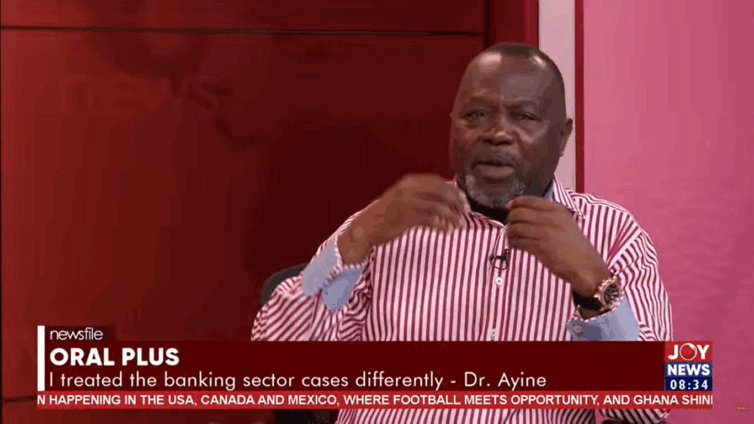
The Attorney-General and Minister of Justice, Dr Dominic Ayine, has explained why he adopted a different approach to the prosecution of banking sector cases, arguing that the charges were largely weak and risked criminalising ordinary banking activity.
Speaking on JoyNews’ Newsfile, Dr Ayine said his assessment of the cases led him to the conclusion that many of the allegations did not meet the threshold for criminal prosecution.
According to him, a central issue in several of the cases was the claim that financial loss had been caused because some banks received liquidity support from the Bank of Ghana and allegedly misapplied those funds.
Dr Ayine questioned the basis of such accusations, stressing that the concept of “misapplication” had not been clearly demonstrated.
“If you take banks generally, banks are in the business of taking risks,” he explained on Saturday, January 10.
“They lend, and sometimes those who take the loans default, probably not due to any fault of theirs, but because the business has gone bust.”
He warned that treating such outcomes as criminal conduct would set a dangerous precedent for the entire financial system. In his view, if banks were to be criminalised simply because liquidity support was granted and loans subsequently failed, then virtually every bank operating in the system could be exposed to prosecution.
“It doesn’t make sense for you to say that because liquidity support was given, they did not apply it in a manner that you thought they ought to apply it,” he stated.
Dr Ayine also addressed specific cases, including that involving former Finance Minister Dr Kwabena Duffuor. He stressed that the allegations were not about theft or personal enrichment.
“In the case of Duffuor, it wasn’t the case that they stole the money. It wasn’t the case that they pocketed the money,” he said.
Rather, the Attorney-General noted that the issues under consideration related to possible negligence and, in some instances, the making of fictitious entries in banks’ books to present a healthier financial position.
He explained that such practices, if proven, may have been aimed at enabling banks to continue operating and to secure further support from the central bank.
“At the end of the day,” Dr Ayine said, “what I then said was that for all the banking cases, I had assessed them, and the evidence was also weak just like the rest of the cases.”
Latest Stories
-
MMFL anchors MTN Group’s fintech push in Ghana
3 minutes -
Ghana’s economy shows recovery signs, but risks persist – S&P maintains stable outlook
19 minutes -
SWAG commemorates its 8th anniversary with a public lecture
22 minutes -
Ibrahim Mahama claims Police Commander failed to stop alleged assault
24 minutes -
Damang lease award to E&P followed due process — Minerals Commission
36 minutes -
Today’s Front pages: Wednesday, April 8, 2026
38 minutes -
Julian Opuni reaffirms Fidelity Bank support for industry-led skills training at DTI Berekuso campus
44 minutes -
CAF President arrives in Dakar to meet Senegalese President, football authorities over AFCON title saga
45 minutes -
Pastor arrested over viral threats against Vice-President
48 minutes -
2026 Success Africa Summit: MTN’s Adwoa Wiafe challenges youth to act with purpose, not just pursue titles
50 minutes -
Nurse laureate launches Cancer Care Africa Foundation to tackle late diagnosis, workforce gaps
2 hours -
Ghana to lose GH¢18.15bn in revenue by 2027 from abolishing Covid levy, E-levy – CPS study
2 hours -
Reintroduce scrapped taxes to close revenue gap – Tax expert
2 hours -
GRA applauds CPS study, urges continuous policy scrutiny
3 hours -
Wear blue or green hat to survive – IBAG president says insurance industry ‘captured by politics’
3 hours