

Audio By Carbonatix
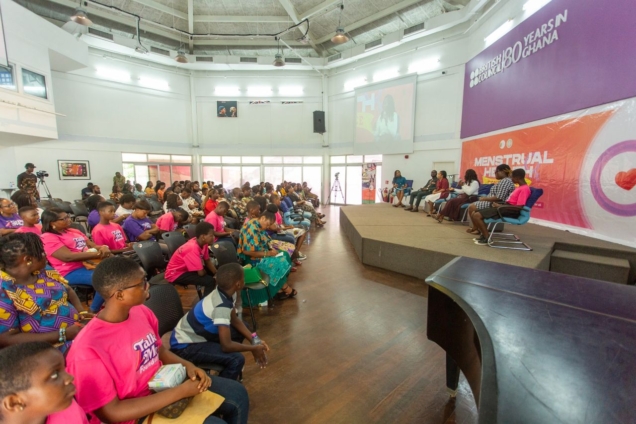
The Orange Girl Foundation, in collaboration with the William Wilson Turner Foundation, organized the maiden Menstrual Health Conference to promote menstrual health conversations, particularly for physically challenged girls.
The event, which was held at the British Council in Accra, brought together advocates, individuals and organizations, students, and teachers who are purposely driven by menstrual health conversations in Ghana to identify gaps and find pragmatic solutions for menstrual health management issues.
According to the founder, Ethel Nanayaa Amoako Baffoe, the brain behind the event is to bring everyone together to have one voice in the menstrual health conversations to achieve a common goal.
“We have all been contributing our quota in our various corners, and it was time to come together to have an extensive conversation,” she added.
She also called on the government to remove the taxes on sanitary pads to eliminate period poverty and promote girl child education.
The conference conversations also centered on providing supportive workplace policies for women, especially those with extreme period pain like endometriosis and dysmenorrhea.
Speaking to the news team, Paul Asante, an SDG advocate, said that physically challenged girls are mostly sidelined in the menstrual health conversations.
“Comprehensive education awareness tailored with special learning materials that can be accessed by persons with disabilities should be enforced by the Ministry of Education through the Ghana Education Service,” he said.
He also called for the passing of a legislative instrument or bill in parliament to design menstrual products that are easy to use for individuals with varying physical or cognitive abilities.
The organization stated that the Menstrual Health Conference will be an annual event.
One in ten girls in Sub-Saharan Africa misses school during their menstrual cycle, which can amount to as much as twenty percent of a given school year. Access to affordable menstrual hygiene products is increasingly challenging for many young girls and women in Ghana, especially those in underserved communities, and most importantly, persons living with disabilities.
Latest Stories
-
Health Ministry engages Ga Mantse ahead of Free Primary Healthcare launch
12 minutes -
We can tackle multiple priorities – Sam George defends Anti-LGBTQ Bill push
47 minutes -
Statement: Ghana Chamber of Mines’ Response to Claims in Joe Jackson’s “Ananse Stories about the Economy of Ghana”
48 minutes -
GES opens 2026 teacher recruitment for licensed B.Ed graduates
50 minutes -
Ghana must value skilled trades, build resilient learners — Ibn Chambas
59 minutes -
Ghana must rethink education around relevance, resilience and responsibility — Ibn Chambas
1 hour -
Prince Harry faces defamation lawsuit from charity he co-founded
1 hour -
South Korea deploys thermal cameras to track escaped zoo wolf
1 hour -
Calls for royal meeting with Epstein survivors grow ahead of US visit
1 hour -
Ibn Chambas advocates blend of technology and human values in education
1 hour -
UMA improves healthcare access in Asutifi North with GH₵700k ‘Kim Taylor Legacy’ Walkway
1 hour -
Scholarships Authority and Fanaka University offer sponsorship for procurement and supply chain studies
1 hour -
Bisa Kdei drops new single ‘Go N Look’ featuring Medikal
1 hour -
Benin facing rising terrorism in north as French military presence faces growing criticism
1 hour -
UEW Public Lecture Series 2026: Education debate ‘about the soul of Ghana’s future’ — Dr Ibn Chambas
1 hour