

Audio By Carbonatix
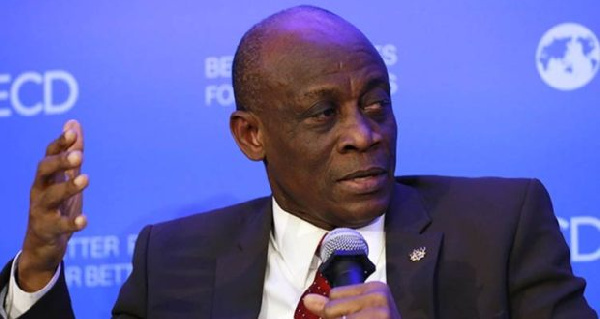
Former Finance Minister, Seth Terkper says the National Democratic Congress (NDC) administration of 2013-2016 had an effective plan to deal with the banking sector crisis.
This plan, he argues, would rather have saved most of the indigenous banks instead of collapsing them.
The Bank of Ghana (BoG) revoked the licenses of seven indigenous banks between August 2017 and January 2019.
The BOG said these banks had been mismanaged, leaving depositors at the risk of losing savings. It, therefore, stepped in to save the situation.
Government has been criticised for opting to collapse the banks after Finance Minister Ken Ofori-Atta revealed that it cost the taxpayer some GH¢21 billion to ensure the safety of depositors funds.
The former Finance Minister, Seth Terkper on Monday addressed a lecture organized by the NDC’s Professionals Forum.
He argued that the NDC administration would have handled the situation differently.
Mr Terkper said the NDC administration undertook an asset quality review of the banks, which gave it a sense of the state of the banks.
He admits some malfeasance was discovered, but the appropriate approach would have been to slowly sell the banks' assets while trying to keep most of the banks operational.
He further stated that the NPP government did not need to borrow to deal with the situation. He claimed the NDC government, through the Energy Sector Levy Act, left some GH¢43 billion available to the government.
“I don’t think we should accept this narrative that we left the current administration to go and borrow to resolve the banking sector crisis. So what happened to the 43 billion cedis? Couldn’t it be used to restructure?” Mr Terkper quizzed.
On the impact of Covid-19 on the economy, the former Minister said the pandemic cannot be blamed entirely for the state of affairs.
The former Minister insisted the current administration has received the most support for a crisis in the nation's history.
“IMF $1 billion, Bank of Ghana $1.7 billion, World Bank, African Development Bank and others put together $500 to $600 million and counting. A lot of resources have flowed in, and so that is where we must dig deeper. Covid is painful, but a lot of resources have flowed.”
Latest Stories
-
Tech CEOs suddenly love blaming AI for mass job cuts. Why?
2 minutes -
Shops and restaurants in Egypt told to close early as energy crisis deepens
30 minutes -
OmniBSIC delivers 104% profit growth, assets and deposits doubled in 2025
39 minutes -
South Africa’s exclusion from G7 summit no surprise, says Ramaphosa
40 minutes -
Austria becomes latest to propose social media ban for children
50 minutes -
‘We’re having a moment’ – fear and denial in Silicon Valley over social media addiction trial
1 hour -
75% of fans oppose VAR in Premier League, says Football Supporters’ Association
1 hour -
Italy investigates Sephora and Benefit over marketing skincare to children
1 hour -
Three arrested in Paris after attempted bomb attack outside Bank of America
2 hours -
Partial government shutdown becomes the longest in US history
2 hours -
Oil rises above $115 and Asia stocks slide as Iran war escalates
2 hours -
Accra New Town building collapse: 3 dead, 20 survivors as Interior Minister reveals full casualty breakdown
4 hours -
Couple in court for stealing, dishonestly receiving over GH¢5m
4 hours -
Three suspects, including pregnant woman, arrested over Keri shooting
4 hours -
Woman granted GH¢100,000 bail over false ‘murderer’ post on Uber driver
4 hours