


Audio By Carbonatix
A coronavirus vaccine developed by the University of Oxford appears safe and trains the immune system.
Trials involving around 1,077 people showed the injection led to them making antibodies and white blood cells that can fight coronavirus.
The findings are hugely promising, but it is still too soon to know if this is enough to offer protection and larger trials are under way.
The UK has already ordered 100 million doses of the vaccine.
How does the vaccine work?
The vaccine - called ChAdOx1 nCoV-19 - is being developed at unprecedented speed.
It is made from a genetically engineered virus that causes the common cold in chimpanzees.
It has been heavily modified, first so it cannot cause infections in people and also to make it "look" more like coronavirus.
Scientists did this by transferring the genetic instructions for the coronavirus's "spike protein" - the crucial tool it uses to invade our cells - to the vaccine they were developing.
This means the vaccine resembles the coronavirus and the immune system can learn how to attack it.
What are antibodies and T-cells?
Much of the focus on coronavirus so far has been about antibodies, but these are only one part of our immune defence.
Antibodies are small proteins made by the immune system that stick onto the surface of viruses.
Neutralising antibodies can disable the coronavirus.
T-cells, a type of white blood cell, help co-ordinate the immune system and are able to spot which of the body's cells have been infected and destroy them.
Nearly all effective vaccines induce both an antibody and a T-cell response.
Levels of T-cells peaked 14 days after vaccination and antibody levels peaked after 28 days. The study has not run for long enough to understand how long they may last, the study in the Lancet showed.
Prof Andrew Pollard, from the Oxford research group told the BBC: "We're really pleased with the results published today as we're seeing both neutralising antibodies and T-cells.
"They're extremely promising and we believe the type of response that may be associated with protection.
"But the key question everyone wants to know is does the vaccine work, does it offer protection... and we're in a waiting game."
The study showed 90% of people developed neutralising antibodies after one dose. Only ten people were given two doses and all of them produced neutralising antibodies.
"We don't know the level needed for protection, but we can maximise responses with a second dose," Prof Pollard told the BBC.
Is it safe?
Yes, but there are side-effects.
There were no dangerous side-effects from taking the vaccine, however, 70% of people on the trial developed either fever or headache.
The researchers say this could be managed with paracetamol.
Prof Sarah Gilbert, form the University of Oxford, UK, says: "There is still much work to be done before we can confirm if our vaccine will help manage the Covid-19 pandemic, but these early results hold promise."
What are the next steps in the trial?
The results so far are promising, but their main purpose is to ensure the vaccine is safe enough to give to people.
The study cannot show whether the vaccine can either prevent people from becoming ill or even lessen their symptoms of Covid-19.
More than 10,000 people will take part in the next stage of the trials in the UK.
However, the trial has also been expanded to other countries because levels of coronavirus are low in the UK, making it hard to know if the vaccine is effective.
There will be a large trial involving 30,000 people in the US as well 2,000 in South Africa and 5,000 in Brazil.
There are also calls to perform "challenge trials" in which vaccinated people are deliberately infected with coronavirus. However, there are ethical concerns due to a lack of treatments.
When will I get a vaccine?
It is possible a coronavirus vaccine will be proven effective before the end of the year, however, it will not be widely available.
Health and care workers will be prioritised as will people who are deemed at high risk from Covid-19 due to their age or medical conditions.
However, widespread vaccination is likely to be, at the earliest, next year even if everything goes to plan.
Boris Johnson said: "Obviously I'm hopeful, I've got my fingers crossed, but to say I'm 100% confident we'll get a vaccine this year, or indeed next year, is, alas, just an exaggeration.
"We're not there yet."
What progress is being made with other vaccines?
The Oxford vaccine is not the first to reach this stage, with groups in the US and China also publishing similar results.
The US company Moderna was first out of the blocks and its vaccine can produce neutralising antibodies. They are injecting coronavirus RNA (its genetic code), which then starts making viral proteins in order to trigger an immune response.
The companies BioNtech and Pfizer have also had positive results using their RNA vaccine.
A technique similar to the Oxford one, developed in China, also also seems promising.
However, all these approaches are at the absolute boundary of science and have not been proven to work before.
More traditional methods of vaccine development are also being investigated. The company Valneva is taking the whole coronavirus, inactivating it and then inject it.
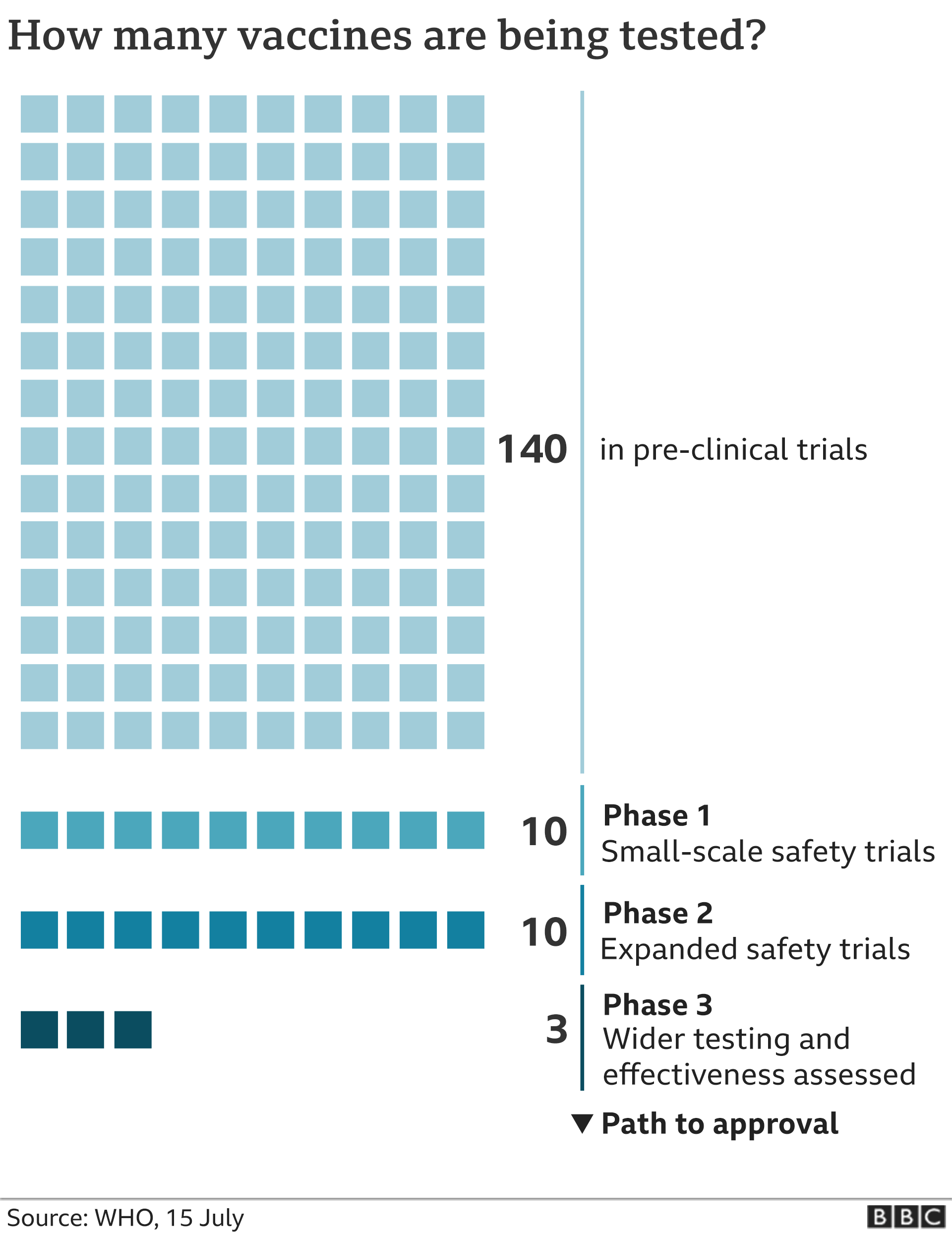
In total there are 23 coronavirus vaccines in clinical trials around the world and another 140 in early stage develoment.
Will the UK get a coronavirus vaccine?
The UK government has struck deals for 190 million doses of different vaccines.
This includes:
- 100 million doses of the Oxford vaccine made from a genetically engineered virus
- 30 million doses of the BioNtech/Pfizer vaccine, which injects part of the coronavirus' genetic code
- 60 million doses of the Valneva inactivated coronavirus
These have been paid for even though it is uncertain which, if any, of the vaccines may prove effective for immunising a nation with 66m people.
Kate Bingham, chairwoman of the UK Vaccine Taskforce, told the BBC: "What we are doing is identifying the most promising vaccines across the different categories, or different types of vaccine, so that we can be sure that we do have a vaccine in case one of those actually proves to be both safe and effective.
"It's unlikely to be a single vaccine for everybody.
"We may well need different vaccines for different groups of people."
Latest Stories
-
Armed men reportedly storm Adjen Kotoku Onion Market amid tensions
7 minutes -
Tecco Mensah writes: Why football fans must look beyond statistics
50 minutes -
Police recover stolen Honda CR-V in Kumasi within 48 hours
1 hour -
Apetorku Gbodzi 2026 Festival opens in Dagbamete with development focus
2 hours -
President Mahama arrives in Lyon to co-chair One Health Summit
2 hours -
Beverly View Plus Hotel draws crowds amid coastal Easter rush in Volta
2 hours -
Maiden Zongo Festival held in Wa amid calls to tackle drug abuse among the youth
2 hours -
FDA warns of fake HIV test kits on Ghanaian market
3 hours -
Africa urged to build resilient health systems as donor support tightens
3 hours -
Easter gesture: Ablakwa settles medical bills for 85 North Tongu constituents
4 hours -
Africa must harness its population strength—Titus-Glover
4 hours -
Visa-free access doesn’t mean unlimited stay – Lom Ahlijah
5 hours -
From Golgotha to Kwahu: The Easter Migration of the Faithful and the Faithless
6 hours -
How the Ghanaian onion traders’ standoff with Nigeria unfolded and threatened local supply
6 hours -
No compensation for demolished structures on 24-Hour Economy market lands — Gov’t to structure owners
6 hours